Rediscovering photography with Kiev 4AM rangefinder

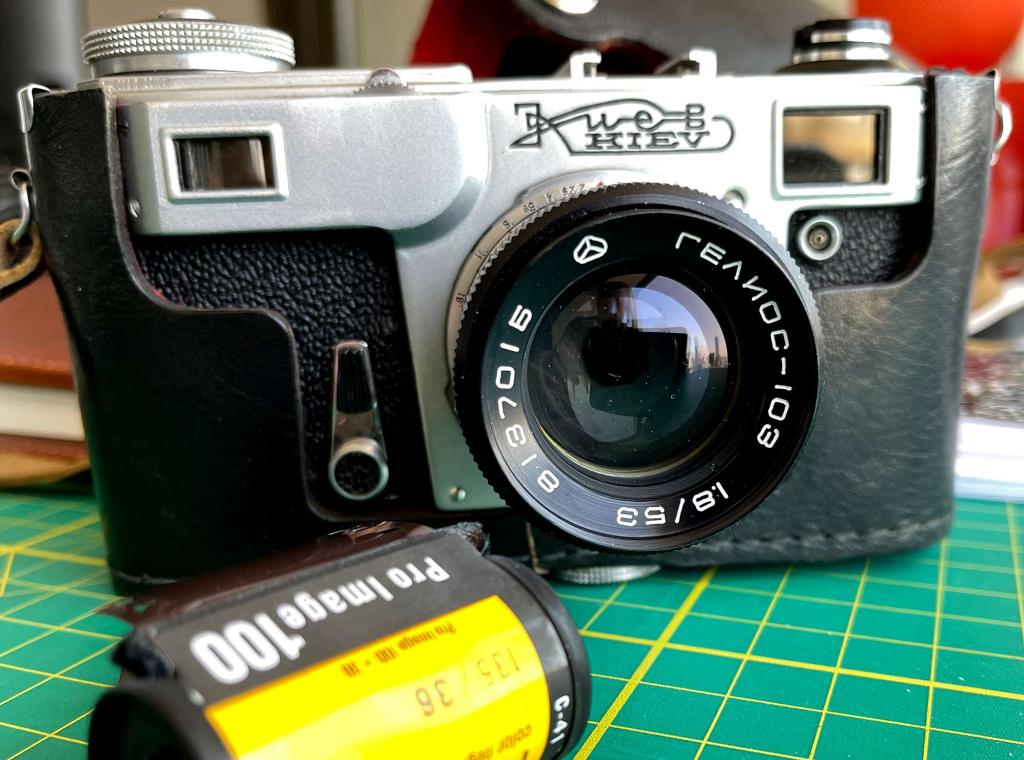
Photo of Kiev 4AM rangefinder camera.
My Kiev 4AM rangefinder, fresh from Ukraine — and loaded with Kodak Pro Image 100.

I recently experienced the thrill of receiving a Kiev 4AM rangefinder camera shipped all the way from Ukraine. As a photographer, there’s something magical about acquiring a piece of history, and the Kiev is an exceptional addition to my collection.

The Kiev 4AM is not just any camera; it’s steeped in history. Based on the pre-World War II Contax rangefinder, the Kiev embodies a legacy of meticulous German engineering and post-war Soviet manufacturing.

After World War II, the Soviet Union acquired the designs and machinery from the Carl Zeiss factory, enabling production of the Contax-inspired Kiev cameras. Manufacture of these cameras continued until the 1980s, making them a fascinating blend of pre-war design and Cold War-era craftsmanship.

Unboxing the Kiev 4AM, I was immediately struck by its solid, mechanical feel. Unlike modern digital cameras, the Kiev is built like a tank, with a reassuring heft that speaks to its durability. The controls are mechanical and precise, offering a tactile experience that is increasingly rare. It’s no Leica M series, known for its legendary precision and elegance, but the Kiev has a charm and robustness all its own.

Eager to test my new acquisition, I loaded it with Kodak Pro Image 100, a film known for its vibrant colors and fine grain. I exposed three rolls and sent them off to The Darkroom for processing and scanning.

While the Kiev 4AM lacks the prestige or the price tag of a Leica, it offers a unique and rewarding photographic experience. The camera’s history, combined with its solid build and reliable performance, makes it a standout piece in my collection. It has quickly become a favorite, not just for its functionality, but for the sense of connection it provides to the rich history of photography.

I look forward to many more rolls of film and countless photographic adventures with my Kiev 4AM.

Photos coming soon!

My disappointment with the Holga 120: A cautionary tale

Photo of Chicago's Oak Street Beach taken from the 44th floor of the John Hancock Center.
Here’s one of the few good images I managed to coax from a Holga 120GCFN medium-format camera.

As someone who has experimented with various cameras, my experience with the Holga 120 has been disappointing. Despite its cult following, I’ve never gotten reliably consistent results from any model I’ve owned. It baffles me how people can be in love with this camera.

The Holga 120, introduced in China decades ago, was designed to target the country’s vast consumer market. Surprisingly, the poor-quality images this camera produces didn’t spark another cultural revolution. The design is meant to be simple and affordable, but it meets those goals at the expense of quality. None of the images I’ve taken with the Holga are printable or digitally usable without extensive work in Photoshop.

One of the most significant issues I’ve found is the camera’s inconsistency. One roll might come out somewhat decent, and the next, a complete disaster. Light leaks, focus problems, and scratched film are a few of the recurring issues.

The camera’s plastic lens, while charming to some for its vignetting and blurring effects, often results in more frustrating than artistic images. Even the “premium” Holgas with glass lenses don’t cut it.

A particularly disheartening experience was with the Holga stereo camera. I had an assignment to shoot event photos and decided to use this camera to capture 3-D images, adding an exciting dimension to the project.

Before the event, I shot two test rolls that came out perfectly, which gave me false confidence. On the night of the event, however, things went awry. One or both lenses intermittently did not work, making fewer than a third of the images usable.

Naturally, these defects weren’t apparent until the photofinisher returned the film and scans.

This was embarrassing because the event organizer and I had distributed anaglyph glasses to attendees, promising them the thrill of seeing themselves in glorious 3-D on a website. Instead, I spent hours in Photoshop trying to salvage what I could from the usable images. Despite my best efforts, the final product was far from the stunning 3-D experience we had envisioned.

The Holga’s unpredictability and the amount of post-processing required make it a tool more suited for hobbyists looking for a whimsical challenge rather than advanced amateurs or professionals needing reliable results. While some may argue that the Holga’s flaws are part of its charm, I find them deal-breakers.

It’s not that I don’t appreciate the unique aesthetic the Holga can produce — when it works. The problem is that it rarely does so consistently. Amateur or professional photography requires a certain level of dependability that the Holga can’t deliver.

While the Holga 120 camera might have a niche appeal for those who enjoy its quirky, unpredictable nature, it falls short for anyone seeking consistent results. My experiences with this camera have been marked by frustration and disappointment, and I can’t understand the adoration it receives.

If you’re considering a Holga, be prepared for a lot of trial, error, and post-processing. For me, the Holga’s charm has long since worn off.

Dolly Parton: From country queen to seafood supreme

Posing and lighting combine in a cover photo of Dolly Parton in the October 2023 issue of Cowboys & Indians magazine to make it look like Parton's right hand is a lobster claw.

A cover shot, a glamorous grin, and bam! You’ve got yourself a celebrity sporting a crustacean claw.

Yeah, you heard me right. Dolly Parton, bless her heart, is smiling on the front of Cowboys & Indians magazine’s October 2023 issue, but all I see is her hand resembling one of Lobster Boy’s pinchers.

Hold up, don’t tell me you’ve never heard of Lobster Boy Grady Stiles.

Guy had a genetic condition that turned his hands and feet into claws. Made a living out of it in the circus, but things turned dark. He killed his daughter’s fiancé and got himself shot in the head. It could’ve been a regular Shakespearean tragedy if he’d been plugged in the Coriolanus.

Now, you don’t want Dolly or any star looking like Grady unless it’s a horror show you’re shooting. So listen up. Here’s my guide to avoiding such unintentional situations:

  1. Get the Angles Right: Wrong angle, wrong image. Unless you’re gunning for the horror genre, watch those angles. You don’t want a hand looking like it’s auditioning for a seafood commercial.
  2. Watch the Shadows: Shadows can be as tricky as a back-alley hustler. Keep them where they belong. Play it right, and you won’t have to explain why Ms. Parton’s got a taste of the sea.
  3. Use the Props Wisely: A misplaced prop can transform a diva into a sea monster. Coordinate with your subject. Make sure everything fits like a worn-in pair of cowboy boots.
  4. Editing with Care: Too much of a good thing can be bad. You want to Photoshop? Fine, but don’t turn a beauty into a beast.
  5. Previews and Feedback: Don’t be a lone ranger. Get a second opinion, third, hell, as many as you need. Fresh eyes catch what yours miss. Speaking of which, there’s a famous photo of Clayton Moore as the Lone Ranger in which a saguaro cactus arm appears to be scratching our hero’s back. The result is unintended hilarity.

Look, nobody wants to see their favorite stars looking like they belong on a seafood platter. Pay attention, follow the guide, and keep the claws on the lobsters and off the A-listers.

It’s photography, not a freak show.

Exploring dystopia: Does real beat supernatural?

Midjourney-created faux photo shows ruggedly handsome U.S. Army sergeant troubled by what he sees happening at a FEMA security checkpoint in Colorado.
Midjourney helps authjors create compelling photorealistic illustrations.

Many opportunities have opened up in today’s rapidly evolving technological landscape, especially in storytelling.

I’ve traditionally relied on words to tell stories and painted pictures with linguistic artistry. However, I now find myself captivated by the possibility of an innovative form of storytelling that combines the power of words and the allure of visuals.

I’m thinking about creating a dystopian series.

Why?

First, I enjoy the genre. It’s as simple as that.

Second, part of my affinity for dystopian narratives stems from their popularity, a phenomenon that rivals, or perhaps even surpasses, the cultural fascination with zombie and vampire sagas.

A peculiar allure in dystopian stories captivates audiences on a profound level. These narratives, with their grim yet thought-provoking depictions of the future, are compelling in their ability to entertain and pose crucial questions about society, humanity, and our collective future.

In contrast to the fantastical elements of vampire and zombie lore, the dystopian genre is grounded in a stark, often chilling, potential reality. This potential for plausibility contributes to their widespread appeal and my fascination.

The amalgamation of evocative words and realistic images will only amplify these dystopian tales’ compelling nature.

The advent of Midjourney sparked my imagination. This AI bot offers the ability to create astonishingly realistic imagery, which could be a powerful tool for breathing life into the desolate futures I craft.

The thought of generating visual landscapes to go along with my narratives is exhilarating. I envision a book where the words and images are intertwined, exploring a sorrowful future world. The text would narrate the struggles, while the illustrations would lend actual shape to that narrative.

I’ve already begun experimenting with Midjourney, building a tableau of the future. I’ve included some early idea images.

What are your thoughts about this? It is a hybrid book containing narratives and visuals set in a dystopian future.

Does it resonate with you?

Midjourney-created faux photo shows a young deputy sheriff and an older rancher talking about why United Nations troops would be in southeastern Colorado.
Do you remember Fotonovels? I always liked how they handled dialogue.

Midjourney-created faux photo shows a coujty official being arrested by United Nations forces. You can create anything with an AI bot.
The range of characters becomes unlimited, thanks to Midjourney. I feel as if I’m casting a movie.

From pixels to pinkies: An ode to Midjourney’s mesmerizing mastery

My test-driving of Midjourney reveals an occasional finger problem. Check out the digits on the woman’s left hand.

Today, I’m going to gush about my newest artistic obsession that’s been occupying a sizeable chunk of my screen time lately.

It’s Midjourney, a talented bot that creates a dizzying range of artwork and photos. Now, don’t roll your eyes just yet. I know we’ve all seen art bots before, but I assure you, Midjourney is something else.

I’ve been on a Midjourney binge recently, and its capabilities spellbind me. It specializes in conjuring the unbelievable: photo-realistic images. Yes, you heard me right, photo-realistic.

I kid you not; this bot’s images have me questioning reality. If a bot can replicate reality perfectly, what does that say about our perception of the world?

Chew on that.

However, like the awe-inspiring cosmos, Midjourney isn’t without its quirks. Users need to be on the lookout for one occasional idiosyncrasy: strange fingers.

I can’t help but be reminded of the aliens from the 1960s classic series “The Invaders.”

For those too young to remember, architect David Vincent, the lead character, fought off these strange extraterrestrials who were perfect human replicas — except for an occasionally mutated pinkie finger.

In a strangely delightful twist, maybe Midjourney is channeling that alien charm. Who knew art and vintage sci-fi could find common ground in a bot?

Each Midjourney creation arrives with a dose of anticipation. How will the fingers turn out this time? Will it be a subtle shift, a gentle warping of reality you might miss if you aren’t looking closely? Or will it be a glaringly apparent alien appendage daring you to accept this new version of reality? It’s a little thrill that keeps you coming back for more.

All fun and games aside, in my experience, the funky fingers only show up a small percentage of the time.

So, if you’re ready for a wild ride that combines art, AI, and a sprinkling of sci-fi nostalgia, join me in exploring Midjourney.

Midjourney is here, and it’s time we embrace these strange new frontiers — fingers and all.

Midjourney’s magic: Is AI the future of book covers?

A Photorealistic image created by Midjourney shows a cowboy kissing his sweetheart during an evening rain.
Midjourney created this evocative cover for a Western romance novel I’m percolating.

The wonders of AI keep unveiling themselves — most recently, as photorealistic images.

I am astounded.

I’ve been test-driving a new AI program called Midjourney. It can create infinite images, including uncannily lifelike, detailed, photorealistic images from descriptive text.

Last night, in nostalgia for Western romance novels, I tested Midjourney. I prompted: “A young cowboy kisses his sweetheart during an evening rainstorm.” A simple, evocative. I clicked the generate button and prepared for a laughable, cartoonish result.

When the image popped up on my screen, I was speechless.

It was a sight to behold. The image showed a rugged cowboy, complete with a hat, locked in a passionate embrace with his sweetheart. The couple was about to kiss as they stood in the warm glow of a rainy western street. The light from nearby windows reflected off their clothing, creating a surreal, dreamy atmosphere. It was tender, raw, and powerful.

It was so real and vivid that I had to remind myself that no artist’s hand had touched this piece. It was pure AI, Midjourney flexing its silicon muscles to breathe life into a simple string of words.

To say I was pleased would be a gross understatement. I was dumbfounded, thrilled, and utterly captivated. Midjourney’s image wasn’t just photorealistic; it told a story. It captured the moment’s essence, making me feel like I was peering into a novel myself.

Now, I’m left with this burning question: Could this image make it to the big time? Could it stand shoulder to shoulder with professionally photographed book covers? Could it grip a potential reader’s imagination and entice them into the wild, passionate world of a Western romance novel?

I am leaning towards yes. What do you think?

Snap the small stuff: Everyday life needs a close-up

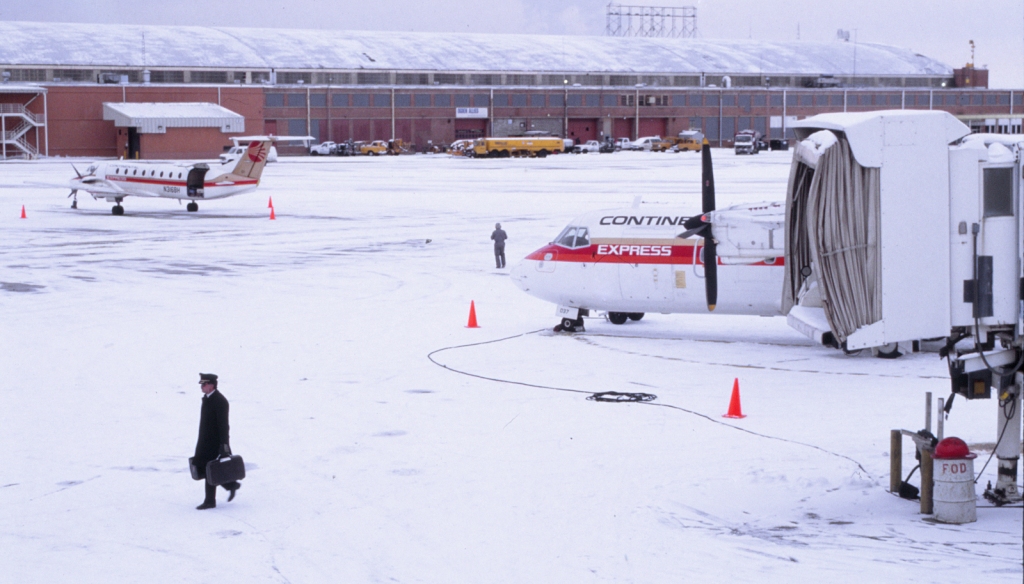
A photo taken in 1991 at Denver's Stapleton International, which closed in 1995. It shows a pilot trudging across a snow-covered apron. He's carrying his flight cases and two Continental Express commuter prop planes are in the background.
I photographed this scene at Denver’s now-closed Stapleton International Airport in 1991.

Many years ago, I went to a presentation about scrapbooking and journal-keeping given by a passionate historian. Sure, she said to document major social events, but remember to snap pictures of your everyday environment.

She mentioned something that got me thinking: Ever since Route 66 sprung into being, it’s been incessantly photographed. Despite being supplanted by interstates, people still take pictures of the Mother Road.

Yet, the historian wondered, who is photographically documenting the interstate highways?

She suggested that we spend at least a day each year going around our neighborhoods, taking black-and-white photos of things that seem as ordinary as dirt. Why use black and white film? Its negatives are archival and, unlike digital images, will not depend on possibly ephemeral technology.

It’s even a good idea to archive digital images on film.

The historian had some specific stuff she thought we should capture. You’ll probably chuckle — I know I did — but she was all about telephone poles, transformers, transmission lines, you name it.

But when you think about it, this makes sense. These things are mundane and ordinary, but they’ll be as rare as a dial-up modem one day. Tech moves fast, and soon all those cables and poles will be tucked away out of sight, underground. When that day comes, a humble photo collection becomes a precious historical record.

The point hit home for me in the early 1990s when I was living in Denver. I decided to photograph the soon-to-be-closed Stapleton International Airport. Man, did I pick a day to do it — it was snowing cats and dogs. But I’m glad I braved the cold. The snowfall added a certain magic to my photos. They aren’t just pictures anymore. They’re slices of history, proof that an era once existed.

Regular stuff only stays boring for a while because once something’s gone, it’s history.