The awesome legacy of ‘Land of the Giants’

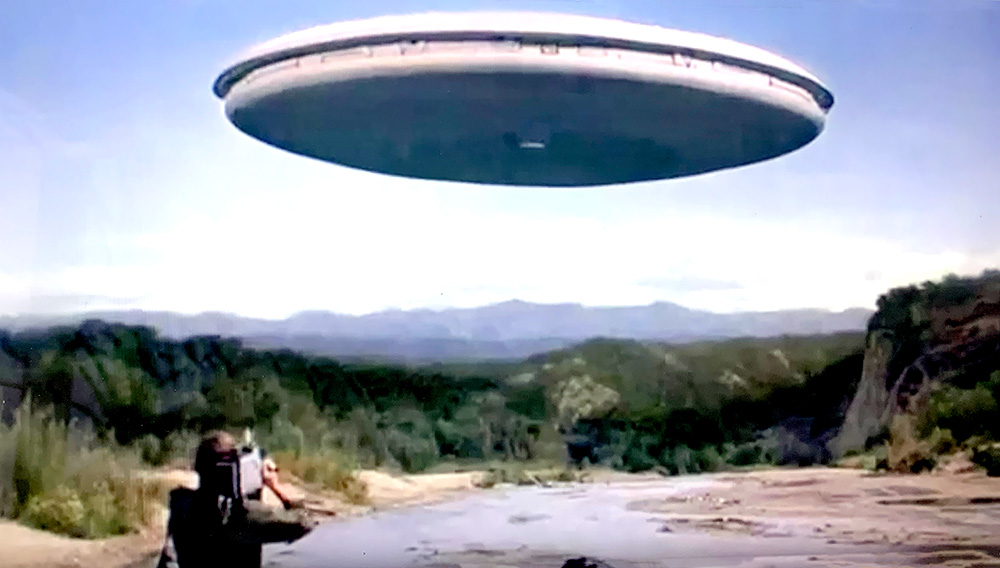
Main title logo for the first-season opening of Irwin Allen's "Land of the Giants."


Land of the Giants” is a classic piece of science-fiction television history. Despite only airing for two seasons between 1968 and 1970, it established a robust presence in the genre. The series remains noteworthy with its thoughtfully blended narrative, ideas, and enduring special effects.

The show was developed by producer Irwin Allen, who effectively amalgamated elements from literary and cinematic works like “Gulliver’s Travels,” “Dr. Cyclops,” and “The Incredible Shrinking Man.” Allen’s synthesis of these and other sources gives “Land of the Giants” a unique flavor, leveraging established ideas to create an innovative and exciting narrative.

However, one significant criticism of “Land of the Giants” is its character similarities to another Allen production, “Lost in Space.” The prescient child and the cunning troublemaker found in both shows create a unpleasant sense of déjà vu. While not negating the originality of “Land of the Giants,” this structural mirroring makes it feel needlessly derivative.

On the plus side, the show effectively updated the premise of the most memorable segments of “Gulliver’s Travels,” infusing it with science-fiction elements. It explored power dynamics as symbolized by size, drawing inspiration from “Dr. Cyclops,” and, like “The Incredible Shrinking Man,” used size reduction to magnify life’s essential questions.

Additionally, “Land of the Giants” deserves commendation for its impressive special effects. Despite the technological constraints of its era, the show produced a believable world of giants. Its ability to deliver visually, even after half a century, is a testament to the skill and creativity of its production team.

“Land of the Giants” holds a special place in the history of science-fiction television. Despite its short lifespan, it showed an innovative approach to storytelling, combining thoughtful narrative with compelling visuals. It remains a reference point for the genre, a testament to its well-executed design and timeless appeal.

Original Concept Artwork from Land of the Giants (Irwin Allen Productions, 1968-1970). Vintage original concept art from The Land of the Giants in tempera and gouache, measuring 19-¾" x 30" on 4-ply artist board, glue tipped to a mat measuring 24-½" x 35" and hinged with transparent mylar overlay. The pre-production artwork depicts the crew in "Spindrift" being examined by a giant piercing eye.
If you’re an Irwin Allen fan and have some spare cash, check out the storyboards, concept art, publicity material, and toys from his movies and TV shows now up for grabs at Heritage Auctions. This pre-production artwork depicts the Spindrift crew encountering a giant. (Imaged by Heritage Auctions)

‘Ice Station Zebra’ is the perfect movie title

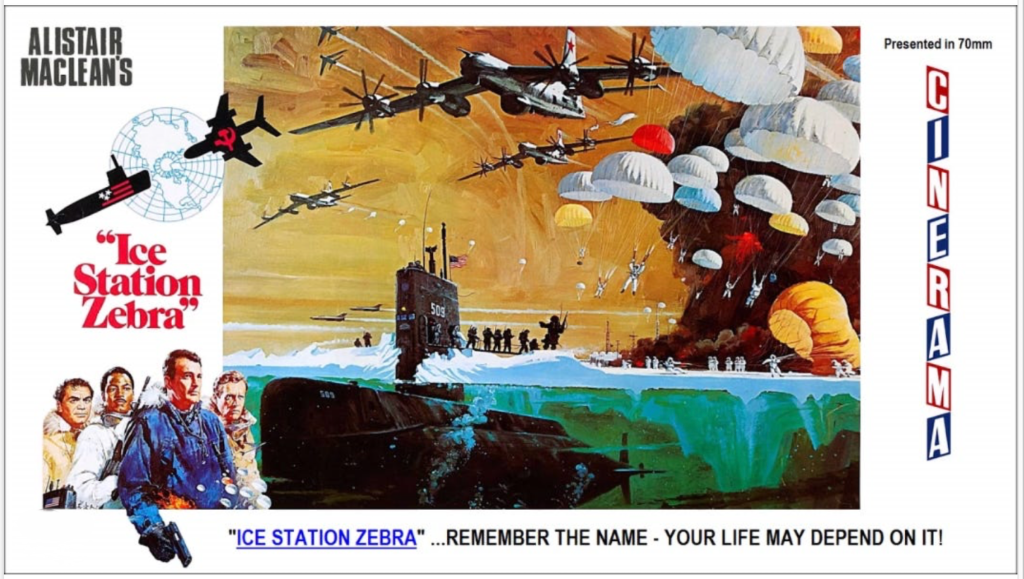
Poster art for 1968 film "Ice Station Zebra."


As a film viewer, one’s relationship with movie titles is like a sommelier’s with wine labels. Both encapsulate entire universes of experience in a few choice words. They are a prelude, a tease, an overture.

Over the decades, I’ve pondered upon hundreds of these word-woven spells, from the beguilingly simple “Jaws” and “Psycho” to the grandly pompous “The Magnificent Ambersons” and “Lawrence of Arabia.”

After all these years, however, one title has held me in its icy grasp: “Ice Station Zebra.”

Here’s why.

A title must be succinct but also evocative. It must tickle curiosity but only divulge a little. Now, consider “Ice Station Zebra.” It’s three simple words. Ice. Station. Zebra. Each is mundane. But together, they conjure up an image at once bizarre and intriguing. What is this icy station? And, pray tell, what is a zebra doing there?

The first two words, “Ice Station,” present harsh, chilly remoteness. Think about it. Any title beginning with “Ice Station” promises a grueling adventure in a frosty, desolate landscape. As audiences, we are immediately transported into a realm far removed from our comfortable living rooms. The tension is palpable.

Then comes the zinger: “Zebra.” What an unexpected departure. It’s like taking a left turn at Albuquerque on your way to Seattle. Suddenly, the mundane “Ice Station” transforms into a mysterious, surreal landscape. The contrast of a zebra’s stark stripes against the white snow brings a delightful paradox, a twist that one can hardly resist.

“Ice Station Zebra” also has the advantage of perfect context. The film is a Cold War thriller based on a novel by Alistair MacLean, released at the height of the space race in 1968. The title’s chilly nuances echo the frosty U.S.-Soviet relationship. The “Zebra,” a code name, hints at espionage, covert operations, and secrets buried beneath layers of ice and intrigue.

Perhaps most important, “Ice Station Zebra” doesn’t overpromise. It’s not “The Greatest Story Ever Told.” It doesn’t pronounce itself as “Unforgiven.” It’s understated yet compelling. It’s unassuming yet unforgettable.

The artistry of a movie title lies in its ability to capture the essence of a film and yet leave ample room for imagination. By that measure, “Ice Station Zebra” is a testament to the art. It stands as a bold beacon in the wintry white landscape of cinema, a lighthouse guiding curious audiences to the warmth of a riveting tale. It is a perfect title, a zebra among horses. A paradox, a poem, and a promise all rolled into one.

So here’s to “Ice Station Zebra.” Long may it reign in the frosty kingdom of movie titles. We might all be a bit warmer for it.

I saw this epic film first-run in 70mm at Denver’s Cooper Cinerama Theater.

Does the new Indiana Jones movie stink?

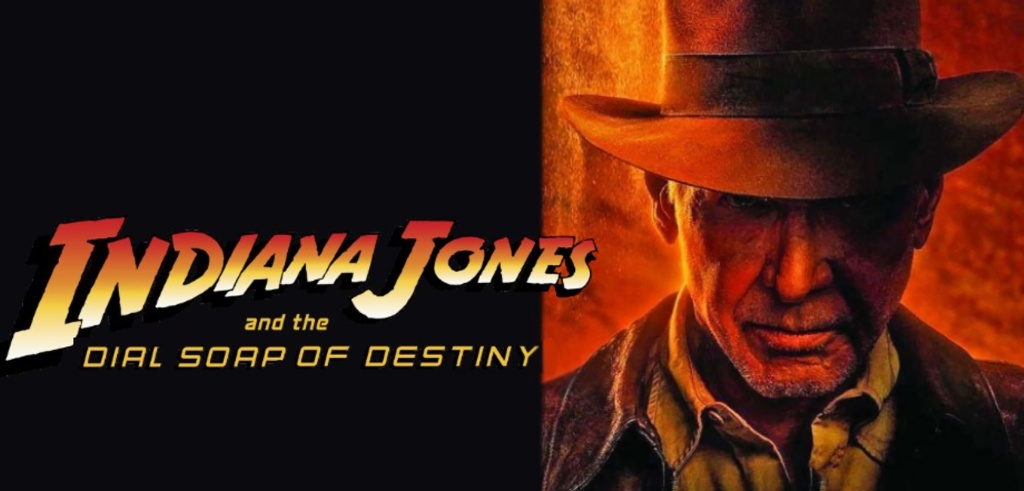
Parody of logo artwork for Indiana Jones and the Dial of Destiny that changes title to Indiana Jones and the Dial Soap of Destiny.

Some early reviews suggest that “Indiana Jones and the Dial of Destiny” is a real stinker. Everybody makes mistakes, so here’s some script-doctoring for Kathleen Kennedy free of charge.

“Indiana Jones and the Dial Soap of Destiny”

The movie begins in Indiana Jones’ university office, where he receives an anonymous, cryptic package. Inside is a soap bar engraved with strange symbols and a handwritten note saying, “To the clean goes the world.”

Following a sudden knock at the door, Indy finds a bizarrely behaving Pepé Le Pew outside his office. Pepé explains that he escaped from the Warner Bros. animation studio after noticing strange occurrences and discovering a vast German conspiracy.

He reveals that Germany plans to disrupt the balance of power and influence in the world by introducing a New World Odor. They’re secretly manipulating Hollywood’s elite to stop bathing, leading to an olfactory onslaught that could make America’s cultural exports intolerable worldwide.

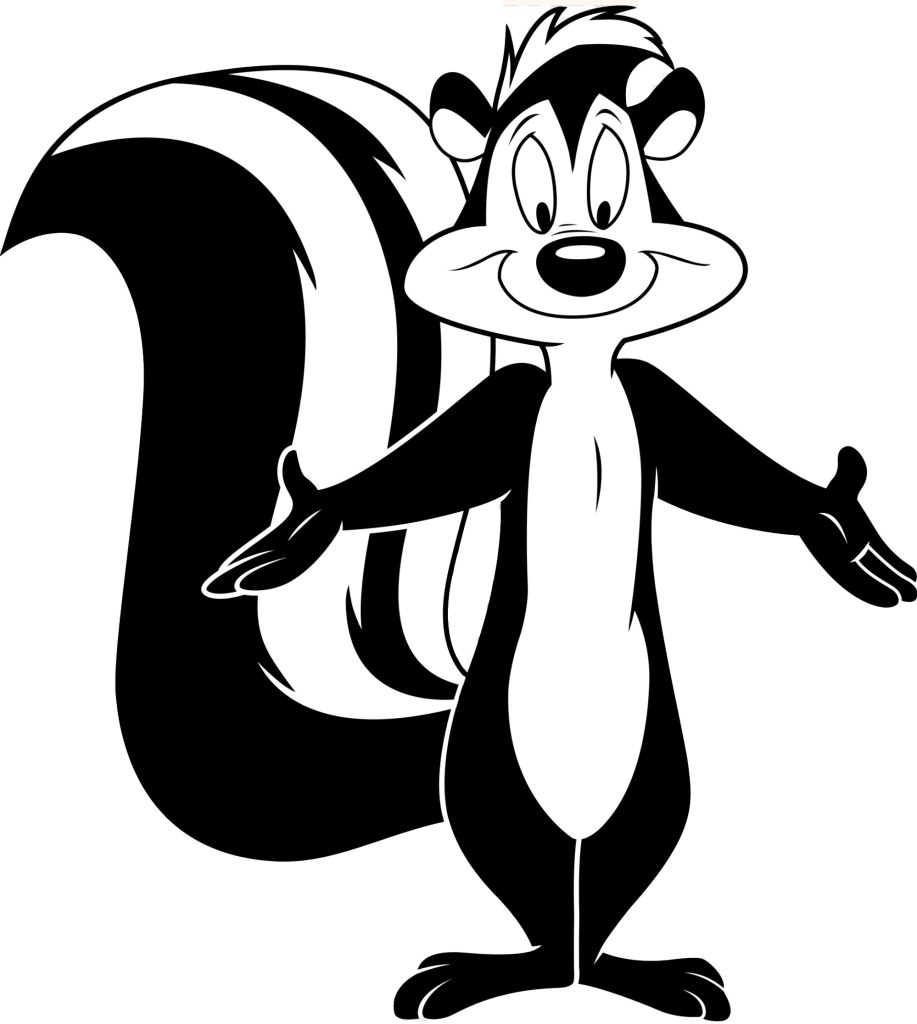
Black-and-white image of Looney Tunes character Pepé Le Pew.

Teaming up, Indy and Pepé embark on an adventure that takes them across continents, from the hidden underbelly of Hollywood to the soap factories of Nuremberg. Along the way, they encounter many obstacles, including resistant movie stars, hygienically challenged henchmen, and treacherous shower-free environments. They must dodge not just bullets and boulders, but Mr. Bubble flakes and Air Wick solids.

Meanwhile, they discover that the Dial Soap of Destiny is not an ordinary soap. It has been crafted from an ancient recipe found in the ruins of Babylonian bathing houses, and has the power to control odors, good or bad, across the world.

Their journey brings them to the Cannes Film Festival, where they uncover the villainous mastermind: a German soap baron who plans to use a cinematic masterpiece premiere to release the New World Odor on the unsuspecting audience.

In the climactic finale, Indy and Pepé disrupt the premiere, leading to a chaotic, slapstick sequence involving a cinematic duel of odor.

Armed with the Dial Soap of Destiny, they rush to reverse the smell, chasing the baron through the chaotic Cannes streets and even on top of the cinema screen.

Indy and Pepé save the day and Hollywood, restoring the natural order of bathing habits and the world’s odors.

Through this wild ride, the movie combines the thrilling action and adventure of Indiana Jones with the absurd humor and slapstick comedy of Looney Tunes. The quirky partnership of Indiana Jones and Pepé Le Pew, their thrilling race against time, and the hilarious yet potentially disastrous New World Odor all combine for a delightful comedy adventure.

‘Skyjacked’ still flies high

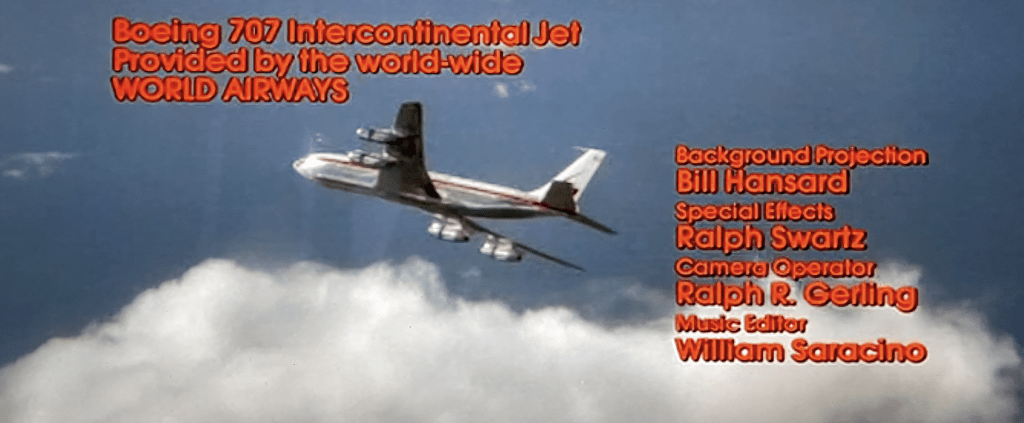
Screenshot from the main title of the 1972 movie Skyjacked shows a Boeing 707-373C airliner gracefully banking to the right above a cloud bank.
A Boeing 707-373C receives screen credit in the “Skyjacked” main title.

I watched “Skyjacked” last night for the first time since I saw the film in 1972 — and it holds up amazingly well. The aerial cinematography almost puts it in the same league as “Strategic Air Command.” Indeed, the Boeing 707 pretty much is the film’s co-star, its soaring shape ideally suited to the wide Panavision aspect ratio.

“Skyjacked” shuns effects shots, except for a few rear-projection setups. As a result, its overall feel is much more realistic than even the original “Airport,” which suffered from comedically obvious aircraft miniatures made painfully apparent in 70mm Todd-AO.

National Guard F-100s in Russian paintjobs fill in for MiGs.