Movie’s connection to ‘mad gassers’ is examined

Criminal mastermind Dr. Mabuse loves the smell of gas in Weimar Germany.

Is Fritz Lang’s “The Testament of Dr. Mabuse” linked to bizarre events in Virginia and Illinois?

The Mad Gasser of Botetourt County, Virginia, also known as the “Anesthetic Prowler,” was reported to be active during the winter of 1933-1934. The attacks typically occurred at night when an unidentified assailant sprayed gas through windows or under doors. Victims described symptoms such as nausea, headaches, dizziness, and respiratory issues, which fueled widespread panic and fear in the community.

The phenomenon resurfaced under similar circumstances a decade later in Mattoon, Illinois, leading to further intrigue and speculation. Both incidents remain enveloped in mystery and are often discussed in the context of folklore and collective hysteria.

In the film, criminal mastermind Mabuse, despite confinement in an insane asylum, furiously scrawls plans for crime sprees that include gas attacks – and explains these seemingly senseless acts are but a prelude to a larger goal.

“Humanity’s soul must be shaken to its very depths, frightened by unfathomable and seemingly senseless crimes,” Mabuse declares. “Crimes that benefit no one, whose only objective is to inspire fear and terror. Because the ultimate purpose of crime is to establish the endless empire of crime. A state of complete insecurity and anarchy founded upon the tainted ideals of a world doomed to annihilation.”

That certainly describes what happened in Botetourt County and Mattoon.

“The Testament of Dr. Mabuse,” released in 1933, was part of a more extensive dialogue about the power of mass media and the potential for films to influence public behavior and fears – so much so that Reich Minister of Propaganda Joseph Goebbels banned the film in Germany.

In examining the possible link between Lang’s film and the Botetourt County incidents, one must consider the cultural and media landscape of the 1930s and 1940s. Movies were a dominant form of entertainment and stoked public perceptions and fears. The depiction of a gas attack in a popular film could undoubtedly have planted the idea in the minds of potential pranksters or malicious actors in rural Virginia. The timing of the film’s release and the subsequent attacks might suggest more than mere coincidence; it could imply a direct influence, where the visual and narrative representation of such attacks provided a blueprint or inspiration.

The success of such attacks in unnerving Virginians might have provided the impetus for the incidents a decade later in Mattoon.

While it is possible that “The Testament of Dr. Mabuse” could have influenced the gas attacks in Botetourt County, showing a definitive link requires more than circumstantial evidence. The film’s release coincides with the initial attacks, and its content provides fertile ground for speculation.

Still, this discussion underscores how art and life can sometimes intersect unexpectedly and disturbingly.

DO YOU WANT TO KNOW MORE?

Books

Historian William B. Van Huss serves history, perspective, and speculation with a healthy side dish of skepticism in “The Mad Gasser of Botetourt County: Reconsidering the Facts.” Van Huss examines the incidents in Botetourt County as well as Mattoon and provides a wealth of documentation and attribution. His book is see-worthy for anyone with an appetite for legends, urban and otherwise.

In “The Mad Gasser of Mattoon: Dispelling the Hysteria,” chemistry teacher Scott Maruna not only suggests that the Mattoon gas attacks were real but names a suspect. Maruna’s book is out of print; the link above takes you to a Google Books page where you can read it.

Online

The Mad Gasser of Mattoon

The Mad Gasser of Botetourt County

Fritz Lang’s “The Testament of Dr. Mabuse

Weird day in Wyoming still haunts me 50 years on

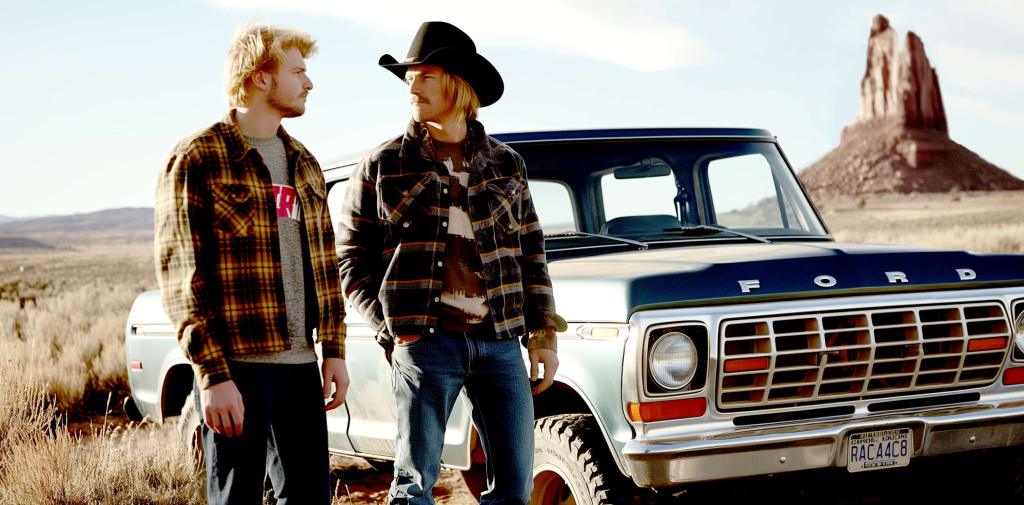
In the 1970s, two young men stand near a Ford truck with Boar's Tusk rock formation behind them.

I grew up in Colorado and spent many years working at newspapers in Colorado, Arizona, and Wyoming. I love the West and hope to retire there someday. The West is in my heart.

When most folks think of the West, they envision a land in which the echoes of homesteaders, cowboys, Indians, and Manifest Destiny still echo. But there’s another side to the West whose echoes you only hear late at night; you’d best listen to these tales with the lights on. Such weird West stories range from legends of cryptids like the thunderbird to accounts of strange doorways into parallel universes.

Tall tales collect a patina of reality out West because so many still lie at the edge of living memory and are told and retold by those who insist they witnessed the events. Besides, as a newspaper editor in John Ford’s “The Man Who Shot Liberty Valance” famously observes, “This is the West, sir. When the legend becomes fact, print the legend.”

A recent series of books by David Paulides of the CanAm Missing Project explores the disturbing possibility that for more than a century, people have disappeared under unusual circumstances in wilderness areas. In his books, Paulides also claims that this phenomenon isn’t restricted to the United States and that clusters of similar disappearances exist worldwide.

I’ve been following his research since discovering Paulides’ books several years ago. I just purchased his latest volume, “Missing 411: The Devil’s in the Detail,” the list of oddities in the Great Outdoors continues as regularly as Old Faithful eruptions.

I’m fascinated by Paulides’ research because almost 50 years ago, I experienced something similar that I still can’t fully explain — and even writing about it now makes me uncomfortable.

Alone in the middle of nowhere

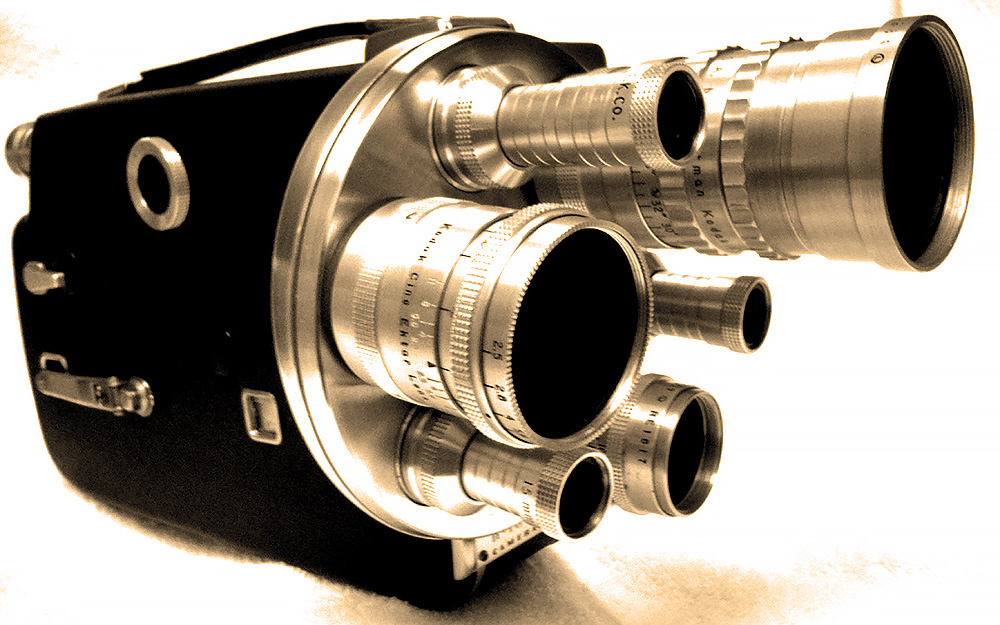
When I worked for the Daily Rocket-Miner in Rock Springs, Wyoming, as a reporter and photographer, I discovered an old 4×5 Crown Graphic camera in a darkroom closet. Our publisher told me I could shoot some test images with it, so I talked a friend of mine into driving me out to Boar’s Tusk. I needed a cover photo for the Progress Edition, and this stark rock formation out in the Red Desert would be good.

My friend Dennis (not his real name) had just bought a Ford Bronco and agreed to drive me out to Boar’s Tusk one Saturday. We’d made it nearly there when clouds began to move in. A thunderstorm was imminent, so I decided to slap on a red filter and grab a few shots of Boar’s Tusk framed by dramatic clouds before the sky opened.

Dennis pulled off the gravel county road, and I set up my tripod, mounted the vintage press camera, and pointed it at the distant remnant of an ancient volcano. I took light meter readings and was about to slide in the film when Dennis approached me, leaned close, and whispered: “Something’s wrong here. We need to get out of here NOW.”

He told me to loudly ask him to return to the truck and get some more film — and that when he’d reached the vehicle, I should quickly fold up the tripod with the camera still attached, carry it to the back of the truck, throw it in, and climb into the passenger side.

That’s what I did. A second after I got in the Bronco, Dennis fired it up and sped out as fast as he could. He didn’t slow down until we were back on pavement at least five to 10 miles away.

I was maybe 22 at the time, and Dennis was in his mid-30s. He was an experienced hunter and outdoorsman who didn’t drink to excess or do drugs.

People were hiding — and watching us

Once he’d calmed down, Dennis told me that a couple of minutes after we got out of the truck, he noticed a disturbing lack of insect sounds — and that in late summer, the place should have been screaming with noise.

What he said next still gives me goosebumps. Dennis said he saw at least two human eyes staring at us.

I told him that was crazy. There was no place for people to hide, and the sparse scrub and sage were maybe three feet tall at most.

That’s when Dennis said the people had been lying on the ground and holding what he took to be rifles.

Dennis drove back to Rock Springs and kept checking the rearview. My friend didn’t want to return to his place, so he spent the rest of Saturday at my apartment. Neither of us could sleep, and although we hadn’t seen anybody following us, at one point, we became convinced “people” were combing Rock Springs looking for us.

Neither of us could get to sleep.

Would authorities think we’re crazy?

By noon Sunday, we still hadn’t calmed down much and thought about calling the police and sheriff’s office. Then, suddenly, we both felt a strange sense of calm and realized that nobody had followed us. We began to consider the possibility that nobody had been out there in the desert watching us at all.

Both of us were starving, and it occurred to me that we hadn’t eaten or slept in more than 24 hours. So we walked over to the Taco John’s just up the street from my tiny apartment. I specifically remember ordering a taco salad, a taco burger, and a large cola.

Neither of us told friends or family about the incident until years later. I’ve since lost touch with Dennis.

As the decades passed, I decided that Dennis and I must have somehow locked our thought processes into some mutual feedback loop that amplified our paranoia into a brief, self-limiting, synchronized psychosis.

Several weeks previously, we had rambling, late-night discussions about the cattle mutilation cases unnerving ranchers across the Rocky Mountain West. I had also recently become obsessed with UFOs reported near Pinedale, Wyoming, and had interviewed the University of Wyoming’s Dr. Leo Sprinkle about his ufology research, which included investigating reports of alien abductions years before the subject saturated the public mind.

In short, we had been constantly talking about weird stuff for a long time. Perhaps a strange spark on a Saturday in the wilderness ignited a brief mental brushfire in both of our minds.

Another possibility is that somebody drugged us, but we hadn’t stopped to eat or drink on our way out to Boar’s Tusk, and we’d only consumed soft drinks from sealed cans stored in a small cooler.

I’ve decided I’ll never determine what happened.

But I’ll tell you this: I’ve never returned to Boar’s Tusk.

Mystery airships of the Civil War

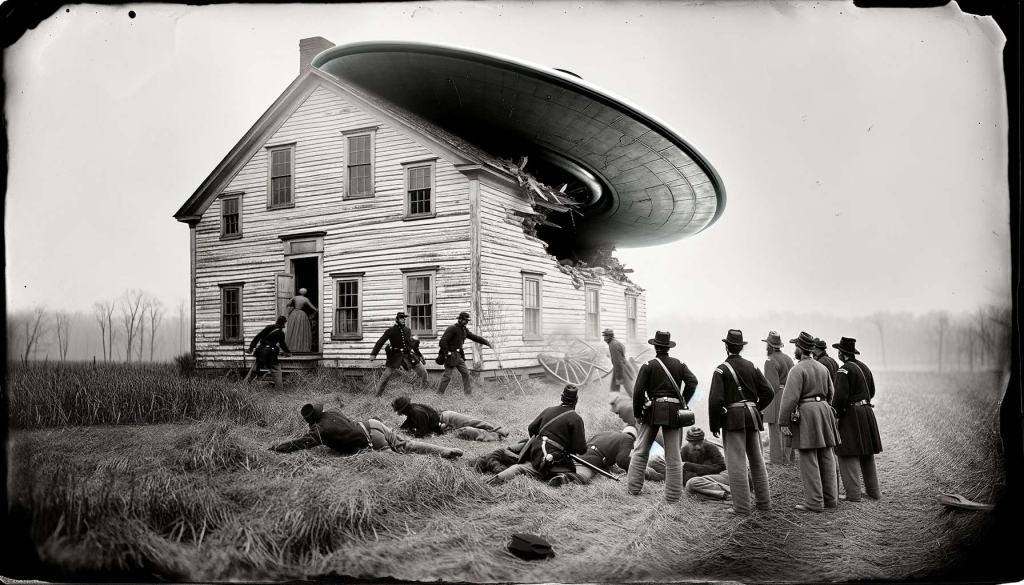
Civil War-era photo shows a flying saucer that has crashed into a two-story farmhouse.

My Dearest Cousin Lavinia,

With a spirit agitated by events most peculiar, I pen this missive. It has been but a fortnight since General Sherman’s men did descend upon Goshen Farms.

Amidst the chaos, a happening most strange and fearful took place – a great flying machine, the likes of which I could scarce imagine, fell from the sky and crashed into the side of Master Thompson’s farmhouse, laying ruin to its structure.

Under the compulsion of the General’s men, I was bade enter this abode of destruction. Within, I beheld a sight that has since haunted my slumbers.

Creatures of an aspect most unusual were strewn amidst the wreckage. They were of a slight and delicate frame, with skin as pale as the moon’s glow and eyes that seemed to hold the very cosmos. They bore no resemblance to any beast of God’s creation known to my eyes.

Their attire was of a fabric unknown, shimmering under the dim light that pierced the gloom of the shattered dwelling. Though fear gripped my heart, I could not deny a certain sorrow for these otherworldly beings so far from their home, now lying silent in their iron carriage.

I pray thee, believe my words, for what mine eyes have beheld, the mind struggles to comprehend. May the Lord grant us understanding of these mysteries in His own time.

Yours in bewildered kinship, I remain,

Jessy Worthington
Goshen Farms, Georgia

Text and photo copyright © 2024 L.T. Hanlon. All content in this post is fiction.

I did not need to watch this video at 2 a.m.

I’ve been to many places, seen many things, and heard a truckload of stories.

By day, I worked at newspapers. By night, I’d lean into conspiracies. It’s not every journalist who’s got a side passion for Fortean phenomena. I’m not saying I believe in all that jazz, but something about UFOs, cryptids, and high strangeness catches me and hooks me in. It’s like a lousy earworm of a song you can’t shake.

Legends? They’ve got a life of their own. Ever heard of the telephone game? Start a rumor on one end of the bar, and by the time it reaches the jukebox, it’s turned into some wild tale. These urban myths — they spread, mutate, and grow legs. Sometimes wings.

Speaking of wings, let’s talk Mothman. A creature seen in Point Pleasant, West Virginia. But it’s not the red-eyed beast that gets me. It’s his alleged buddy, Indrid Cold. Some folks call him the Grinning Man.

The story goes: a chap named Woodrow Derenberger was driving home one night in 1966 when he got flagged down by a vehicle that screamed, “Not from this galaxy.”

Out pops a man with a metal grin dressed to the nines. This smiling suit introduces himself as Indrid Cold. Over time, Woody and Indrid chat telepathically, with Mr. Cold spewing tales of interstellar travels. Bizarre, right?

Then Indrid Cold became intertwined with the Mothman sightings. Some say he’s an alien, others believe he’s a government agent covering up the Mothman hullabaloo, and others still reckon he’s a fragment of overactive imaginations.

Whatever the truth, stories like his keep the legend alive, burning like a neon sign outside a dive bar.

I’ve driven endless late nights under countless starry skies, sometimes thinking about those twinkling dots. Could there be life out there? Probably. But I’m not holding my breath for a close encounter.

I’m as skeptical as they come. But when the clock hits 3 a.m., and I hear a strange noise outside my window, I get a tad jumpy.

UFOs and cryptids might be campfire tales, but they sure as hell make the night a little more interesting.

Did ‘Back to the Future’ predict 9/11?

You’ll be blown away by this one. Could it be that there are no coincidences?

Here’s the deal. I stumbled on this video, right? Puts “Back to the Future” and the September 11 attacks in the same sentence. Sounds like mixing apple pie and motor oil, doesn’t it? But bear with me.

First off, Marty McFly. Guy’s a regular teen with a crappy family and a DeLorean. He gets into a time machine and aims to fix his life. We’ve all seen the flick.

It’s Americana wrapped in Spielberg, a rollercoaster of a movie. But put it next to one of America’s most tragic days, and your brain starts doing somersaults.

This video claims all these “hints” and “clues” peppered throughout the film point to 9/11. I’m talking about clocks, license plates, scenes that should be viewed upside-down, and even lines of dialogue. Makes you think Marty should’ve been more worried about a national catastrophe than his parents’ lame love story.

So I watched it.

Once.

Twice.

Then, a third time after eating half a bag of kratom gummies because, hey, why not?

And I had a full-tilt freakout. Not because I bought into it but because someone sat down and stitched this wild quilt of conspiracy. Like taking pieces of a Picasso and a Pollock and saying they tell the same tale.

I’m not the tinfoil hat type. There are no alien abductions or Bigfoot sightings in my book. But this? It’s like when you’re three sheets to the wind, and someone starts talking politics — you listen but don’t buy the T-shirt.

So, watch the video, then let me know whether Marty McFly could’ve, would’ve, should’ve warned us about 9/11.

Terror in the Yukon: Close encounters of the gas kind

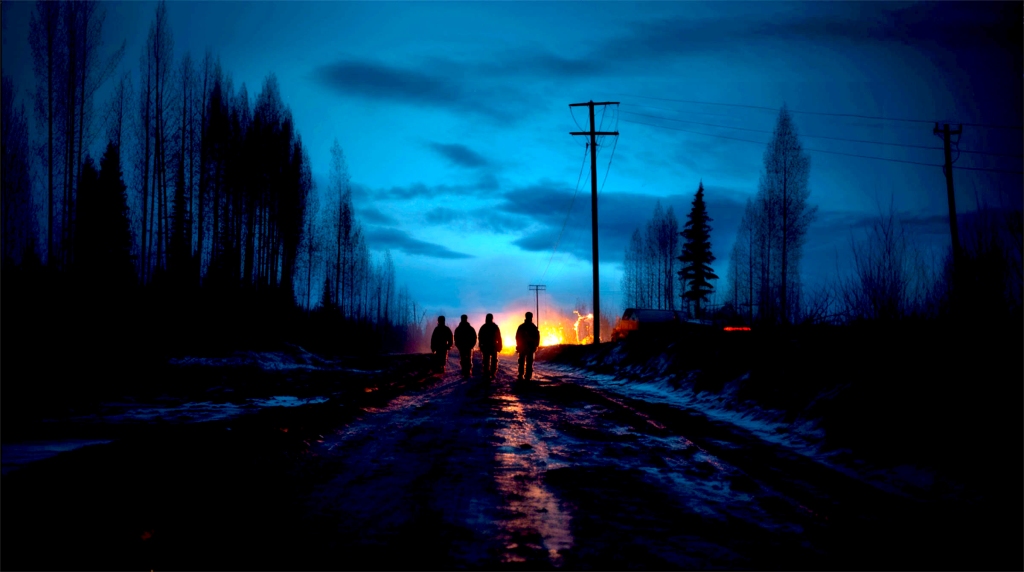
Midjoiurney image shows four shadowy figures blocking a gravel road in the middle of nowhere as an orange light flickers on the horizon.
A sight similar to this caused my junior-high self to nearly have a nervous breakdown. (Synthograph by Midjourney)

It’s late summer 1968, and I’m about to enter ninth grade. Then my dad quits — or is fired from — his job at the National Bank of Alaska in Anchorage, piles our family into our VW Campmobile, and we leave town.

Mom tells me we’re moving to Seattle, but after a half-day of driving, it’s clear that’s not our route. My parents reveal we’re heading northeast over 300 miles to link up with the Alaska Highway at Delta Junction and then drive almost 3,000 miles down to Denver, Colorado.

This is the second time in two years we’ll be traveling the highway — but in the opposite direction.

We drove up in 1966 from the Bay Area after Dad quit — or was fired from — his job with Wells Fargo in San Francisco.

Today, the Alaska Highway is paved, but in the late 1960s, 75 percent remains unpaved and winds through some of North America’s most desolate inhabited stretches. You can drive for miles even during the day and not meet another vehicle.

Services are so scarce that travelers carry “The Milepost,” a guidebook listing gas stations, grocery stores, campgrounds, motels, radio stations, RCMP outposts, and hospitals designated by their mile marker along the highway. Failure to mind your “Milepost” can leave you stranded or dead.

Around midnight, we’re in the Yukon Territory and heading south. On the horizon, I spot a yellowish-orange glow. As we get nearer, the light brightens and flickers; the source seems beyond a small hill.

I tell Dad to stop and turn around, that this doesn’t seem right. Someone is going to “get us.” Years later, Mom will recollect that I nearly had a complete breakdown — screaming, throwing things around, banging my head on the floor.

Dad slows the Campmobile to a crawl, and as we reach the top of the hill, we see…

An oil drilling rig venting and burning off natural gas. Today, nobody wastes petroleum that way, but back then, it just hinders tapping a petroleum field.

The oilfield workers smile and wave us on.

I don’t consider the incident anything other than a funny story — until maybe 10 years ago. I’m reviewing the events in my mind, and that’s when I suddenly remember something else that happened after we found the oil rig.

A few hours later, we stop in a small town with one of those old downtown hotels. It’s not a motel but an actual hotel with a lobby. It’s maybe 2 a.m. now. Mom and Dad usher me out of the Campmobile and into the lobby. At first, I’m excited — I wouldn’t say I like camping and am looking forward to sleeping in a real room for a change.

But we don’t check in. There aren’t any people coming in or out of the hotel that I can recall, and I never see a desk clerk. All I remember is hearing an old clock ticking somewhere and watching Mom sit on a battered leather couch. I’m in a big chair next to her — and my father stands at the hotel lobby window, staring out into the street.

Dawn comes early this far north in summer, and we leave. None of us mentions either incident to relatives when we arrive in Denver.

The oil rig story passes into family lore as an amusing example of why I never should have been allowed to read “The Interrupted Journey,” one of the first widely publicized alien-abduction stories. Betty and Barney Hill described a similar encounter. So did architect David Vincent, for that matter.

And nobody but me remembers the hotel — and it doesn’t bubble to the surface until 20 years later.

When I tell this story, I think it’s funny, and the people I’m telling it to do, too.

But I get a different response when I tell the story to Wally Reichert, a freelance photographer with whom I discuss high strangeness.

Wally suggests that the oil rig incident is merely a false-memory implant and that something else happened that night.

At one point, I considered being hypnotized to recover these alleged abduction memories. Still, I decided against the idea since my mind is so polluted by ufology and pop culture I doubt the truth could be sifted out.

But I still get the shivers over UFO stories.

Nazi flying saucers are a load of crap

The other night, I came across this YouTube video, screen flickering in the dark, promising me “stunning” photographic of Nazi-engineered flying saucers.

The grainy footage, eerie music, and an air of “The truth is out there — and here it is!” reeled me in.

So, what’s the claim? In the expanded universe version of this urban legend, these Third Reich bozos not only built flying saucers using antigravity propulsion — one sportier model knwn as Die Glocke had a time-traveling option that caused it to bounce ahead to 1965 and crash outside Kecksburg, Pennsylvania. The story sounds like Steven Spielberg and George Lucas got hammered, whipped out a Ouija board, and channeled Ed Wood.

Let’s shatter this glass house right off the bat: Nazis were pipe-clogging turds who saw the world as their punchbowl. If they’d had technology as advanced as some of these UFO nuts insist, the Allies would’ve been screwed six ways to Sunday.

But let’s get real. The Nazis documented everything with Teutonic efficiency and an obsessive compulsion — from the horror shows at death camps to the pomp and circumstance of Nuremberg rallies.

Leni Riefenstahl filmed “Triumph of the Will” with a goddamn sense of aesthetic purpose. I mean, if you can make evil look that good on camera, why does your flying saucer footage look like Bigfoot took it while having a seizure?

Seriously, the evidence is shakier than Elvis in his final years. Blurred images, poorly exposed film — this is the stuff conspiracy theorists drool over.

I get it. The unknown excites people. But attaching this UFO myth to Nazi scientists is as absurd as claiming that John Williams is an alien because he composes damn good music.

Even if German scientists constructed a saucer-shaped conventionally powered aircraft, it’s a far cry from building a working UFO. We’re talking about engineering marvels beyond rocket science. Literally.

So why do people buy into this garbage? Wishful thinking? A desire to make the world crazier than it already is? If you ask me, folks latch onto these increasingly bizarre conspiracy theories the same way pornography addicts need to keep pumping up the kink to reach orgasm.

Let’s give a nod to the influence, though. These rumored German saucer designs left a mark on pop culture.

You’ve got George Adamski, who claimed contact with Venusians, sketching and photographing craft that eerily resemble this Nazi nonsense.

And then the TV show “The Invaders”? Their flying saucers could’ve been extras in that grainy Nazi film reel. Hollywood knows a good prop when it sees one.

Bottom line: Don’t buy into the hype. Nazis constructing flying saucers is as believable as me turning water into whiskey. And if I could, you bet I’d be a hell of a lot richer than I am now.

We deserve public answers about UFOs

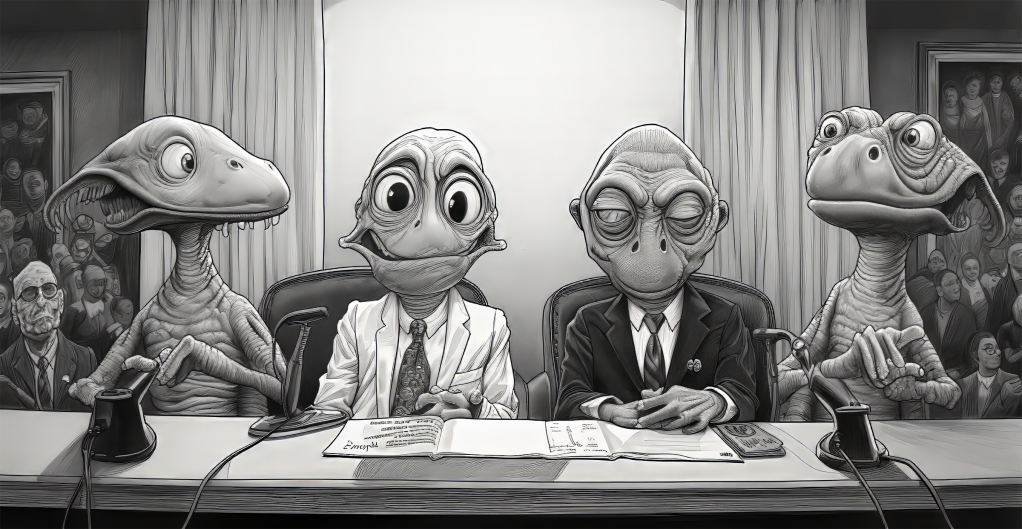
Cartoon illustration of four goofy-looking aliens seated at a table during a congressional hearing.

I’m still catching my breath from yesterday’s supposed “reveal” at the Subcommittee on National Security, the Border, and Foreign Affairs. Despite the hype, there wasn’t even a whiff of extraterrestrial cologne in the air, let alone any proof of them or their fancy interstellar toys.

David Grusch, the former U.S. Air Force officer and intelligence official, dodged questions like a pro, repeatedly offering to provide answers only in a closed hearing.

Oh, the suspense!

But forgive me if I’m not biting my nails waiting for the curtain to rise on that shadowy encore.

Chairman Rep. Glenn Grothman kicked off the hearings with a fiery pro-transparency rallying cry. He said, “The lack of transparency surrounding UAPs has fueled wild speculation and debate for decades, eroding public trust in the very institutions that are meant to serve and protect them.”

I couldn’t have put it better, Glenn. The Wisconsin Republican was onto something, but did we hit pay dirt?

Close, but no cigar-shaped object.

If you’re involved in UFO and UAP research, you’ve got to spill the beans in public hearings. It’s as simple as that.

Without public transparency, UFO research will keep lurking in the same murky corner as other beloved mysteries like Roswell, JFK, RFK, Oklahoma City, Jeffrey Epstein, and 9/11.

Remember the Phoenix Lights of 1997 or the Rendlesham Forest incident? How about the UFO flap in Belgium? Or the Lonnie Zamora case? If we’ve learned anything from these, the truth is far more intricate and unnerving than what’s been spoon-fed.

Stanton Friedman, the granddaddy of ufology, put it best: “The evidence is overwhelming that Planet Earth is being visited by intelligently controlled extraterrestrial spacecraft. There is no doubt that a small number of people in governments both in the United States and overseas have been actively covering up the truth about these visits. There really is a ‘Cosmic Watergate.’”

Cosmic Watergate, indeed.

So, let’s take a wild guess. Do you think we’ve been given the whole enchilada?

If you think so, I’ve got a slightly used flying saucer to sell you driven only on Sundays by a little old gray lady from Zeta Reticuli.