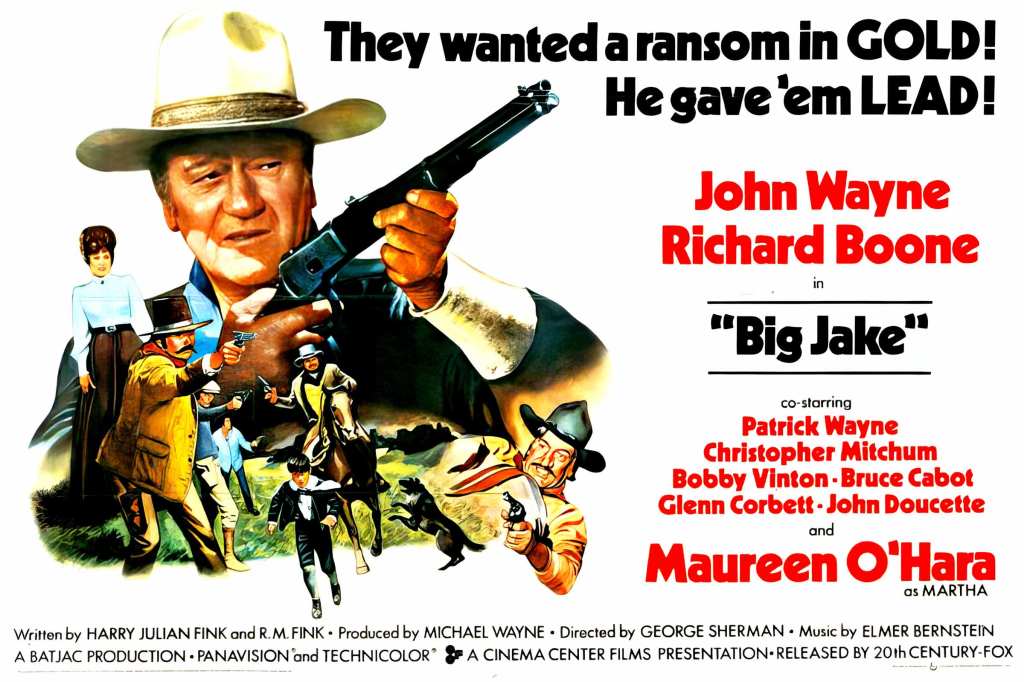
From machete mayhem to timeless tale: Revisiting ‘Big Jake’

Poster for the 1971 John Wayne film "Big Jake."

Having watched “Big Jake” for the first time in more than 50 years, its timeless quality struck me. It’s amazing how this 1971 John Wayne classic could easily pass for a modern production, especially considering its graphic narrative and intense action sequences that resonate with the high-amp shocks we adore in Quentin Tarantino movies.

The film spins a riveting tale of child kidnapping, and it doesn’t shy away from brutality, much like the stylized violence we see today. There’s a particular member of the kidnap gang who wields a machete with chilling fondness. The gruesome fate of the Duke’s dog, not to mention a few unfortunate characters, reflects a brand of violence that’s unsettling precisely because director George Sherman leaves much of the violence to the imagination.

Yet, despite the grim elements, “Big Jake” remains a standout Western, thanks to a powerhouse cast including Richard Boone, Maureen O’Hara, and Patrick Wayne. The movie holds its own, even when you put it side by side with other Westerns of its era like “The Wild Bunch” or “Butch Cassidy and the Sundance Kid.” These films, too, pushed the boundaries of the genre, but “Big Jake” has a unique appeal. Its mix of traditional Western tropes with unexpectedly graphic content gives it a distinctive edge.

It’s fascinating to see how this film anticipated the evolution of cinematic storytelling, embracing a rawness and directness that would become the hallmark of later directors.

In revisiting “Big Jake,” I’ve rekindled memories of the classic Western era and gained a fresh appreciation for its forward-thinking approach to storytelling and visual style.

Time, space, and Marty Robbins’ ‘El Paso’ saga

Today I chanced upon an excellent analysis of Marty Robbins’ El Paso song cycle. I’ve included it above, and you should watch the video — it’s that good.

I’m reminded of a blog post I published 17 years ago about the relationship of “El Paso” to “As Time Goes By” and Albert Einstein.

Round up the usual subatomic particles
(July 9, 2006)

Today at work, I needed to fact-check a reference to lyrics from “As Time Goes By” — best known for its use in the classic motion picture “Casablanca” — and discovered something pretty profound: This song’s introductory verse is actually about Albert Einstein and his Theory of Relativity.

This day and age we’re living in
Gives cause for apprehension
With speed and new invention
And things like fourth dimension.

Yet we get a trifle weary
With Mr. Einstein’s theory.
So we must get down to earth at times
Relax, relieve the tension
And no matter what the progress
Or what may yet be proved
The simple facts of life are such
They cannot be removed.

You must remember this. . .

You just don’t encounter a lot of verse introductions these days. It wasn’t until several years ago that I even heard the “White Christmas” intro about being in Southern California in December and why the singer dreams of a white Christmas.

Thanks to iTunes, I discovered another musical delight recently. I was searching for “El Paso,” the classic Western ballad by Marty Robbins and, yeah, I saw “El Paso City,” too — but also for sale was an incredible song I’d never heard before: “Feleena (From El Paso).”

This amazing song tells the “El Paso” saga from Feleena’s viewpoint and is guaranteed to evoke an almost operatic cascade of emotions from anyone like me who loves the original.

You surely know the tragic ending of the “El Paso” story, so I’ll risk a spoiler by quoting my favorite set of lyrics from “Feleena.”

Feleena knelt near him,
To hold and to hear him
When she felt the warm blood
That flowed from the wound in his side.

He raised to kiss her
and she heard him whisper,
“Never forget me, Feleena.
It’s over, goodbye.”

Quickly she grabbed for
the six-gun that he wore
And screaming in anger
and placing the gun to her breast,

“Bury us both deep
and maybe we’ll find peace,”
Then pulling the trigger,
she fell ’cross the dead cowboy’s chest.

Time — the fourth dimension — is why you might not have heard “Feleena.” The song clocks in at 8 minutes, 19 seconds, so it doesn’t get much airplay.

There’s also an internal time problem with “Feleena.” In the original “El Paso,” the young cowboy apparently spent some time in the badlands of New Mexico, yet in “Faleena,” he tragically returns the next day.

Or maybe, as Einstein might say, it’s all relative.

Midjourney’s magic: Is AI the future of book covers?

A Photorealistic image created by Midjourney shows a cowboy kissing his sweetheart during an evening rain.
Midjourney created this evocative cover for a Western romance novel I’m percolating.

The wonders of AI keep unveiling themselves — most recently, as photorealistic images.

I am astounded.

I’ve been test-driving a new AI program called Midjourney. It can create infinite images, including uncannily lifelike, detailed, photorealistic images from descriptive text.

Last night, in nostalgia for Western romance novels, I tested Midjourney. I prompted: “A young cowboy kisses his sweetheart during an evening rainstorm.” A simple, evocative. I clicked the generate button and prepared for a laughable, cartoonish result.

When the image popped up on my screen, I was speechless.

It was a sight to behold. The image showed a rugged cowboy, complete with a hat, locked in a passionate embrace with his sweetheart. The couple was about to kiss as they stood in the warm glow of a rainy western street. The light from nearby windows reflected off their clothing, creating a surreal, dreamy atmosphere. It was tender, raw, and powerful.

It was so real and vivid that I had to remind myself that no artist’s hand had touched this piece. It was pure AI, Midjourney flexing its silicon muscles to breathe life into a simple string of words.

To say I was pleased would be a gross understatement. I was dumbfounded, thrilled, and utterly captivated. Midjourney’s image wasn’t just photorealistic; it told a story. It captured the moment’s essence, making me feel like I was peering into a novel myself.

Now, I’m left with this burning question: Could this image make it to the big time? Could it stand shoulder to shoulder with professionally photographed book covers? Could it grip a potential reader’s imagination and entice them into the wild, passionate world of a Western romance novel?

I am leaning towards yes. What do you think?