It’s late summer 1968, and I’m about to enter ninth grade. Then my dad quits — or is fired from — his job at the National Bank of Alaska in Anchorage, piles our family into our VW Campmobile, and we leave town.
Mom tells me we’re moving to Seattle, but after a half-day of driving, it’s clear that’s not our route. My parents reveal we’re heading northeast over 300 miles to link up with the Alaska Highway at Delta Junction and then drive almost 3,000 miles down to Denver, Colorado.
This is the second time in two years we’ll be traveling the highway — but in the opposite direction.
We drove up in 1966 from the Bay Area after Dad quit — or was fired from — his job with Wells Fargo in San Francisco.
Today, the Alaska Highway is paved, but in the late 1960s, 75 percent remains unpaved and winds through some of North America’s most desolate inhabited stretches. You can drive for miles even during the day and not meet another vehicle.
Services are so scarce that travelers carry “The Milepost,” a guidebook listing gas stations, grocery stores, campgrounds, motels, radio stations, RCMP outposts, and hospitals designated by their mile marker along the highway. Failure to mind your “Milepost” can leave you stranded or dead.
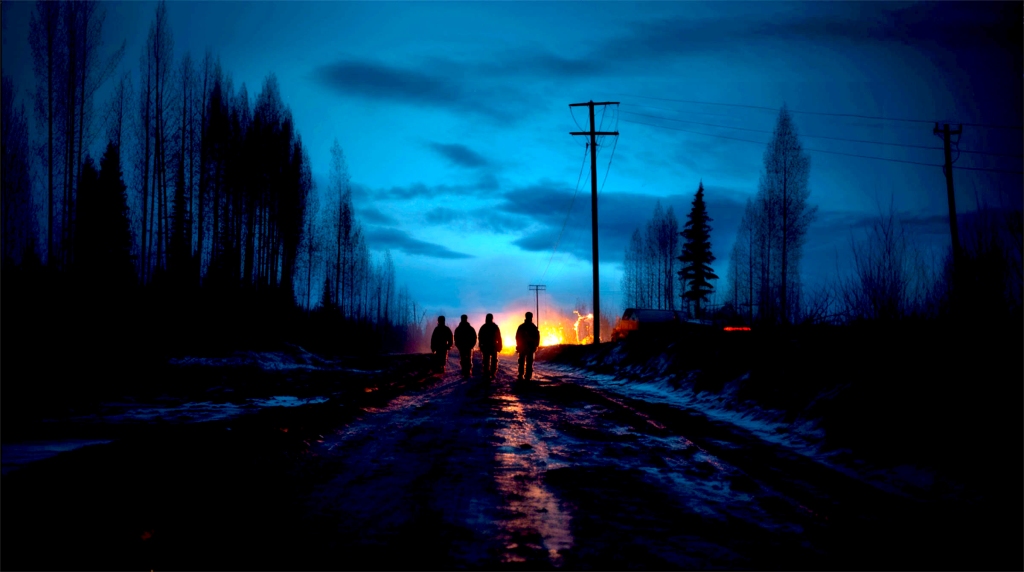
Around midnight, we’re in the Yukon Territory and heading south. On the horizon, I spot a yellowish-orange glow. As we get nearer, the light brightens and flickers; the source seems beyond a small hill.
I tell Dad to stop and turn around, that this doesn’t seem right. Someone is going to “get us.” Years later, Mom will recollect that I nearly had a complete breakdown — screaming, throwing things around, banging my head on the floor.
Dad slows the Campmobile to a crawl, and as we reach the top of the hill, we see…
An oil drilling rig venting and burning off natural gas. Today, nobody wastes petroleum that way, but back then, it just hinders tapping a petroleum field.
The oilfield workers smile and wave us on.
I don’t consider the incident anything other than a funny story — until maybe 10 years ago. I’m reviewing the events in my mind, and that’s when I suddenly remember something else that happened after we found the oil rig.
A few hours later, we stop in a small town with one of those old downtown hotels. It’s not a motel but an actual hotel with a lobby. It’s maybe 2 a.m. now. Mom and Dad usher me out of the Campmobile and into the lobby. At first, I’m excited — I wouldn’t say I like camping and am looking forward to sleeping in a real room for a change.
But we don’t check in. There aren’t any people coming in or out of the hotel that I can recall, and I never see a desk clerk. All I remember is hearing an old clock ticking somewhere and watching Mom sit on a battered leather couch. I’m in a big chair next to her — and my father stands at the hotel lobby window, staring out into the street.
Dawn comes early this far north in summer, and we leave. None of us mentions either incident to relatives when we arrive in Denver.
The oil rig story passes into family lore as an amusing example of why I never should have been allowed to read “The Interrupted Journey,” one of the first widely publicized alien-abduction stories. Betty and Barney Hill described a similar encounter. So did architect David Vincent, for that matter.
And nobody but me remembers the hotel — and it doesn’t bubble to the surface until 20 years later.
When I tell this story, I think it’s funny, and the people I’m telling it to do, too.
But I get a different response when I tell the story to Wally Reichert, a freelance photographer with whom I discuss high strangeness.
Wally suggests that the oil rig incident is merely a false-memory implant and that something else happened that night.
At one point, I considered being hypnotized to recover these alleged abduction memories. Still, I decided against the idea since my mind is so polluted by ufology and pop culture I doubt the truth could be sifted out.
But I still get the shivers over UFO stories.
 L.T. Hanlon