Snap the small stuff: Everyday life needs a close-up

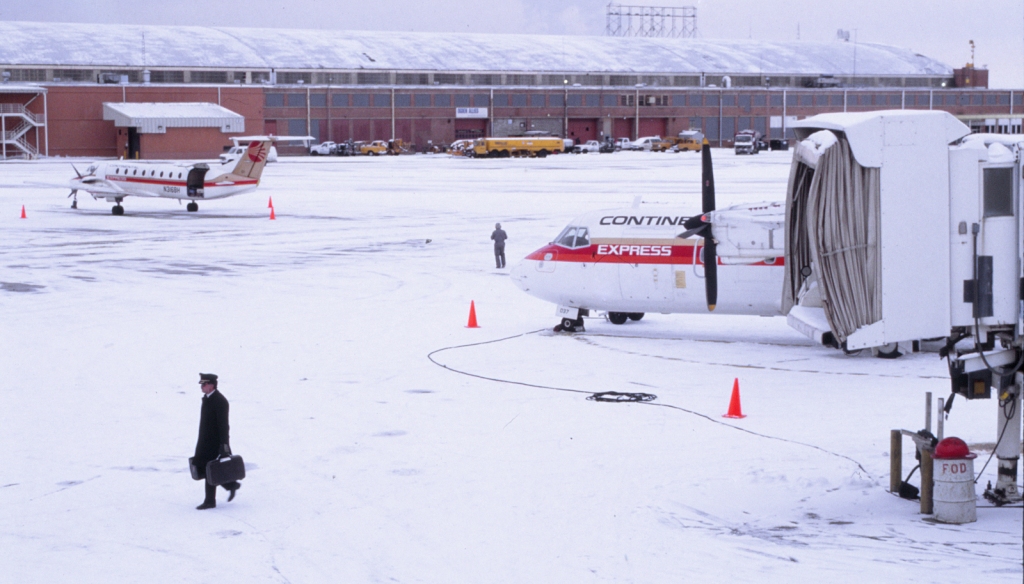
A photo taken in 1991 at Denver's Stapleton International, which closed in 1995. It shows a pilot trudging across a snow-covered apron. He's carrying his flight cases and two Continental Express commuter prop planes are in the background.
I photographed this scene at Denver’s now-closed Stapleton International Airport in 1991.

Many years ago, I went to a presentation about scrapbooking and journal-keeping given by a passionate historian. Sure, she said to document major social events, but remember to snap pictures of your everyday environment.

She mentioned something that got me thinking: Ever since Route 66 sprung into being, it’s been incessantly photographed. Despite being supplanted by interstates, people still take pictures of the Mother Road.

Yet, the historian wondered, who is photographically documenting the interstate highways?

She suggested that we spend at least a day each year going around our neighborhoods, taking black-and-white photos of things that seem as ordinary as dirt. Why use black and white film? Its negatives are archival and, unlike digital images, will not depend on possibly ephemeral technology.

It’s even a good idea to archive digital images on film.

The historian had some specific stuff she thought we should capture. You’ll probably chuckle — I know I did — but she was all about telephone poles, transformers, transmission lines, you name it.

But when you think about it, this makes sense. These things are mundane and ordinary, but they’ll be as rare as a dial-up modem one day. Tech moves fast, and soon all those cables and poles will be tucked away out of sight, underground. When that day comes, a humble photo collection becomes a precious historical record.

The point hit home for me in the early 1990s when I was living in Denver. I decided to photograph the soon-to-be-closed Stapleton International Airport. Man, did I pick a day to do it — it was snowing cats and dogs. But I’m glad I braved the cold. The snowfall added a certain magic to my photos. They aren’t just pictures anymore. They’re slices of history, proof that an era once existed.

Regular stuff only stays boring for a while because once something’s gone, it’s history.

Typewriters highlight museum exhibit

Photo of several people using some of the eight typewriters available for visitors to try out at the American Writers Museum in Chicago.
Test driving typewriters is a big attraction at Chicago’s American Writers Museum, which just opened its “Tools of the Trade” exhibit.

Oops! Never mind my comment below about the birthyear of Gwendolyn Brooks’ Hermes Rocket. I totally misread that as “1954.” It actually is from 1964 — and I wish I were of a similar vintage!

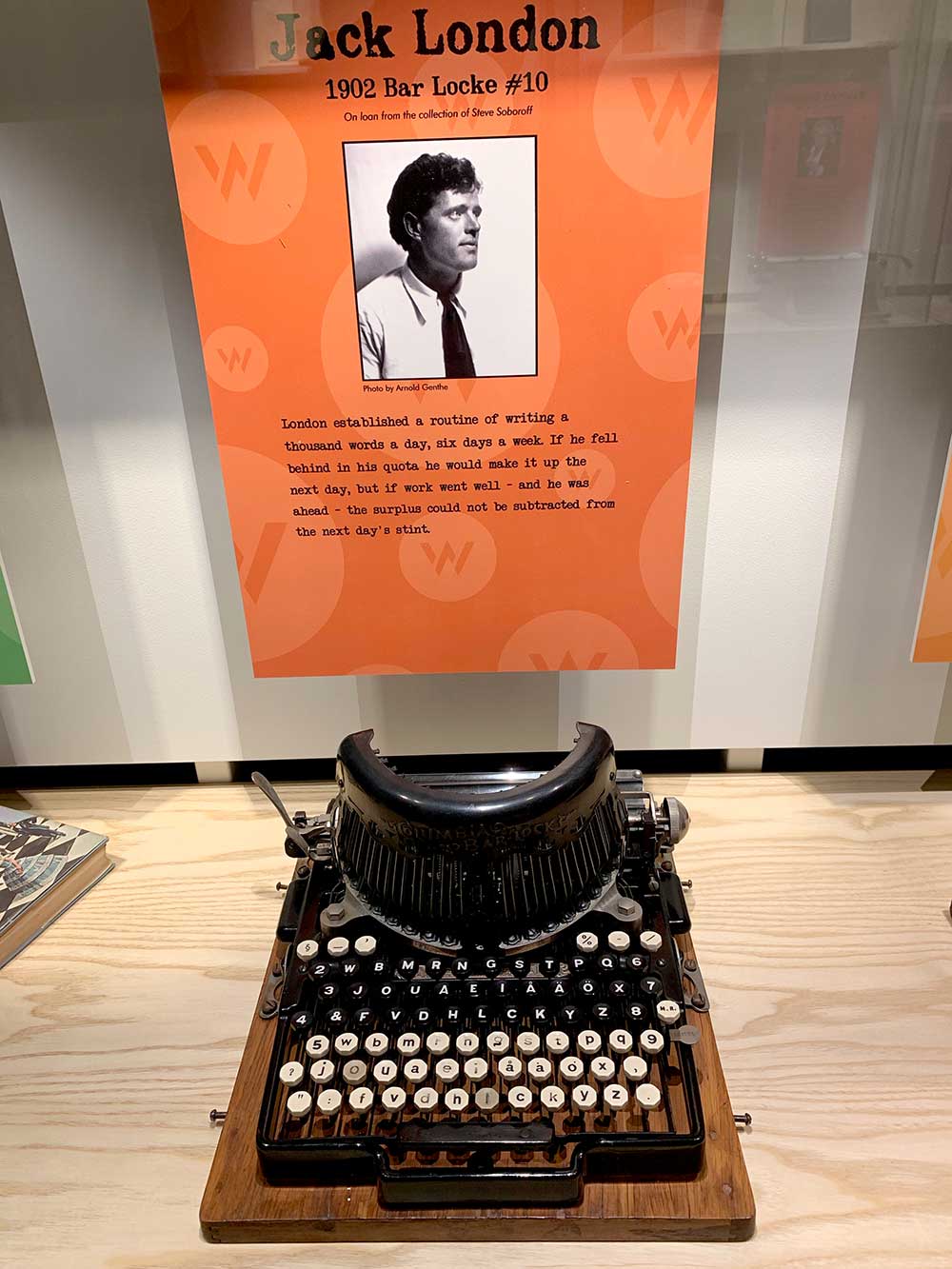
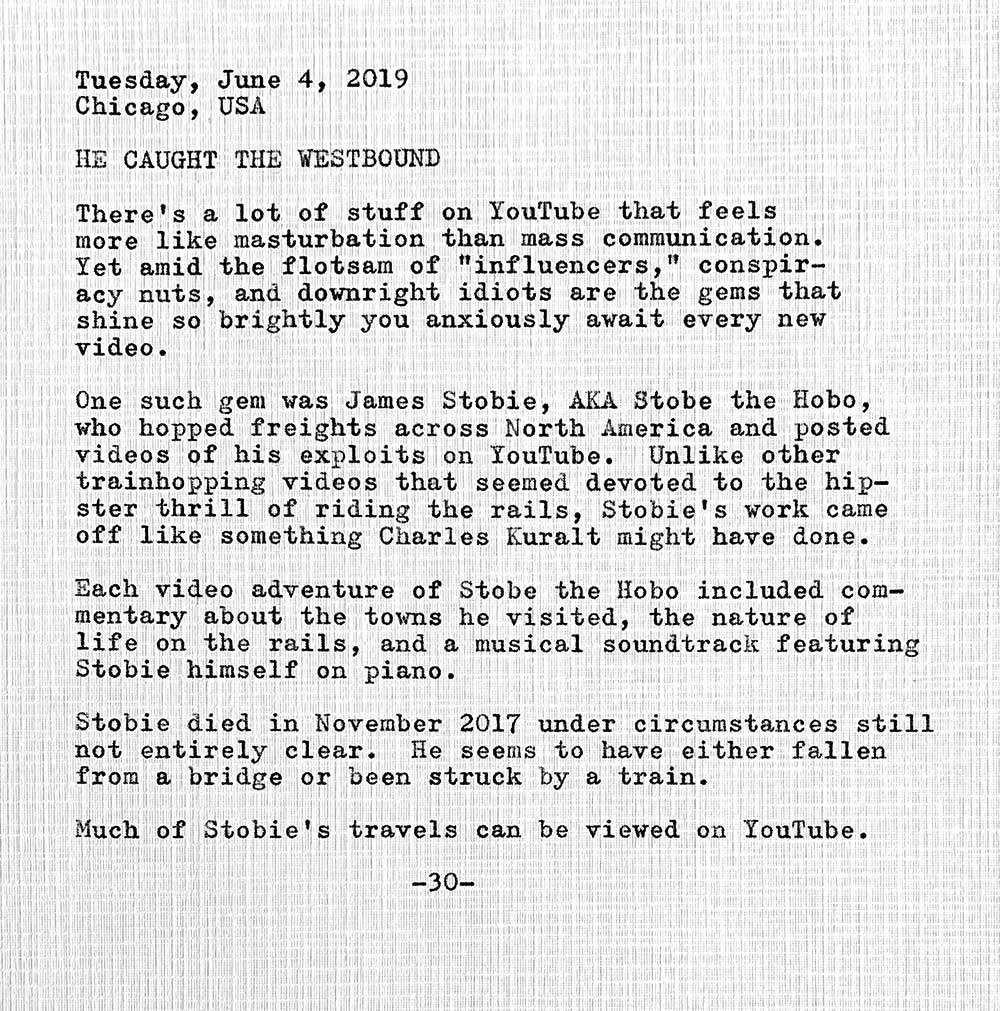
This photo of a typewritten page shows the following. Saturday, June 22, 2019, Chicago, USA. Smith-Corona Silent—Super; 1954; Pica. Museum exhibit is just my type. Thanks to my ex-boss Laura Strom, I got to accompany her to the preview of a new exhibit at Chicago's American Writers Museum called Tools of the Trade. It’s about typewriters mostly. In addition, visitors can test drive the actual models that  are featured in most of the displays. I especially enjoyed trying out an Olympia SG—1 and appreciated its snappy, powerful operation. Another outstanding model on view for testing was a Smith—Corona Super Sterling whose incredible response surprised me. As for the behind—glass typewriters once owned  by famous folks, the most amazing one was a 1902 Bar-Lock owned by Jack London. The thing looks like an Enigma machine — there are separate keys for upper- and lower-case letters. There's a 1926 Underwood 4-Bank once owned by Orson Welles that I found particularly interesting since its keys are so tiny that I can’t possibly imagine Orson managing to have plunged his sausage snappers onto them with any degree of accuracy. Other celebrity machines on view once were the prized possessions of Truman Capote, Gore Vidal, Ray Bradbury, and Mae West. My favorite celebrity typewriter was the Hermes Rocket owned by Gwendolyn Brooks — made in 1954  just like me! There’s also a 1939 Royal Portable DeLuxe owned by Jerry Siegel, co—creator of Superman. This exhibit is definitely worth seeing.

Museum display shows Gwendolyn Brooks' Hermes Rocket typewriter. The typewriter is streamlined and graceful, just like Brooks' writing.

Museum display shows Jack London's 1902 Bar-Lock typewriter. This machine bears little resemblence to later typewriters and has separate keys for uppercase and lowercase letters, as well as keys for numbers seemingly scattered at random. It could pass for a spy coding and decoding device.