Predictable patterns: How AI holds a mirror to our universal storytelling

Calvin and Hobbes comic strip in which Calvin defends creating generic snowmen.
Did Bill Watterson have Calvin predict the coming of AI-created content?

It’s an age-old debate in art and creativity: what is true originality? Every artist has tapped into universal themes, stereotypes, and structures that resonate with audiences, from Shakespeare to Spielberg. As we dive into the 21st century, a new contender has entered the arena—Artificial Intelligence. As writers and creators turn to AI for inspiration and even content generation, skeptics raise eyebrows. But is there really much difference between human-generated clichés and those constructed by algorithms?

Let’s consider popular genres.

Despite the studio, superhero movies often orbit around a protagonist with a tragic backstory, a formidable antagonist, a colossal battle, and a resolution.

Similarly, romance novels are interwoven with familiar tropes: enemies to lovers, hidden royalty, or the classic will-they-or-won’t-they.

Spy thrillers? A charismatic lead, global stakes, high-octane chase sequences, double agents, and plot twists.

Sounds formulaic? That’s because it is.

And it’s not just limited to literature and film. Pop songs have their share of predictable patterns. Inevitably using Auto-Tune, sometimes called the “Cher effect,” gives vocals a distinct robotic sound.

And can we ever have enough of the word “baby” in our love songs? A college instructor told us that if we ever wanted to know how “baby” is overused in song lyrics, substitute the words “boat dock.” She was joking, but now, 50 years later, I still hear . . .

“Be My Boat Dock”
“Boat Dock Love”
“Love to Love You Boat Dock”

. . . well, you get the idea.

What we’re encountering isn’t a deficit of originality but a reflection of our collective consciousness — a set of stories, beats, and patterns that resonate universally. If these patterns are deeply embedded, why shouldn’t an AI designed to recognize and emulate patterns produce something similar?

AI’s ability to create isn’t about replacing human ingenuity. It’s about acknowledging that much of what we consume and call “original” is often derived from age-old patterns. If a machine can replicate those patterns, it doesn’t demean our art — it merely reflects our preferences.

To dismiss AI-generated content as “unoriginal” means confronting an uncomfortable reality about our tastes and patterns.

Instead of shunning silicon assistance, it may be time we embrace it. After all, whether it’s Shakespeare, Spielberg, or an AI, aren’t we all just looking for a good story?

By the way, that “Calvin and Hobbes” strip was shared with me many years ago by a famous comics artist. We got a good laugh of it — but I doubt either of us predicted AI’s coming impact.
‘Dandelion Wine’ and ‘Something Wicked This Way Comes’ define their seasons

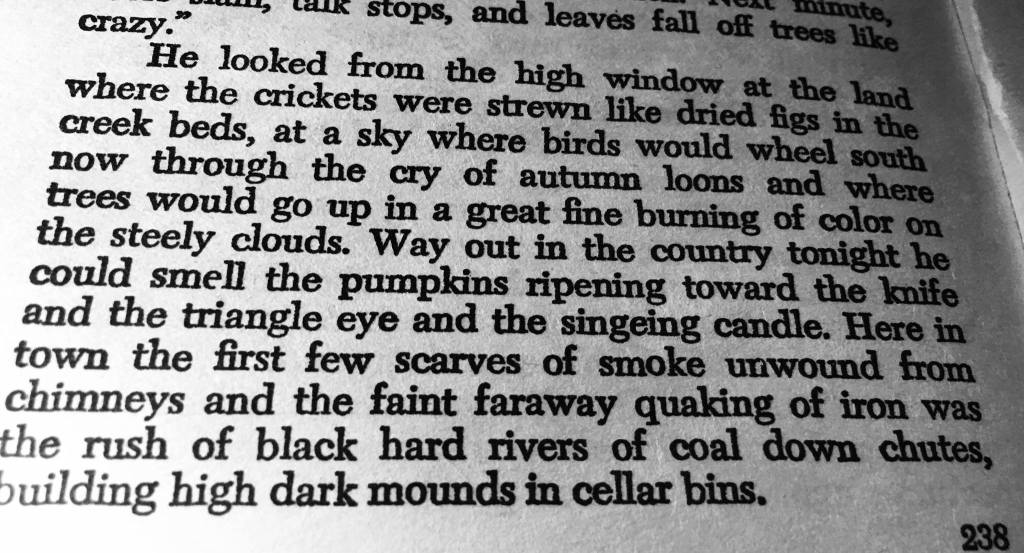
Photo of paragraph from the final chapter of Dandelion Wine.
This paragraph near the conclusion of “Dandelion Wine” has stuck with me through the decades.

Every summer, I crack open “Dandelion Wine,” and come fall, it’s “Something Wicked This Way Comes.”

This has been a ritual since junior high. You’d think the magic would wear off. No, Bradbury’s still got it. Guy was like the Wagner of words.

“Dandelion Wine” kicks off my summer right. Takes me back and makes me a kid again, running through the grass barefoot. Green Town, Illinois, isn’t Chicago, but Bradbury makes you wish it was. Life, distilled in a bottle; not bad for an old paperback.

Then autumn rolls in, and “Something Wicked” hits the table. Spooky carnival, Dust Witch, and Mr. Dark with his tats.

Bantam paperback copy of Dandelion Wine from the late 1960s.

The seasons change, the books change, but the grip stays the same. You don’t get to unplug from Bradbury.

So why’s this guy still on my bookshelf over 50 years later? Simple. Bradbury doesn’t just write. The man’s an architect who builds worlds out of words with real characters who can sit next to you at a bar.

And damn, if he doesn’t nail the human condition. You laugh, you shiver, you wonder.

With every read, something new jumps out. It’s like finding an easter egg in a Tarantino film you’ve watched a dozen times. Bradbury keeps giving, doesn’t go stale. It’s a “Pulp Fiction” of feelings, a “Kill Bill” of imagination.

You can’t box Bradbury in. He’s timeless. Not just because he was a literary wizard but because he got people.

And as long as I’m around, summer won’t start without “Dandelion Wine,” and fall can’t begin without “Something Wicked.”

So here’s to another 50 years.

Disney mostly did a good job bringing “Something Wicked This Way Comes” to the big screen.

Dolly Parton: From country queen to seafood supreme

Posing and lighting combine in a cover photo of Dolly Parton in the October 2023 issue of Cowboys & Indians magazine to make it look like Parton's right hand is a lobster claw.

A cover shot, a glamorous grin, and bam! You’ve got yourself a celebrity sporting a crustacean claw.

Yeah, you heard me right. Dolly Parton, bless her heart, is smiling on the front of Cowboys & Indians magazine’s October 2023 issue, but all I see is her hand resembling one of Lobster Boy’s pinchers.

Hold up, don’t tell me you’ve never heard of Lobster Boy Grady Stiles.

Guy had a genetic condition that turned his hands and feet into claws. Made a living out of it in the circus, but things turned dark. He killed his daughter’s fiancé and got himself shot in the head. It could’ve been a regular Shakespearean tragedy if he’d been plugged in the Coriolanus.

Now, you don’t want Dolly or any star looking like Grady unless it’s a horror show you’re shooting. So listen up. Here’s my guide to avoiding such unintentional situations:

  1. Get the Angles Right: Wrong angle, wrong image. Unless you’re gunning for the horror genre, watch those angles. You don’t want a hand looking like it’s auditioning for a seafood commercial.
  2. Watch the Shadows: Shadows can be as tricky as a back-alley hustler. Keep them where they belong. Play it right, and you won’t have to explain why Ms. Parton’s got a taste of the sea.
  3. Use the Props Wisely: A misplaced prop can transform a diva into a sea monster. Coordinate with your subject. Make sure everything fits like a worn-in pair of cowboy boots.
  4. Editing with Care: Too much of a good thing can be bad. You want to Photoshop? Fine, but don’t turn a beauty into a beast.
  5. Previews and Feedback: Don’t be a lone ranger. Get a second opinion, third, hell, as many as you need. Fresh eyes catch what yours miss. Speaking of which, there’s a famous photo of Clayton Moore as the Lone Ranger in which a saguaro cactus arm appears to be scratching our hero’s back. The result is unintended hilarity.

Look, nobody wants to see their favorite stars looking like they belong on a seafood platter. Pay attention, follow the guide, and keep the claws on the lobsters and off the A-listers.

It’s photography, not a freak show.

Sod off, you prats! Use American English!

The Daily Mail consistently refuses to remove British spelling and usage from its content targeting U.S. readers. If the Daily Mail is unwilling to make its publication more accessible to American readers, perhaps it should go all the way and treat us to the full high-tone British experience.

My suggested rewrite follows . . .

Flagler County Sheriff’s Deputy Nick Huzior got whisked off to the ol’ dog and bone, right? Messin’ with fentanyl at a bob standard traffic stop, ‘e did. Them rozzers reckon a mad gust could’ve popped that stuff up ‘is ‘ooter and done ‘im in. Them clever blokes in white coats? They chucked that idea in the ol’ dustbin, said it was complete pony.

Screen shot of a photo and caption from the Daily Mail newspaper online.Photo of a plainclothes detective who is about 30 years old and wearing a neatly trimmed beard. A caption beneath

Newspaper jokes: From punchlines to flatlines

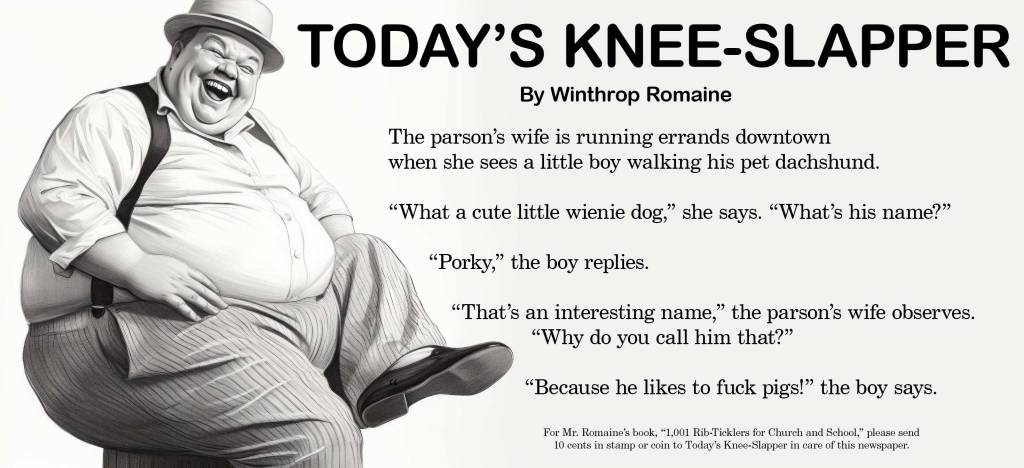
A graphic shows a jolly fat man with suspenders laughing hysterically next to a headline that reads "Today's Knee-Slapper." Next to the man, there's an off-color joke.
How about something like this for a newspaper’s humor column?

When the highlight of a morning coffee ritual is the bitter aftertaste brought on by the “joke of the day” column in your daily paper, one can’t help but wonder: “When did humor retire and forget to tell the newspapers?”

Joke columns, those tiny blocks of text nestled in the corner of the front page, are a moth-eaten relic from a bygone era — not charming antiques but the stuff of musty basements.

The so-called “jokes” they sputter out have aged worse than a water-damaged Shakespearean folio, and even that would be a more amusing read.

One might argue, “They were funny in 1930!” If you hold this opinion, I’d recommend a thorough reality check, accompanied by a comprehensive sense of humor transplant. These chronically recycled jests’ monotony and predictable punchlines are as engaging as a Kamala Harris word salad.

Worse, these chestnuts make “dad jokes” look like comedic masterpieces.

The brilliance of humor lies in unexpectedness, novel insight, and clever subversion of reality. The comedy peddled by these columns delivers none of this.

We’ve advanced in leaps and bounds in every other field, so why do we settle for subpar humor in our daily dose of news?

Research for a never-written steamy novel

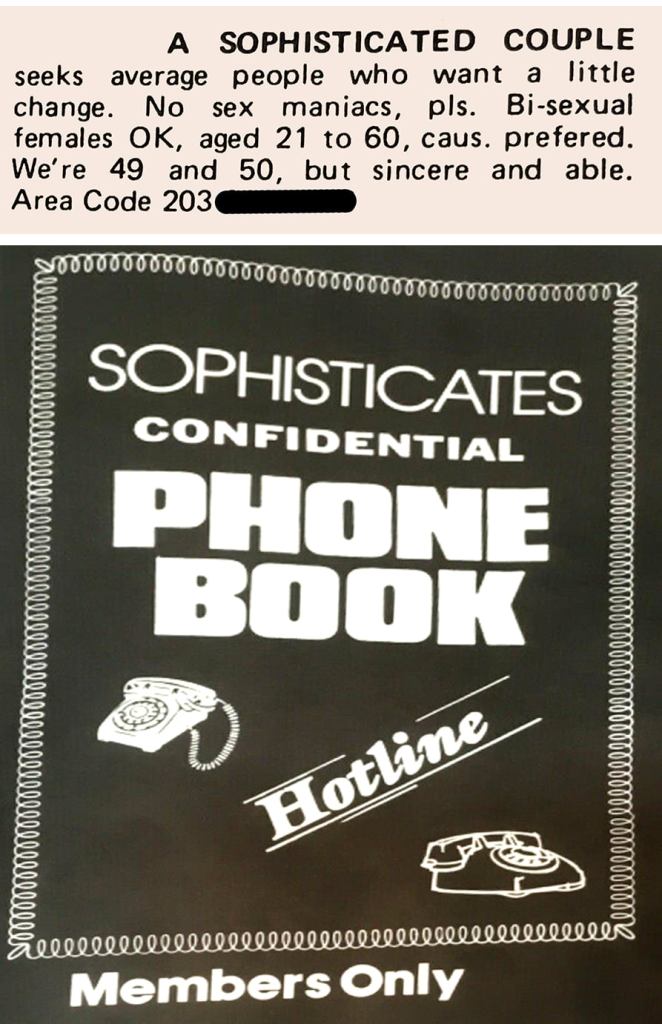
Phioto of the cover a sex guide for swingers called "Sophisticates Confidential Phone Book Hotline" probably published in the late 1960s or early 1970s.The title is in stark white type on a black background. Two crude clip-art drawings of rotary-dial telephones flank the word "hotline." Above the book cover is an ad from inside that reads: "A sophisticated couple seeks average people who want a little change.  No sex maniacs, pls. Bisexual females OK, aged 21 to 60, Caucasian preferred. We're 49 and 50, but sincere and able. Area Code 203 XXX-XXXX."
This is the directory that started — and ended — it all for me.

While browsing eBay for eclectic printed ephemera several years back, I spied an auction for “Sophisticates Confidential Phone Book Hotline, — Members Only” a guide for swingers that appeared to have been published in the late 1960s or early 1970s.

Intrigued, I bid and won this little book, and as I leafed through it, got the idea to pound out a steamy novel in which its ads are the basis for story arcs. Because more than a few ads mentioned meeting up in motels, I figured that could be the narrative frame.

I probably got the idea of the setting from the 1987 TV movie “Bates Motel” in which Bud Cort portrays a guy who befriended Norman Bates during their incarceration and inherits the motel when Norman dies. The movie was a pilot for a series, I think.

OK, so I had the sexy stories and the motel setting, but the story needed a better overall theme.

While watching a documentary about Julius and Ethel Rosenberg, more inspiration struck: What if a sleazy motel on a busy tourist highway is run by Russian agents whose job is to get blackmail material on anybody and everybody who checks in?

Here’s the brief description of “No-Tell Motel” that I came up with, including ideas for the first three chapters . . .

In the sultry backdrop of the early 1960s, along a bustling tourist highway, lies the enigmatic No-Tell Motel. Hidden behind its kitschy facade, this ordinary lodging is a hotbed of secrets and seduction, its true purpose concealed to all but its cunning owners — the enigmatic couple, Viktor and Natalia Ivanov, who double as covert Russian agents.

Viktor, a dashing and charismatic figure with piercing blue eyes and a disarming smile, manages the motel with an air of charm that conceals his true intentions. Natalia, his captivating and mysterious wife, exudes allure with her fiery red hair and a demeanor that masks her covert skills. Together, they form a formidable pair, using their unique talents to exploit unsuspecting guests who answer the siren call of their strategically placed ads in swinger magazines.

Chapter 1: “The Honeytrap” — When a high-ranking government official checks into the No-Tell Motel, Viktor and Natalia see an opportunity too good to pass up. As an alluring duo seeking a thrilling night, they draw the official into their web of temptation. Little does he know that their passionate encounter is meticulously recorded for future leverage. As the night unfolds, the couple realizes that emotions are entangling them in unexpected ways, leading them to question the true nature of their mission.

Chapter 2: “The Actress and the Diplomat” — When a glamorous Hollywood actress, Grace Harper, and a dashing foreign diplomat, Alexei Volkov, simultaneously check into the No-Tell Motel, Viktor and Natalia find themselves in a complex web of desire, ambition, and political intrigue. Drawn to each other like moths to a flame, Grace and Alexei’s clandestine affair takes center stage while the Ivanovs gather compromising information to exert influence over these influential players. But as emotions intensify, loyalties blur, and the line between duty and passion becomes dangerously thin.

Chapter 3: “The Double Agents” — An unexpected twist of fate reunites Viktor and Natalia with two familiar faces from their past – fellow Russian agents posing as a married couple, Yuri and Irina Petrov. As the two couples join forces to extract critical information from a renowned scientist staying at the motel, tensions run high, and old wounds resurface. Betrayals and revelations from their shared history threaten to derail the mission and put everyone’s lives at risk. Amid the steamy encounters and high-stakes espionage, the true test of loyalty and love emerges, forcing the characters to confront their deepest desires and darkest secrets.

“No-Tell Motel” weaves a tale of seduction, espionage, and forbidden wants against the backdrop of the tumultuous 1960s. In a time of shifting allegiances and political intrigue, Viktor and Natalia must navigate the dangerous game of espionage while wrestling with their emotions. As they delve deeper into the lives of their guests, they must confront the moral ambiguity of their actions, leading to a heart-pounding climax that will leave readers breathless and longing for more.

However, I decided that Joe Weisberg executed the basic idea much better with “The Americans,” so I abandoned the project.

From bias to balance: Google’s Genesis could pave the way

Cartoon shows two smiling humans work with their AI partner in a newsroom.
Humans and AI working together could save the news business.

In today’s world, many news stories are influenced by personal views or politics. This is a big problem for the news business. Now, Google has made Genesis, an AI bot that writes news. This might be a big step toward information that is fairer.

When we talk about “fair” news, we mean information not influenced by views or politics. Readers should be able to make their thoughts based on the facts. Recently, communication has become more influenced by personal or political beliefs.

AI, like Genesis, has no political or personal views. It doesn’t have feelings that can cause it to be biased like humans. AI uses algorithms to find, sort, and show data. It doesn’t form views.

Genesis can mine many data sources and find, sort, and show it faster and on a larger scale than humans. It can check these sources for facts and make complete, balanced reports without views or slants. This not only means more topics can be covered but also that the points stay true.

However, can pick up biases from the data it uses to learn. For example, if an AI uses a lot of data from one political view, it might show that view in its work. So, the people who make and use AI have a big job to ensure the data is fair and the AI is used correctly.

Also, AI can’t replace human news writers. Genesis is good at finding and showing facts, but humans understand feelings and complex ideas better. The best way forward might be for AI and humans to work together: Genesis can give the points, and humans can provide the meaning and tell the story.

Genesis is a big chance for the news business. News that is just facts could make people trust information again. However, it is essential to remember that AI is a tool, not a magic fix. Making sure news is fair requires hard work and care from those who create and use AI. If we use Genesis correctly, it could start a new time of unbiased news.

If we use AI like Genesis thoughtfully, we could move the news business away from views and back to truth and fairness. In a time where false news and over-dramatic stories have made things unclear, AI could be the guide to help us understand the world fairly and clearly.

Teeing off with Tesla, landing in the rough with Hitler

AI generated image intended to show Nikola Tesla playing golf during a lightning storm. According to the artist who created the image, Tesla sort of looks like Hitler.
Nikola Tesla or Herr Schicklgruber? You be the judge.

Once upon a time, I embarked on a noble journey as an artist, intending to shed light on a misunderstood genius from the past. Little did I know that this artistic adventure would lead me into an unexpected situation.

The protagonist of this story is none other than myself. The misunderstood genius I sought to portray is the legendary Nikola Tesla, whose knowledge lay in lightning rather than in perfecting his golf swing.

Now, here’s where things took an unforeseen turn. Alongside the vision of Tesla playing golf, I inadvertently generated an AI-created image that, by chance, bore a passing resemblance to Adolf Hitler, the infamous turd who made the world his punchbowl.

I must emphasize that there is no actual historical or factual connection between Tesla and Hitler.

My idea was to present Tesla in an unusual setting, breaking free from his usual lab environment and having a playful moment on the golf course. The irony of such a depiction was an intriguing creative challenge, a project worth sharing.

So, I enlisted the help of my AI bot assistant and provided the following prompt:

“Create a photorealistic HD 8K portrait of Nikola Tesla on a golf course, with lightning striking dramatically in the background. The photo should be set in 1930, using 2-color Technicolor, depicting a stormy day with ominous clouds in a 16:9 aspect ratio.”

As you can see, the outcome sort of captures Tesla’s essence but also somewhat sort of resembles Hitler. (It’s essential to clarify that the similarity in the AI-generated image is purely coincidental.)

Similarly, odd coincidences show Barack Obama resembling Clutch Cargo, J.J. Abrams and Rachel Maddow seeming to have been separated at birth, and Paul Revere looking like either Bob Hope or Jack Black.

Does Barack Obama look like Clutch Cargo? You be the judge.
Were Rachel Maddow and J.J. Abrams separated at birth?
Does Paul Revere look more like Bob Hope or Jack Black?

Exploring dystopia: Does real beat supernatural?

Midjourney-created faux photo shows ruggedly handsome U.S. Army sergeant troubled by what he sees happening at a FEMA security checkpoint in Colorado.
Midjourney helps authjors create compelling photorealistic illustrations.

Many opportunities have opened up in today’s rapidly evolving technological landscape, especially in storytelling.

I’ve traditionally relied on words to tell stories and painted pictures with linguistic artistry. However, I now find myself captivated by the possibility of an innovative form of storytelling that combines the power of words and the allure of visuals.

I’m thinking about creating a dystopian series.

Why?

First, I enjoy the genre. It’s as simple as that.

Second, part of my affinity for dystopian narratives stems from their popularity, a phenomenon that rivals, or perhaps even surpasses, the cultural fascination with zombie and vampire sagas.

A peculiar allure in dystopian stories captivates audiences on a profound level. These narratives, with their grim yet thought-provoking depictions of the future, are compelling in their ability to entertain and pose crucial questions about society, humanity, and our collective future.

In contrast to the fantastical elements of vampire and zombie lore, the dystopian genre is grounded in a stark, often chilling, potential reality. This potential for plausibility contributes to their widespread appeal and my fascination.

The amalgamation of evocative words and realistic images will only amplify these dystopian tales’ compelling nature.

The advent of Midjourney sparked my imagination. This AI bot offers the ability to create astonishingly realistic imagery, which could be a powerful tool for breathing life into the desolate futures I craft.

The thought of generating visual landscapes to go along with my narratives is exhilarating. I envision a book where the words and images are intertwined, exploring a sorrowful future world. The text would narrate the struggles, while the illustrations would lend actual shape to that narrative.

I’ve already begun experimenting with Midjourney, building a tableau of the future. I’ve included some early idea images.

What are your thoughts about this? It is a hybrid book containing narratives and visuals set in a dystopian future.

Does it resonate with you?

Midjourney-created faux photo shows a young deputy sheriff and an older rancher talking about why United Nations troops would be in southeastern Colorado.
Do you remember Fotonovels? I always liked how they handled dialogue.

Midjourney-created faux photo shows a coujty official being arrested by United Nations forces. You can create anything with an AI bot.
The range of characters becomes unlimited, thanks to Midjourney. I feel as if I’m casting a movie.

From pixels to pinkies: An ode to Midjourney’s mesmerizing mastery

My test-driving of Midjourney reveals an occasional finger problem. Check out the digits on the woman’s left hand.

Today, I’m going to gush about my newest artistic obsession that’s been occupying a sizeable chunk of my screen time lately.

It’s Midjourney, a talented bot that creates a dizzying range of artwork and photos. Now, don’t roll your eyes just yet. I know we’ve all seen art bots before, but I assure you, Midjourney is something else.

I’ve been on a Midjourney binge recently, and its capabilities spellbind me. It specializes in conjuring the unbelievable: photo-realistic images. Yes, you heard me right, photo-realistic.

I kid you not; this bot’s images have me questioning reality. If a bot can replicate reality perfectly, what does that say about our perception of the world?

Chew on that.

However, like the awe-inspiring cosmos, Midjourney isn’t without its quirks. Users need to be on the lookout for one occasional idiosyncrasy: strange fingers.

I can’t help but be reminded of the aliens from the 1960s classic series “The Invaders.”

For those too young to remember, architect David Vincent, the lead character, fought off these strange extraterrestrials who were perfect human replicas — except for an occasionally mutated pinkie finger.

In a strangely delightful twist, maybe Midjourney is channeling that alien charm. Who knew art and vintage sci-fi could find common ground in a bot?

Each Midjourney creation arrives with a dose of anticipation. How will the fingers turn out this time? Will it be a subtle shift, a gentle warping of reality you might miss if you aren’t looking closely? Or will it be a glaringly apparent alien appendage daring you to accept this new version of reality? It’s a little thrill that keeps you coming back for more.

All fun and games aside, in my experience, the funky fingers only show up a small percentage of the time.

So, if you’re ready for a wild ride that combines art, AI, and a sprinkling of sci-fi nostalgia, join me in exploring Midjourney.

Midjourney is here, and it’s time we embrace these strange new frontiers — fingers and all.