I’ve seen several women recently wearing their hair in what can only be described as “poo emoji” style. Most recently, I saw this yesterday at the supermarket. I didn’t want to take a photo, but here’s a good AI approximation. Has this trend reached your town yet?
Today I chanced upon an excellent analysis of Marty Robbins’ El Paso song cycle. I’ve included it above, and you should watch the video — it’s that good.
I’m reminded of a blog post I published 17 years ago about the relationship of “El Paso” to “As Time Goes By” and Albert Einstein.
Round up the usual subatomic particles (July 9, 2006)
Today at work, I needed to fact-check a reference to lyrics from “As Time Goes By” — best known for its use in the classic motion picture “Casablanca” — and discovered something pretty profound: This song’s introductory verse is actually about Albert Einstein and his Theory of Relativity.
This day and age we’re living in Gives cause for apprehension With speed and new invention And things like fourth dimension.
Yet we get a trifle weary With Mr. Einstein’s theory. So we must get down to earth at times Relax, relieve the tension And no matter what the progress Or what may yet be proved The simple facts of life are such They cannot be removed.
You must remember this. . .
You just don’t encounter a lot of verse introductions these days. It wasn’t until several years ago that I even heard the “White Christmas” intro about being in Southern California in December and why the singer dreams of a white Christmas.
Thanks to iTunes, I discovered another musical delight recently. I was searching for “El Paso,” the classic Western ballad by Marty Robbins and, yeah, I saw “El Paso City,” too — but also for sale was an incredible song I’d never heard before: “Feleena (From El Paso).”
This amazing song tells the “El Paso” saga from Feleena’s viewpoint and is guaranteed to evoke an almost operatic cascade of emotions from anyone like me who loves the original.
You surely know the tragic ending of the “El Paso” story, so I’ll risk a spoiler by quoting my favorite set of lyrics from “Feleena.”
Feleena knelt near him, To hold and to hear him When she felt the warm blood That flowed from the wound in his side.
He raised to kiss her and she heard him whisper, “Never forget me, Feleena. It’s over, goodbye.”
Quickly she grabbed for the six-gun that he wore And screaming in anger and placing the gun to her breast,
“Bury us both deep and maybe we’ll find peace,” Then pulling the trigger, she fell ’cross the dead cowboy’s chest.
Time — the fourth dimension — is why you might not have heard “Feleena.” The song clocks in at 8 minutes, 19 seconds, so it doesn’t get much airplay.
There’s also an internal time problem with “Feleena.” In the original “El Paso,” the young cowboy apparently spent some time in the badlands of New Mexico, yet in “Faleena,” he tragically returns the next day.
Or maybe, as Einstein might say, it’s all relative.
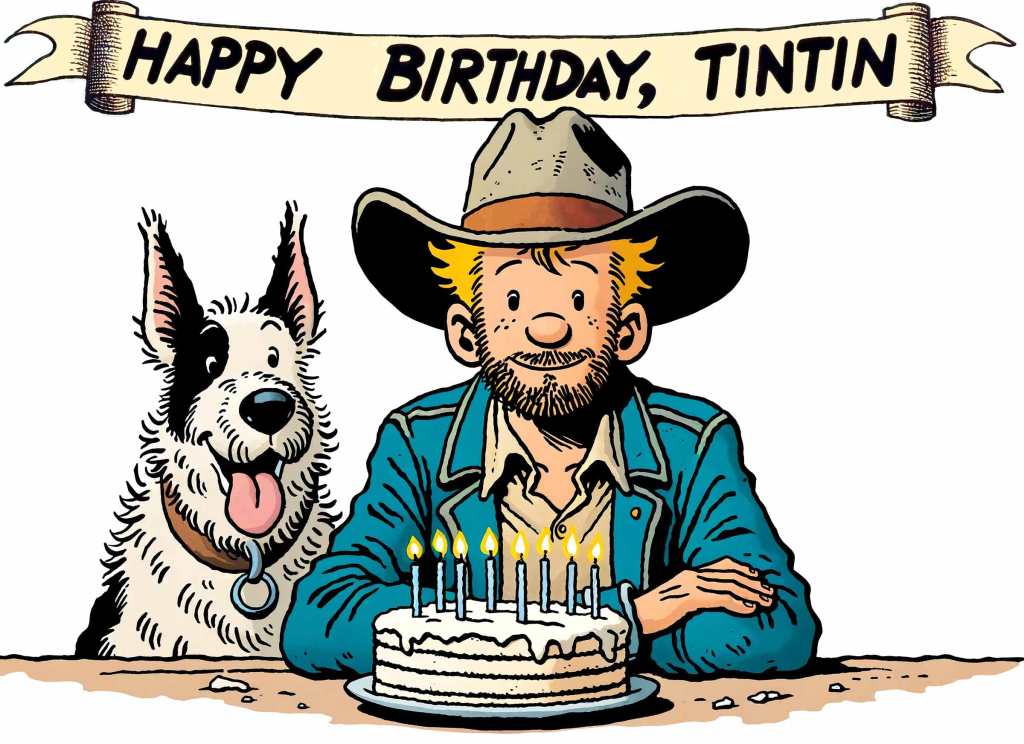
As a kid who always had his head in the clouds, dreaming of airplanes, rockets, and mysteries that span the globe, Tintin was more than just a comic character to me; he was a gateway to a world of endless adventure. Today, on January 10, 2024, we celebrate an incredible 95 years since Hergé introduced Tintin to the world in 1929, marking a legacy of storytelling that has captivated generations.
From the very first story, “Tintin in the Land of the Soviets,” to the lunar escapades in “Explorers on the Moon,” each comic strip was a window into Hergé’s brilliant mind, filled with foreign intrigue and mysterious plots. As a young aviation enthusiast, I was especially drawn to stories like “Flight 714 to Sydney,” where Tintin’s adventures took to the skies, combining my love for airplanes with the thrill of adventure.
Hergé’s artistry was another aspect that set Tintin apart. His use of clear line style – or “ligne claire” – brought a unique clarity and expressiveness to the comics. The vivid, detailed backgrounds and the carefully researched settings make every panel a delight to explore. The level of detail is astounding, from the intricacies of the rocket in “Destination Moon” to the bustling streets of fictional countries.
The 2011 Steven Spielberg movie “The Adventures of Tintin” was another milestone, bringing these beloved characters to life with stunning 3-D animation and gripping storytelling. The film, for me, is a perfect homage to the original comics, especially with the clever nod to Hergé in the opening scene – a delightful treat for fans. The movie captures the essence of Tintin – the unyielding spirit of adventure, the tight-knit camaraderie, and the sheer fun of delving into a good mystery.
Tintin’s stories are timeless. They transcend generations, appealing to the sense of wonder in all of us. Whether uncovering ancient artifacts in “The Seven Crystal Balls” or foiling sinister plots in “The Blue Lotus,” each adventure is a testament to Hergé’s genius in storytelling and art.
As we celebrate 95 years of Tintin, I can’t help but wish for another 95 years of his adventures. Tintin has been more than just a character in a comic book for me; he’s been a companion in my own adventures, a symbol of curiosity and the relentless pursuit of truth and justice.
Here’s to Tintin, the quintessential adventurer, and the countless hours of delightful escapism he has provided. May his stories continue to inspire and entertain for many more years to come.
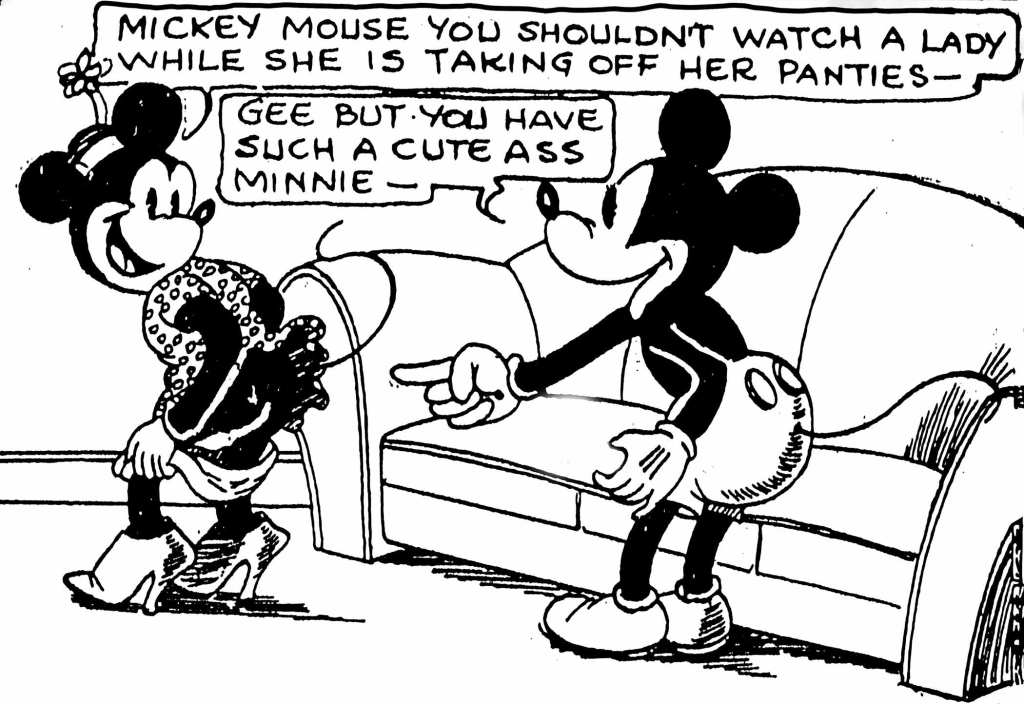
Even in the 1930s, this copyright-violating Tijuana Bible relied upon established Disney branding to make its vulgar humor effective.
In the grand artistic and cultural evolution scheme, the 1928 versions of Mickey and Minnie Mouse entering the public domain seem significant. However, upon closer examination, it becomes apparent that this transition is unlikely to have the revolutionary impact that some anticipate.
To understand why, we need only look at the history of how creativity has interacted with public domain characters, particularly in the case of dinosaurs.
First, let’s address the primary concern: will Mickey and Minnie’s entry into the public domain unleash a wave of creative and innovative reinterpretations? The short answer is probably not. While it’s true that making these characters freely available for use could, in theory, lead to a surge of outsider creativity, the reality is often quite different. The case of dinosaurs in creative media serves as an instructive example.
Dinosaurs, those magnificent creatures that have captured the imagination of generations, have long been a part of the public domain. Anyone can create a dinosaur-based story, film, or art piece without worrying about copyright infringement.
Yet, despite this freedom, most dinosaur-related content has been, to put it mildly, less than inspiring. Sure, there have been a few standout exceptions, but for the most part, the creative use of dinosaurs has been limited to formulaic storylines and stereotypical representations. Why? Because creativity isn’t just about having access to characters or concepts; it’s about what you do with them.
This brings us back to Mickey and Minnie. These characters are deeply ingrained in the cultural fabric and are closely associated with the Disney brand. While they will be available for public use, it’s unlikely that many creators will venture far from the established portrayals.
Even shocking portrayals will depend on this framing.
The characters carry a legacy and a set of expectations that most creators are likely to adhere to, consciously or not. Moreover, Disney still holds the rights to the later versions of these characters, which means that while the 1928 incarnations are fair game, anything that deviates too significantly from that early depiction could still be subject to copyright claims.
Furthermore, the public’s reception of new takes on these iconic characters is another factor to consider. Audiences have a deep-rooted perception of who Mickey and Minnie are, and drastic deviations from this might not be well-received. This creates a natural barrier to creativity, as creators often aim to produce work that resonates with audiences.
The example of dinosaurs in the creative world illustrates this point clearly. Just as the unrestricted use of dinosaurs hasn’t led to a significant outpouring of innovative content, the same will likely be true for these beloved Disney characters.
So, for those worrying about the potential implications of this event, there’s likely no cause for alarm. The legacy of Mickey and Minnie Mouse, as shaped by Disney, will continue to dominate our cultural understanding of these characters, regardless of their public domain status.
During a discussion about poetry way back in a high school English class, some kid lamented that few poets other than Rod McKuen — I told you this was way back — made a living writing the stuff.
Our teacher, however, disagreed, and pointed out that plenty of folks, including McKuen, make a comfortable living writing poetry as song lyrics. What then followed was a fascinating discussion of song lyrics through the years.
What also followed was my first taste of the bad American tendency to enjoy disparaging successful people. More than a few of my classmates had already formed opinions that McKuen was a hack, a purveyor of kitsch, and a populist phony. I lacked the courage to ask them how McKuen was any different from the Beatles.
Over the years, I’ve often recalled that day at Jefferson High School when encountering a particularly good song lyric. Like just a few days ago when Apple Music played on past my KDP Rodeo Days playlist and treated me to “I Don’t Feel That Way Anymore” by Danni Leigh.
I love these lyrics. . .
Well, I’d love to take my clothes off and throw them on your floor. And I would, but I don’t feel that way anymore.
How about you? Have you discovered any lyrics lately that you like?
I love the turn of phrases in “I Don’t Feel That Way Anymore.”
Television has seen only a few theme songs that have excited viewers and encapsulated the essence of the shows they introduce. Paul Sawtell’s composition for the series “Voyage to the Bottom of the Sea” stands out as a masterstroke, and here’s why.
From the first haunting sonar pings of the main title, listeners are instantly transported to the vast and mysterious realms of the ocean. This isn’t just any ocean but one filled with intrigue, danger, and grandeur. Sawtell’s theme is a siren song, drawing us deep into the depths of the story before the actors even have a chance to say their lines.
But the end credits truly crescendo into something magnificent. With a sweeping dance of deep brass and soaring strings, there’s a feeling of culmination, like returning from an epic voyage. It paints an audioscape of sea monsters, heroic submariners, glimmering treasures, and shadowy threats. The grandeur of these compositions makes one think of oceanic sagas from eras long past.
Unfortunately, the series’ scripts didn’t always rise to the lofty standards set by this stirring music. But Sawtell’s gift to “Voyage to the Bottom of the Sea” is unassailable. While storylines may falter, music can remain timeless, and Sawtell’s theme stands as a testament to this – echoing through the annals of television history as one of the best.
But it was Katey Sagal as Gemma Teller Morrow who grabbed me by the scruff of my neck and wouldn’t let go. Hollywood’s got its stars, sure. People rave about Anthony Hopkins, can’t stop talking about Meryl Streep.
Now, I’m no Roger Ebert, but Katey Sagal? Right up there. No bullshit.
You see Hopkins as Hannibal Lecter, it’s chills down your spine, no two ways about it.
Meryl Streep? She could make reading the phonebook Oscar material.
Then you got Katey Sagal, the rock ’n’ roll backbone of “Sons of Anarchy,” the thread stitching together this sprawling saga of an outlaw motorcycle club into a tsunami of women’s viewpoints worthy of Douglas Sirk.
Every time Sagal steps into a scene, you can’t take your eyes off her. She doesn’t act; she lives Gemma. She’s the fuel, the fire, the smoke, and the ash.
Here’s the kicker: It took me a solid 15 minutes to realize this is the same woman who played Peg Bundy in “Married… With Children.”
Talk about range. From a ditzy, shopaholic housewife to the queen bee of an MC? That’s like Michael Jordan nailing baseball after dominating basketball. Gemma’s tough as nails but vulnerable, calculating but human.
Don’t hear what I’m not saying. Hopkins and Streep? Icons. But Katey Sagal, she’s like that scene in Steven Spielberg’s “The Adventures of Tintin” in which the camera pulls back to show Herge as a street artist sketching the film’s CGI Tintin as his 2-D character.
So, here’s the deal. Next time you’re listing the greats, carve out a space for Katey Sagal. She’s the real deal, no question.
If acting were a bar brawl, she’d be the last one standing, wiping the blood off her knuckles, ready for the next round.
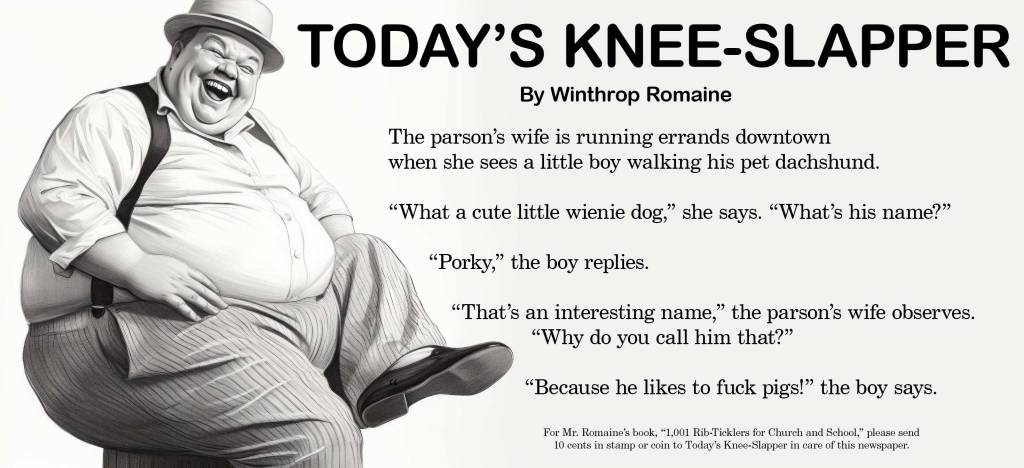
How about something like this for a newspaper’s humor column?
When the highlight of a morning coffee ritual is the bitter aftertaste brought on by the “joke of the day” column in your daily paper, one can’t help but wonder: “When did humor retire and forget to tell the newspapers?”
Joke columns, those tiny blocks of text nestled in the corner of the front page, are a moth-eaten relic from a bygone era — not charming antiques but the stuff of musty basements.
The so-called “jokes” they sputter out have aged worse than a water-damaged Shakespearean folio, and even that would be a more amusing read.
One might argue, “They were funny in 1930!” If you hold this opinion, I’d recommend a thorough reality check, accompanied by a comprehensive sense of humor transplant. These chronically recycled jests’ monotony and predictable punchlines are as engaging as a Kamala Harris word salad.
Worse, these chestnuts make “dad jokes” look like comedic masterpieces.
The brilliance of humor lies in unexpectedness, novel insight, and clever subversion of reality. The comedy peddled by these columns delivers none of this.
We’ve advanced in leaps and bounds in every other field, so why do we settle for subpar humor in our daily dose of news?
Many opportunities have opened up in today’s rapidly evolving technological landscape, especially in storytelling.
I’ve traditionally relied on words to tell stories and painted pictures with linguistic artistry. However, I now find myself captivated by the possibility of an innovative form of storytelling that combines the power of words and the allure of visuals.
I’m thinking about creating a dystopian series.
Why?
First, I enjoy the genre. It’s as simple as that.
Second, part of my affinity for dystopian narratives stems from their popularity, a phenomenon that rivals, or perhaps even surpasses, the cultural fascination with zombie and vampire sagas.
A peculiar allure in dystopian stories captivates audiences on a profound level. These narratives, with their grim yet thought-provoking depictions of the future, are compelling in their ability to entertain and pose crucial questions about society, humanity, and our collective future.
In contrast to the fantastical elements of vampire and zombie lore, the dystopian genre is grounded in a stark, often chilling, potential reality. This potential for plausibility contributes to their widespread appeal and my fascination.
The amalgamation of evocative words and realistic images will only amplify these dystopian tales’ compelling nature.
The advent of Midjourney sparked my imagination. This AI bot offers the ability to create astonishingly realistic imagery, which could be a powerful tool for breathing life into the desolate futures I craft.
The thought of generating visual landscapes to go along with my narratives is exhilarating. I envision a book where the words and images are intertwined, exploring a sorrowful future world. The text would narrate the struggles, while the illustrations would lend actual shape to that narrative.
I’ve already begun experimenting with Midjourney, building a tableau of the future. I’ve included some early idea images.
What are your thoughts about this? It is a hybrid book containing narratives and visuals set in a dystopian future.
Does it resonate with you?
Do you remember Fotonovels? I always liked how they handled dialogue.The range of characters becomes unlimited, thanks to Midjourney. I feel as if I’m casting a movie.



 L.T. Hanlon