Oroville (California) Mercury Register
October 2, 1943
(Scan of newspaper page bottom incomplete.)

Oroville (California) Mercury Register
October 2, 1943
(Scan of newspaper page bottom incomplete.)
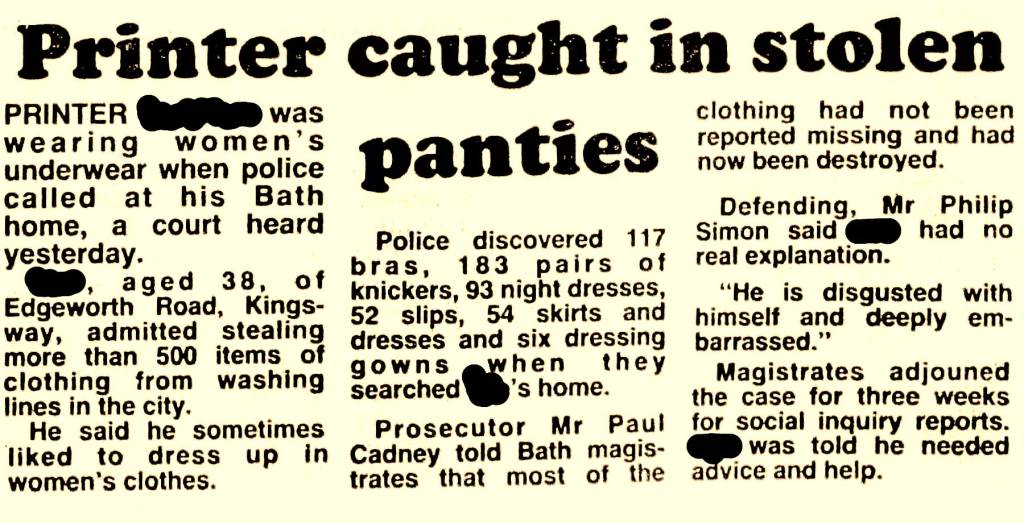
Western Daily Press; Bristol, Avon, England — September 3, 1987
Note that since the alleged perp is a printer by trade, use of Cooper Black as the headline typeface only adds to the man’s humiliation.
The New London (Connecticut) Evening Day — September 2, 1955

The (Scranton) Times-Tribune — August 22, 1956

The Daily Mail consistently refuses to remove British spelling and usage from its content targeting U.S. readers. If the Daily Mail is unwilling to make its publication more accessible to American readers, perhaps it should go all the way and treat us to the full high-tone British experience.
My suggested rewrite follows . . .
Flagler County Sheriff’s Deputy Nick Huzior got whisked off to the ol’ dog and bone, right? Messin’ with fentanyl at a bob standard traffic stop, ‘e did. Them rozzers reckon a mad gust could’ve popped that stuff up ‘is ‘ooter and done ‘im in. Them clever blokes in white coats? They chucked that idea in the ol’ dustbin, said it was complete pony.

Austin American-Statesman — August 4, 1962

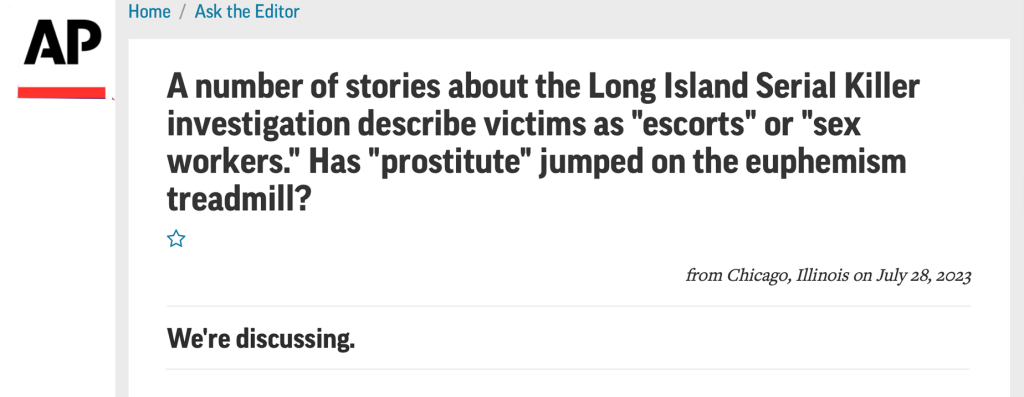
I queried AP Stylebook’s editor a few days ago about whether it’s preferred to discontinue “prostitute” in favor of “sex worker” or “escort.” Below is a screenshot of the response I received today. How do you think the AP should decide?
See my original post on this issue.
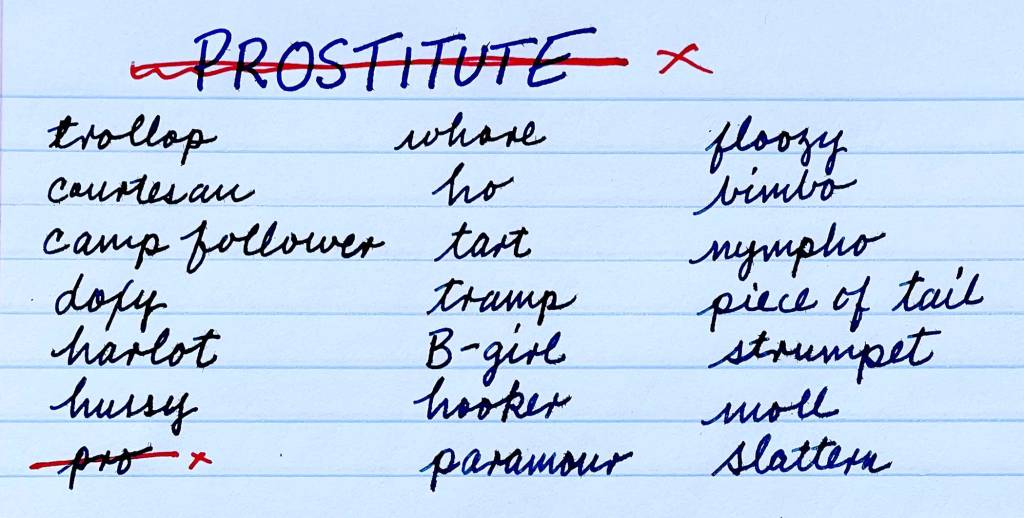
I’ve been noticing something strange in the news lately. Many news stories about the Long Island Serial Killer no longer refer to some victims as prostitutes.
The media’s preferred term is becoming “escort” or “sex worker.”
But why is that? And why should journalists still write “prostitute”?
Forget about being politically correct. Yes, we should usually respect how people want to be identified and avoid using hurtful words.
But let’s be honest: Most prostitutes do it because they are desperate or forced. Saying “escort” or “sex worker” makes it sound like a regular job, which it sure as hell wasn’t for them.
Using the word “prostitute” reminds us of the harsh truth about sex work. It’s a trade in which people are taken advantage of, often in terrible ways. It tells us we must help those caught in this situation.
If we use nicer-sounding words, we forget how serious and urgent this problem is.
So, who wins when we change the words we use?
People who want us to see sex work as just another job like these new words. If we think of sex work as normal and not something terrible, it might help their cause. But that view forgets about all the people forced into prostitution because they’re poor, addicted to drugs, or because someone made them do it.
Also, as a society, we don’t like to face harsh truths. Using nicer words helps us feel better and keep a safe distance from real problems.
But here’s the thing: A journalist’s job is to tell the truth, not make people feel good.
Remember that we shouldn’t use the word “prostitute” in a mean way. The Long Island Serial Killer’s victims were real people with families and friends. Their lives mattered, and they died horribly.
Journalists must recognize the hard truths to tell their stories right and not hide behind more sociable words.
Journalists should keep writing and saying “prostitute” because it shows how bad things are for some people and reminds us we need to help.
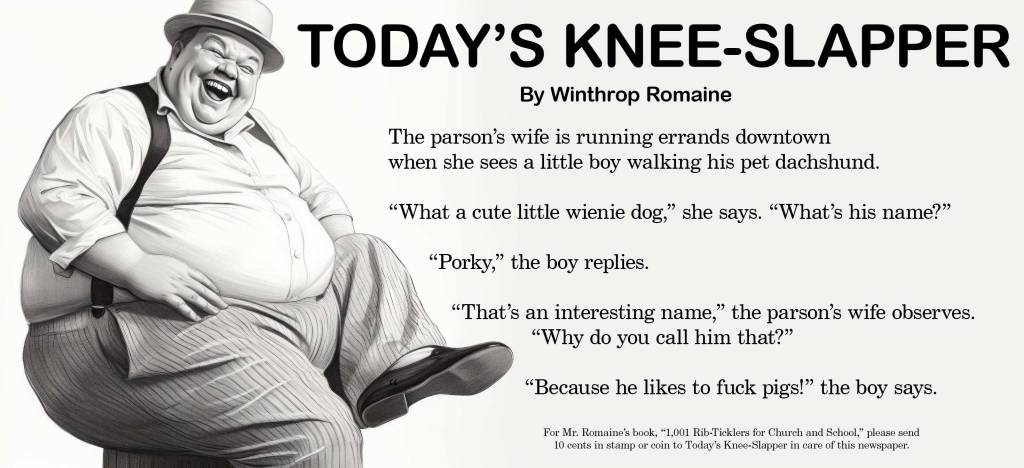
When the highlight of a morning coffee ritual is the bitter aftertaste brought on by the “joke of the day” column in your daily paper, one can’t help but wonder: “When did humor retire and forget to tell the newspapers?”
Joke columns, those tiny blocks of text nestled in the corner of the front page, are a moth-eaten relic from a bygone era — not charming antiques but the stuff of musty basements.
The so-called “jokes” they sputter out have aged worse than a water-damaged Shakespearean folio, and even that would be a more amusing read.
One might argue, “They were funny in 1930!” If you hold this opinion, I’d recommend a thorough reality check, accompanied by a comprehensive sense of humor transplant. These chronically recycled jests’ monotony and predictable punchlines are as engaging as a Kamala Harris word salad.
Worse, these chestnuts make “dad jokes” look like comedic masterpieces.
The brilliance of humor lies in unexpectedness, novel insight, and clever subversion of reality. The comedy peddled by these columns delivers none of this.
We’ve advanced in leaps and bounds in every other field, so why do we settle for subpar humor in our daily dose of news?

In today’s world, many news stories are influenced by personal views or politics. This is a big problem for the news business. Now, Google has made Genesis, an AI bot that writes news. This might be a big step toward information that is fairer.
When we talk about “fair” news, we mean information not influenced by views or politics. Readers should be able to make their thoughts based on the facts. Recently, communication has become more influenced by personal or political beliefs.
AI, like Genesis, has no political or personal views. It doesn’t have feelings that can cause it to be biased like humans. AI uses algorithms to find, sort, and show data. It doesn’t form views.
Genesis can mine many data sources and find, sort, and show it faster and on a larger scale than humans. It can check these sources for facts and make complete, balanced reports without views or slants. This not only means more topics can be covered but also that the points stay true.
However, can pick up biases from the data it uses to learn. For example, if an AI uses a lot of data from one political view, it might show that view in its work. So, the people who make and use AI have a big job to ensure the data is fair and the AI is used correctly.
Also, AI can’t replace human news writers. Genesis is good at finding and showing facts, but humans understand feelings and complex ideas better. The best way forward might be for AI and humans to work together: Genesis can give the points, and humans can provide the meaning and tell the story.
Genesis is a big chance for the news business. News that is just facts could make people trust information again. However, it is essential to remember that AI is a tool, not a magic fix. Making sure news is fair requires hard work and care from those who create and use AI. If we use Genesis correctly, it could start a new time of unbiased news.
If we use AI like Genesis thoughtfully, we could move the news business away from views and back to truth and fairness. In a time where false news and over-dramatic stories have made things unclear, AI could be the guide to help us understand the world fairly and clearly.
 L.T. Hanlon