Finding Barry De Vorzon’s ‘Dillinger’ score on YouTube

Composer Barry De Vorzon infuses “Red River Valley” with an epic, emotional sweep.

Uncovering hidden gems is a thrill that never fades. So, imagine my delight when, during a YouTube rabbit hole expedition, I stumbled upon several music tracks from John Milius’ 1973 film “Dillinger.”

This discovery is a treasure trove not only for its rarity but also for its connection to Barry De Vorzon. His score in this underappreciated movie is a textbook example of musical understanding.

De Vorzon masterfully combines classic tunes with new expository material in “Dillinger,” encapsulating the Gangster Era of the 1930s and blending it seamlessly with Milius’ gritty, unapologetically romantic vision of the outlaw’s life. De Vorzon’s score is an important narrative force, helping Milius capture the tumultuous spirit of the 1930s and the raw, chaotic energy of John Dillinger’s criminal escapades.

The tracks available on YouTube mix adrenaline-pumping compositions with melancholic melodies. Among these, the renditions of “Red River Valley” stand out. This classic tune becomes an emotional anchor in the film, evoking lost innocence, the fading American dream, and the outlaw’s inevitable decline into despair, defeat, and death.

DO YOU WANT TO KNOW MORE?

Listen to De Vorzon’s score.

Read my comments about “Red River Valley.”

Get the “Dillinger” original soundtrack album on eBay.
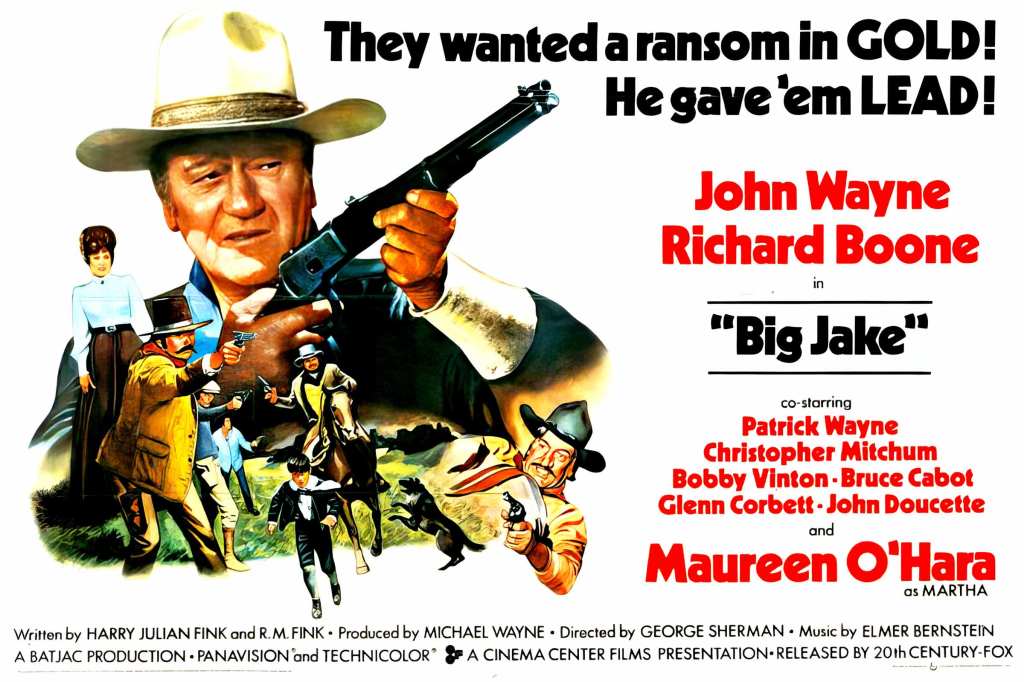
From machete mayhem to timeless tale: Revisiting ‘Big Jake’

Poster for the 1971 John Wayne film "Big Jake."

Having watched “Big Jake” for the first time in more than 50 years, its timeless quality struck me. It’s amazing how this 1971 John Wayne classic could easily pass for a modern production, especially considering its graphic narrative and intense action sequences that resonate with the high-amp shocks we adore in Quentin Tarantino movies.

The film spins a riveting tale of child kidnapping, and it doesn’t shy away from brutality, much like the stylized violence we see today. There’s a particular member of the kidnap gang who wields a machete with chilling fondness. The gruesome fate of the Duke’s dog, not to mention a few unfortunate characters, reflects a brand of violence that’s unsettling precisely because director George Sherman leaves much of the violence to the imagination.

Yet, despite the grim elements, “Big Jake” remains a standout Western, thanks to a powerhouse cast including Richard Boone, Maureen O’Hara, and Patrick Wayne. The movie holds its own, even when you put it side by side with other Westerns of its era like “The Wild Bunch” or “Butch Cassidy and the Sundance Kid.” These films, too, pushed the boundaries of the genre, but “Big Jake” has a unique appeal. Its mix of traditional Western tropes with unexpectedly graphic content gives it a distinctive edge.

It’s fascinating to see how this film anticipated the evolution of cinematic storytelling, embracing a rawness and directness that would become the hallmark of later directors.

In revisiting “Big Jake,” I’ve rekindled memories of the classic Western era and gained a fresh appreciation for its forward-thinking approach to storytelling and visual style.

From red fezzes to screaming goats: The wild world of ‘Law Talk With Mike’

“Law Talk With Mike” takes you on a high-octane, shag-carpet joyride you’ll enjoy every day.

If you haven’t caught “Law Talk With Mike,” you’re missing the fun boat.

Michael J. Gravlin, Chicago’s legal YouTube maestro, turns courtroom Latin into barroom English quicker than you can shout, “Objection!” The show? Think of it as a comedy club where the American justice system is both the joke and the punchline.

“Law Talk With Mike” is one of those YouTube channels you can’t help but binge, like a “Breaking Bad” season, but with less meth and more legal jargon.

Gravlin’s channel features a compilation of proceedings from our nation’s courts. And, boy, does this guy have a knack for keeping the show rolling. Sovereign citizen starts spouting nonsense? Boom! Out comes the red fez. Something bonkers happens? It’s time for the screaming goat toy. Yeah, you heard me right, a screaming goat toy. It’s like a courtroom version of a laugh track, only always on point.

One recent episode — Gravlin titled it “Vaseline!” — had me in stitches. It involved a defendant caught doing something so embarrassing in his car, parked in a CVS lot, it’d make a Kardashian blush. Gravlin tore into the case with the snark you’d expect from a late-night host, only with a law degree.

But here’s the kicker: Gravlin’s not just some talking head. He’s built a community around these online court shenanigans. The guy’s got over 1,400 episodes under his belt and is closing in on 200,000 subscribers. And amid the humor, he provides genuine insight into the legal process in which he’s been involved as a prosecutor and a personal injury and workers’ compensation attorney.

Thanks to Gravlin’s success, he’s helped turn judges, prosecutors, and even serial defendants into minor celebrities. It’s like the Marvel Cinematic Universe, but for people who can’t fly or shoot lasers from their eyes.

The guy’s got a new episode almost every day, sometimes more. So, if you’re tired of the same old reruns and want something that’ll make you laugh, think, and occasionally cringe, do yourself a favor and check out “Law Talk With Mike.”

Trust me, it’s the kind of ride you won’t want to get off.

High school revelation: Lyrics are poetry

During a discussion about poetry way back in a high school English class, some kid lamented that few poets other than Rod McKuen — I told you this was way back — made a living writing the stuff.

Our teacher, however, disagreed, and pointed out that plenty of folks, including McKuen, make a comfortable living writing poetry as song lyrics. What then followed was a fascinating discussion of song lyrics through the years.

What also followed was my first taste of the bad American tendency to enjoy disparaging successful people. More than a few of my classmates had already formed opinions that McKuen was a hack, a purveyor of kitsch, and a populist phony. I lacked the courage to ask them how McKuen was any different from the Beatles.

Over the years, I’ve often recalled that day at Jefferson High School when encountering a particularly good song lyric. Like just a few days ago when Apple Music played on past my KDP Rodeo Days playlist and treated me to “I Don’t Feel That Way Anymore” by Danni Leigh.

I love these lyrics. . .

Well, I’d love to take my clothes off
and throw them on your floor.
And I would,
but I don’t feel that way anymore.

How about you? Have you discovered any lyrics lately that you like?

I love the turn of phrases in “I Don’t Feel That Way Anymore.”

Predictable patterns: How AI holds a mirror to our universal storytelling

Calvin and Hobbes comic strip in which Calvin defends creating generic snowmen.
Did Bill Watterson have Calvin predict the coming of AI-created content?

It’s an age-old debate in art and creativity: what is true originality? Every artist has tapped into universal themes, stereotypes, and structures that resonate with audiences, from Shakespeare to Spielberg. As we dive into the 21st century, a new contender has entered the arena—Artificial Intelligence. As writers and creators turn to AI for inspiration and even content generation, skeptics raise eyebrows. But is there really much difference between human-generated clichés and those constructed by algorithms?

Let’s consider popular genres.

Despite the studio, superhero movies often orbit around a protagonist with a tragic backstory, a formidable antagonist, a colossal battle, and a resolution.

Similarly, romance novels are interwoven with familiar tropes: enemies to lovers, hidden royalty, or the classic will-they-or-won’t-they.

Spy thrillers? A charismatic lead, global stakes, high-octane chase sequences, double agents, and plot twists.

Sounds formulaic? That’s because it is.

And it’s not just limited to literature and film. Pop songs have their share of predictable patterns. Inevitably using Auto-Tune, sometimes called the “Cher effect,” gives vocals a distinct robotic sound.

And can we ever have enough of the word “baby” in our love songs? A college instructor told us that if we ever wanted to know how “baby” is overused in song lyrics, substitute the words “boat dock.” She was joking, but now, 50 years later, I still hear . . .

“Be My Boat Dock”
“Boat Dock Love”
“Love to Love You Boat Dock”

. . . well, you get the idea.

What we’re encountering isn’t a deficit of originality but a reflection of our collective consciousness — a set of stories, beats, and patterns that resonate universally. If these patterns are deeply embedded, why shouldn’t an AI designed to recognize and emulate patterns produce something similar?

AI’s ability to create isn’t about replacing human ingenuity. It’s about acknowledging that much of what we consume and call “original” is often derived from age-old patterns. If a machine can replicate those patterns, it doesn’t demean our art — it merely reflects our preferences.

To dismiss AI-generated content as “unoriginal” means confronting an uncomfortable reality about our tastes and patterns.

Instead of shunning silicon assistance, it may be time we embrace it. After all, whether it’s Shakespeare, Spielberg, or an AI, aren’t we all just looking for a good story?

By the way, that “Calvin and Hobbes” strip was shared with me many years ago by a famous comics artist. We got a good laugh of it — but I doubt either of us predicted AI’s coming impact.

Hitler, a cat, and the allure of deceptive beauty

Frames taken from "Triumph of the Will" appear to show Hitler and a cat looking at each other."
Adolf Hitler and a cat exchange glances before the Nuremberg Rally.

Several years ago, I went to a film party held at a friend’s big-ass house in, of all places, the Lincoln Square neighborhood. The hood was once heavily German, an irony that will be apparent shortly.

The crowd was a motley crew of film students, history buffs, and just plain hangers-on. I wound up there because I’d had dinner with friends who knew about the party and dragged me along.

The first few films at the event were funny World War II-era shorts, many requiring a trigger-warning disclaimer today but still riotously funny. I’m talking stuff like Looney Tunes’ “Tokio Jokio,” Paramount’s Superman cartoon “Japoteurs,” and then British intelligence’s “The Lambeth Walk: Nazi Style.”

Right after the Teutonic “Lambeth Walk” came the film that had provided its inspiration: Leni Riefenstahl’s “Triumph of the Will.” On the surface? A propaganda machine oiled and prepped by the Nazis.

But dive deeper, and you’ll see the sinister craftsmanship — the kind that seduces you with visuals, as tempting as a fresh streuselkuchen straight out of a Berlin bakery.

Artistic? Sure. George Lucas thought so, snatched that Nuremberg Rally three-person strut for “Star Wars” (1977). Brian De Palma? He nabbed it for “Mission to Mars” (2000). Tinsel Town got its claws on Riefenstahl’s shots a long time ago.

Yet, here’s the deal: No one’s lauding the message, just acknowledging the craft. Is it kosher to admire a snake’s beauty, knowing it can bite?

This post came about because I’ve finished reading “Leni Riefenstahl: The Seduction of Genius” by Rainer Rother, which prompted me to watch “Triumph of the Will” again.

My favorite scene? The one where Hitler looks up from his motorcade Mercedes-Benz and locks eyes with a cat. The cat’s perched at a window beside a swastika flag, taking in the show. A moment of serendipity in a film otherwise dense with choreography. Those eyes, Hitler’s and the cat’s, a dance of curiosity in a world on the cusp of darkness.

But I’ll be clear: Nazis? They’re the storm cloud in every silver lining. Admiring Riefenstahl’s work isn’t a salute to them. It’s a nod to a filmmaker’s ability to make evil look good, a reminder always to question what we see.

FOR MORE INFORMATION

“Triumph of the Will” analysis.

The real “Lambeth Walk” from “Me and My Girl.”

Getting small with ‘Gen V’: This spinoff’s worth the ride

In the new series "Gen V," Lizze Broadway portrays Emma "Little Cricket" Meyer, whose superpower is throwing up and then shrinking down. Here, she climbs out from under a plate of mixed vegetables.
Lizze Broadway’s scenes bring back fond memories of Irwin Allen’s “Land of the Giants.”

Having recently dived into “Gen V,” a fascinating spinoff of “The Boys,” I’ve been taken by its gripping portrayal of young superhumans in the hallowed halls of Godolkin University.

This isn’t your typical college drama. At Godolkin, where elite superhumans are molded, students must not only grapple with the challenges of young adulthood but also confront the malicious presence lurking right beneath them.

Drawing parallels to the ominous likes of Dolores Umbridge and the formidable Miranda Priestly, the director of the clandestine lab beneath the university grounds masterfully sets the tone for intrigue and suspense. As viewers, we’re drawn into the complex web of power dynamics, ethics, and the often-blurred lines between right and wrong.

Speaking of characters, Emma “Little Cricket” Meyer has undoubtedly caught my attention. Portrayed with depth and nuance by Lizze Broadway, Cricket’s ability to shrink herself by inducing bulimic episodes isn’t merely a party trick. It’s a poignant commentary on young women’s pressure and the lengths they may go to fit into society’s mold.

A stunning effects sequence showcases Cricket’s daring venture into the university’s underground lab to help free a young man being tortured there. This scene makes me yearn for a modern-day reboot of Irwin Allen’s “Land of the Giants.”

However, it’s not all praise for “Gen V.”

As visually captivating and plot-rich as the series is, it sometimes overindulges. I always appreciate the artistry of effects and storytelling, but some moments — like a sex scene with Cricket I won’t describe — could be toned down or eliminated without sacrificing the series’ essence.

While the superhuman college drama offers a mostly fresh perspective, the underlying teen angst is already trying my patience. I like “Gen V” for what it is, but given the looming melodrama, I wonder how long I’ll stay loyal to the series.

“Gen V” brilliantly explores the world of young superhumans and presents a delightful mix of suspense, emotion, dark comedy, social commentary, and visual spectacle. It’s undoubtedly worth watching, especially if you love “The Boys.”

You’ll really eat up ‘The Stuff,’ a classic sci-fi comedy

Michael Moriarty opens his mouth as wide as a salad plate in "The Stuff," a comedy sci-fi film made in 1985.
Michael Moriarty demonstrates how big earthlings’ mouths get when they’re controlled by The Stuff, an extraterrestial goo masquerading as a frozen dessert. Watch “The Stuff” free on YouTube.

After many years, I rewatched “The Stuff,” a 1985 flick by Larry Cohen.

Man, what a ride!

Started with a bubbling, gooey substance oozing from the earth. People taste it. Big mistake, but hey, it’s delicious — and they’re hooked. It’s dessert, it’s a lifestyle, it’s an addiction. Everyone’s gobbling it up.

Enter a corporate saboteur, a young boy, and a disgraced FBI agent played with gusto by Michael Moriarty. Odd trio, but they’re onto the deadly secret of The Stuff. They’ve got to stop its rampage and the clock’s ticking.

Cohen’s direction? Genius. This isn’t your run-of-the-mill horror; it’s a satire. Think about consumerism, 1980s corporate greed, and the junk we feed on, literally and metaphorically.

Subtle? Hell no. Fun? You bet your ass.

Laughs and screams intertwine. The practical effects are pure ’80s charm. Watch folks get devoured by tasty white goo, and tell me you don’t chuckle and cringe simultaneously.

So, if you’re yearning for something different on your screen, this flick’s your ticket.

You’ll never look at dessert the same way again.

‘Voyage to the Bottom of the Sea’ has the best TV theme music

Television has seen only a few theme songs that have excited viewers and encapsulated the essence of the shows they introduce. Paul Sawtell’s composition for the series “Voyage to the Bottom of the Sea” stands out as a masterstroke, and here’s why.

From the first haunting sonar pings of the main title, listeners are instantly transported to the vast and mysterious realms of the ocean. This isn’t just any ocean but one filled with intrigue, danger, and grandeur. Sawtell’s theme is a siren song, drawing us deep into the depths of the story before the actors even have a chance to say their lines.

But the end credits truly crescendo into something magnificent. With a sweeping dance of deep brass and soaring strings, there’s a feeling of culmination, like returning from an epic voyage. It paints an audioscape of sea monsters, heroic submariners, glimmering treasures, and shadowy threats. The grandeur of these compositions makes one think of oceanic sagas from eras long past.

Unfortunately, the series’ scripts didn’t always rise to the lofty standards set by this stirring music. But Sawtell’s gift to “Voyage to the Bottom of the Sea” is unassailable. While storylines may falter, music can remain timeless, and Sawtell’s theme stands as a testament to this – echoing through the annals of television history as one of the best.

Did ‘Back to the Future’ predict 9/11?

You’ll be blown away by this one. Could it be that there are no coincidences?

Here’s the deal. I stumbled on this video, right? Puts “Back to the Future” and the September 11 attacks in the same sentence. Sounds like mixing apple pie and motor oil, doesn’t it? But bear with me.

First off, Marty McFly. Guy’s a regular teen with a crappy family and a DeLorean. He gets into a time machine and aims to fix his life. We’ve all seen the flick.

It’s Americana wrapped in Spielberg, a rollercoaster of a movie. But put it next to one of America’s most tragic days, and your brain starts doing somersaults.

This video claims all these “hints” and “clues” peppered throughout the film point to 9/11. I’m talking about clocks, license plates, scenes that should be viewed upside-down, and even lines of dialogue. Makes you think Marty should’ve been more worried about a national catastrophe than his parents’ lame love story.

So I watched it.

Once.

Twice.

Then, a third time after eating half a bag of kratom gummies because, hey, why not?

And I had a full-tilt freakout. Not because I bought into it but because someone sat down and stitched this wild quilt of conspiracy. Like taking pieces of a Picasso and a Pollock and saying they tell the same tale.

I’m not the tinfoil hat type. There are no alien abductions or Bigfoot sightings in my book. But this? It’s like when you’re three sheets to the wind, and someone starts talking politics — you listen but don’t buy the T-shirt.

So, watch the video, then let me know whether Marty McFly could’ve, would’ve, should’ve warned us about 9/11.