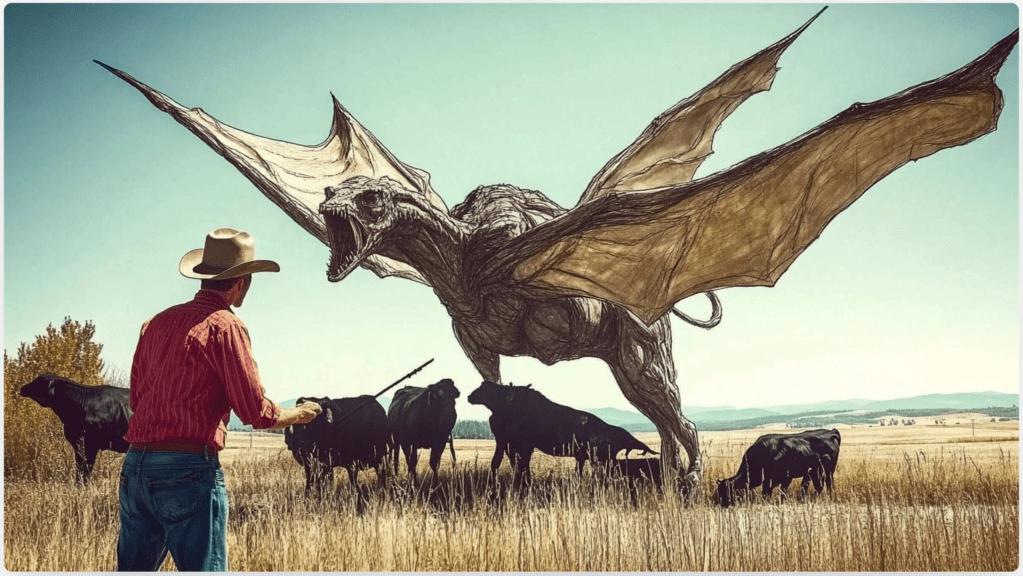
A fun feature of Midjourney is that even when it misses the mark, its efforts can be valuable for other projects. The image above seems to show how the famed “thunderbird” might have terrorized ranchers — and could find use in a Weird West idea I’m developing. For the record, here’s the prompt that generated this image…
Generate a primitive, hastily completed doodle sketch that a cowboy under hypnosis might create to illustrate seeing cattle abducted by extraterrestrials. Despite being an amateurishly created drawing, the images should look scary. This drawing should be shown on a ruled sheet of three-hole notebook paper. –ar 16:9 –v 6.1 –stylize 0 –weird 600
I’m impressed by how Udio helped me create “8-Second Secrets.”
I recently dug into Udio, an AI songwriting assistant garnering attention in the music tech community.
Udio is part of a new wave of tools designed to provide music and lyrics based on simple input. It’s praised for its ability to quickly generate music that captures the essence of a user’s initial ideas.
While Udio can craft lyrics and melodies, inputting my lyrics provides better results. This connection to the song’s emotional core and Udio’s strong music composition capabilities enhance my creative process.
Recently, I applied this approach to a new country track, “8-Second Secrets.” The results were astonishingly quick; within minutes, Udio provided a promising musical sketch based on my lyrics.
The result, while still in its nascent stages, is impressive. It’s rough around the edges, but the speed and ease with which Udio turned my written words into a palpable musical piece were nothing short of astonishing.
For musicians, whether seasoned or novice, integrating AI tools like Udio can ignite a spark of creativity and open up a world of possibilities. It’s about finding the perfect harmony between human creativity and technological assistance, and for me, Udio strikes that balance beautifully.
As a longtime New York Times subscriber, I appreciate the depth and breadth of its content, particularly the extensive online archives dating from 1851, and its coverage of arts, entertainment, and international news.
Yet, I’ve grappled with the paper’s editorial stance, particularly its approach to domestic news, which I perceive as being distinctly elitist and favoring a progressive, globalist viewpoint.
The Times’ appointment of Zach Seward as Editorial Director of A.I. Initiatives marks a significant step toward integrating generative AI into journalism.
Seward, with his impressive background as a founding editor of Quartz and a stint at The Wall Street Journal, is set to lead a small team focusing on the application of AI in news reporting. His role includes establishing principles for using generative AI in the newsroom and ensuring that The Times’ journalism continues to be reported, written, and edited by human journalists while AI tools assist them in their work.
This development brings to the forefront an intriguing proposition: Could AI play a role in addressing biases in reporting?
For instance, employing AI in copy editing might introduce a level of objectivity that I feel is sometimes missing in The Times’ reporting.
If configured to uphold impartiality, an AI-driven copy desk could potentially mitigate the paper’s perceived bias toward progressive viewpoints and its narrative on climate change and social disparities. This approach might balance the editorial tone, addressing concerns like mine about the paper’s leaning.
In conclusion, while The Times remains a valuable source for its archival content and global reporting, its foray into AI under Seward’s leadership presents an opportunity to explore new frontiers in journalism.
Perhaps, with careful implementation, AI can bring a fresh perspective to the newsroom, potentially addressing longstanding concerns about bias in media reporting.
As I’ve been experimenting with AI-assisted writing and editing, I’ve been thinking about how it will shake up the world of work and make many jobs go the way of the dodo.
He says the disruption’s coming fast. Faster than the industrial or digital revolutions. Jobs? Poof. Gone. But he isn’t all doom and gloom. He says it’s not just about handing out universal basic income like Halloween candy. People need agency, a reason to get up in the morning.
Altman’s way with words impresses me. He says humans find “great satisfaction in doing something useful,” something that lets us “add something back to the trajectory of the species.” What a great way to describe that need and feeling most of us share.
But what jobs are already circling the drain? Cashiers? We already have machines for that. Truck drivers? Self-driving semis are on the horizon. Writers and editors? You’re reading AI-generated stories all over the place.
What about bartenders? Can you imagine a robot listening to your troubles or cutting you off when you’ve had one too many? Some jobs need the human touch. But others? Sayonara.
Is it all happening too fast? Hard to say. But one thing’s sure: We can’t cram this genie back in the bottle. We’re on this rollercoaster, and there’s no getting off. So, what’s the plan? Retrain? Find new gigs? Or do we just sit back on our lazy asses and let the machines take the wheel?
Altman’s right: We won’t run out of stuff to do. Humans are restless. We always have been. But must we eternally labor, always sing for our supper? Maybe not. But we’ll find new ways to contribute, to matter. We’re built that way.
I wish I weren’t clocking in at 70. I’m sliding down the far end of the bell curve and won’t be around to see AI’s full Monty. But for those who will, buckle up. It’s going to be one hell of a ride.
Adobe Firefly Image 2 beta (left) and Midjourney 5.2 conjure up some cowboys.
The fusion of technology and artistry is continually evolving in the dynamic realm of AI-driven image generation. As someone who’s been embedded in the world of digital imagery, I was eager to see how Adobe Firefly Image 2 Beta squares off against its competitor, Midjourney 5.2, in generating photorealistic images from a textual cue.
I gave the same prompt to both AI tools:
Two 30-year-old white, male scruffy cowboys hold beer cans as they lean against a brick wall outside a small-town bar. It’s night, it’s raining, and they’re kept dry by a small overhang at the bar’s entrance. A red neon sign reads “Cattlemen’s Club.” Technicolor Anamorphic Panavision.
The outcomes, however, varied significantly. I chose the best of several images created by each chatbot.
To begin, neither chatbot managed to create the “Cattlemen’s Club” neon, each failed to have the guys holding cans, and Midjourney ignored the brick wall request.
Let’s talk about the winner first.
To the right, Midjourney’s rendition is nothing short of cinematic. This isn’t just an image; it’s a narrative. The atmospheric depth suggests multiple tales — from intense crime capers to heartwarming Hallmark moments. And the cowboys? Their faces are canvases, each conveying a story, making them irresistible whether they’re your knight in shining armor or just a night of careless passion.
Now, let’s shift our gaze to the left.
Despite its reputable lineage, Adobe’s Firefly Image 2 Beta presents an image reminiscent of a low-budget TV show. The lighting is overly bright, missing the nuance and depth that makes for compelling imagery. And our cowboy duo? Sure, they’re probably nice guys, but nice guys finish last.
However, Firefly’s modus operandi deserves mention. The AI’s user-friendly interface allows minimal prompting and offers menu options to tweak artistic style, background focus, lighting, and more. It’s possible I leaned too heavily on the textual prompt and didn’t dig deep enough into these refining features.
While Midjourney 5.2 took the lead this time, the AI imagery frontier remains vast and uncharted. Firefly’s track record in Photoshop, from skillfully replacing skies to completing fragmented elements, is undeniable. So, I’m optimistic about its future iterations.
Competition fosters innovation. As these AI tools lock horns and evolve, the creative community and consumers stand to benefit the most.
Did Bill Watterson have Calvin predict the coming of AI-created content?
It’s an age-old debate in art and creativity: what is true originality? Every artist has tapped into universal themes, stereotypes, and structures that resonate with audiences, from Shakespeare to Spielberg. As we dive into the 21st century, a new contender has entered the arena—Artificial Intelligence. As writers and creators turn to AI for inspiration and even content generation, skeptics raise eyebrows. But is there really much difference between human-generated clichés and those constructed by algorithms?
Let’s consider popular genres.
Despite the studio, superhero movies often orbit around a protagonist with a tragic backstory, a formidable antagonist, a colossal battle, and a resolution.
Similarly, romance novels are interwoven with familiar tropes: enemies to lovers, hidden royalty, or the classic will-they-or-won’t-they.
Spy thrillers? A charismatic lead, global stakes, high-octane chase sequences, double agents, and plot twists.
Sounds formulaic? That’s because it is.
And it’s not just limited to literature and film. Pop songs have their share of predictable patterns. Inevitably using Auto-Tune, sometimes called the “Cher effect,” gives vocals a distinct robotic sound.
And can we ever have enough of the word “baby” in our love songs? A college instructor told us that if we ever wanted to know how “baby” is overused in song lyrics, substitute the words “boat dock.” She was joking, but now, 50 years later, I still hear . . .
“Be My Boat Dock” “Boat Dock Love” “Love to Love You Boat Dock”
. . . well, you get the idea.
What we’re encountering isn’t a deficit of originality but a reflection of our collective consciousness — a set of stories, beats, and patterns that resonate universally. If these patterns are deeply embedded, why shouldn’t an AI designed to recognize and emulate patterns produce something similar?
AI’s ability to create isn’t about replacing human ingenuity. It’s about acknowledging that much of what we consume and call “original” is often derived from age-old patterns. If a machine can replicate those patterns, it doesn’t demean our art — it merely reflects our preferences.
To dismiss AI-generated content as “unoriginal” means confronting an uncomfortable reality about our tastes and patterns.
Instead of shunning silicon assistance, it may be time we embrace it. After all, whether it’s Shakespeare, Spielberg, or an AI, aren’t we all just looking for a good story?
By the way, that “Calvin and Hobbes” strip was shared with me many years ago by a famous comics artist. We got a good laugh of it — but I doubt either of us predicted AI’s coming impact.
Integrating artificial intelligence into writing and illustration projects has seen its fair share of contention.
Yet, when done judiciously, AI can significantly enhance these creative processes. Embracing AI in my writing and illustration projects is not about relinquishing my creativity but rather about harnessing tools that make that creativity sharper, more refined, and more impactful.
To understand my viewpoint, it’s vital to realize that, historically, writers and illustrators have always sought aids and tools to improve their work.
The progression has been relentless, from the quill pen to modern-day word processors. AI is just another step on this evolutionary ladder.
Is it wrong for machines to relieve us of complex tasks? Is it unethical to set a DSLR to the automatic setting, that little green square that tells the camera to adjust exposure and focus automatically?
Of course not. That green square upholds photographers’ creativity, helping them quickly achieve their vision.
Sometimes, tools, whether human or AI, are needed to refine and enhance our initial creative bursts.
For years, I worked as a copy editor, enhancing and sometimes heavily revising the work of others, many of whom struggled profoundly with the art of writing. Nobody whined about the ethical implications of my input or its impact on the originality of the content. So, why the outcry when silicon does the job?
The era of AI isn’t about the machine surpassing us but about us working hand in hand with technology.
Whether a human tool or a silicon-based one, the goal remains unchanged: to improve and refine my creative expressions.
Let’s embrace AI not as a threat but as an ally in our continual pursuit of excellence in writing and illustration.
I don’t always ride Google’s search engine. (Midjourney synthagraph)
All right, folks, let’s chat. The U.S. Department of Justice has gone after Google with antitrust charges — and honestly, it’s got many of us shaking our heads. Let’s break down what’s going on.
First off, Google isn’t stealing cookies from the cookie jar. They’re spending big bucks, fair and square, to have that sweet spot on our browsers. And guess what? The folks who own those browsers? They’re not forced to sell that spot to Google. They’re choosing to because it’s good business. If some other search engine wanted to fork out the cash, they could have that spot, too.
Now, let’s talk about search results. Yeah, I admit, I use Google. Why? Because for a ton of my searches, they’re just plain better.
But I’m also a fan of underdogs. Bing? They’ve surprised me more than once with top-notch results. And DuckDuckGo? It’s a great way to guard your privacy.
Google isn’t some sinister monopoly; it’s about getting the best bang for your click.
But here’s the rub: whenever someone does well in America, a line of folks is waiting to knock them down a peg.
Remember when Google was a scrappy startup? Where were AltaVista, Magellan, and HotBot when Google was on the rise? Oh, right, they got outpaced.
Think about our homegrown heroes – Amazon, SpaceX, eBay, Tesla, Microsoft, Apple. None got a free pass to the top. They clawed their way up, took risks, and made it big. And now? They’re household names.
Instead of applauding folks who make it big, we’re waiting to tear them down. What’s next? Will we make everyone play on the same level, even if they’re not bringing the same game?



 L.T. Hanlon