Midjourney’s magic: Is AI the future of book covers?

A Photorealistic image created by Midjourney shows a cowboy kissing his sweetheart during an evening rain.
Midjourney created this evocative cover for a Western romance novel I’m percolating.

The wonders of AI keep unveiling themselves — most recently, as photorealistic images.

I am astounded.

I’ve been test-driving a new AI program called Midjourney. It can create infinite images, including uncannily lifelike, detailed, photorealistic images from descriptive text.

Last night, in nostalgia for Western romance novels, I tested Midjourney. I prompted: “A young cowboy kisses his sweetheart during an evening rainstorm.” A simple, evocative. I clicked the generate button and prepared for a laughable, cartoonish result.

When the image popped up on my screen, I was speechless.

It was a sight to behold. The image showed a rugged cowboy, complete with a hat, locked in a passionate embrace with his sweetheart. The couple was about to kiss as they stood in the warm glow of a rainy western street. The light from nearby windows reflected off their clothing, creating a surreal, dreamy atmosphere. It was tender, raw, and powerful.

It was so real and vivid that I had to remind myself that no artist’s hand had touched this piece. It was pure AI, Midjourney flexing its silicon muscles to breathe life into a simple string of words.

To say I was pleased would be a gross understatement. I was dumbfounded, thrilled, and utterly captivated. Midjourney’s image wasn’t just photorealistic; it told a story. It captured the moment’s essence, making me feel like I was peering into a novel myself.

Now, I’m left with this burning question: Could this image make it to the big time? Could it stand shoulder to shoulder with professionally photographed book covers? Could it grip a potential reader’s imagination and entice them into the wild, passionate world of a Western romance novel?

I am leaning towards yes. What do you think?

Maximize YouTube learning with Field Notes

Photo of an opened Field Note notebook feature notations I wrote while watching YouTube videos.
Recent notes I took while watching YouTube videos.

It was just another ordinary day in 2022 when I chanced upon the intriguing idea of keeping a small notebook while binge-watching YouTube videos.

What began as a whim transformed over time into a beneficial habit that would change how I consumed and processed online content.

Today, friends, I want to share the unexpected advantages of this journey, taken side by side with my trusty, pocket-sized partner — a Field Notes notebook.

Take a moment to look at the illustration – it’s my most recent YouTube session, distilled into the pages of my Field Notes. The brand deserves a special shout-out here. With their rustic charm, durable build, and perfect pocket size, Field Notes has been an ideal companion in my writing adventures everywhere.

Now, about my notes: I’ve developed the habit of numbering each one. The first note might encapsulate a gut-busting joke, the second an intriguing piece of trivia, while the third could enshrine an eloquent quote for future dinner table conversations.

This technique has turned my YouTube viewing into an active rather than passive experience in the past year. My ability to connect the dots between different ideas from various videos has significantly improved.

And here’s the great part: I’ve amassed over 3,000 entries.

Every numbered note is a beacon of my engagement, each leading me back to a moment of knowledge or laughter. These entries archive my online explorations, serving as conversation starters, sparks of inspiration, and sources of amusement.

In my daydreams, I think of myself as a digital-age Samuel Pepys, chronicling my everyday experiences through the videos I watch, the laughter I share, and the knowledge I gain. My entries are light on royal scandals and plague reports, but they capture the essence of my gallivanting through our modern, interconnected era.

So, the next time you embark on a YouTube journey, consider bringing a notebook along for the ride. It might feel odd, but I promise it will enrich your experience.

You might end up with your unique diary brimming with fascinating tidbits, insightful revelations, and abundant personal insight.

Kerouac and Newman: Hot then, hot later?

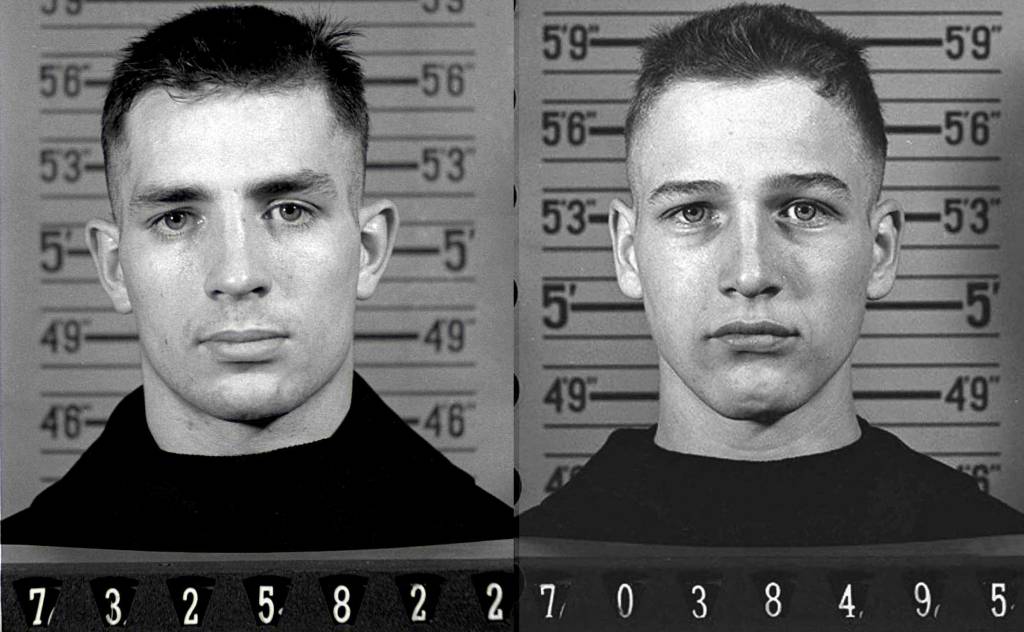
Navy induction photos of Jack Kerouac and Paul Newman. They're both attractuive young men.
Induction photos of Jack Kerouac (left) and Paul Newman.

I’ve recently noticed a continuing stir online over some old Navy induction photos of Jack Kerouac and Paul Newman from the 1940s.

People are losing it over how hot these two dudes look, which got me wondering: Were they that good-looking, or do they seem more desirable because they became famous in later years?

Beauty is a tricky thing; it changes with the times. In the ’40s, men were expected to be clean-cut and rugged, like the all-American boy next door. And Kerouac and Newman were all that and more. Looking at these photos, I can see why folks back then would have swooned over them.

But here’s the thing — we’re also being influenced by what we know about these guys now. It’s like this thing called the halo effect. We’re more inclined to find them attractive because they’re famous, and we know of their achievements later in life. Kerouac became the voice of the Beat Generation, and Newman was not just a brilliant actor but also a great guy who did a lot for charity. All this stuff makes them look even better to us now.

So it’s a mix of both. They were handsome guys back then, but knowing what they achieved makes them even hotter. It’s remarkable how beauty isn’t just one thing; it can change with time and be shaped by our feelings.

What do you think?

How to freeze water in Nalgene bottles

Photo shows two Nalgene bottles in freezer door. One bottle is 32-ounce narrow-mouth clear bottle; the other is a 32-ounce wide-mouth glow-in-the-dark green bottle.Next to the bottles are boxes of Kodak and Ilford photographic film.
I always keep at least two Nalgene bottles in the freezer. They’re two-thirds full of frozen water and ready to accompany me on my daily adventures.

Hey, folks! I received a cool message from a reader today. They saw my recent praise of Nalgene bottles and wanted to know the right way to freeze water in one. So, I thought I’d share my method.

First off, as the good folks at Nalgene explain in their FAQ, don’t fill the bottle all the way to the top. Leave it about two-thirds full. This is because water expands when it freezes, and if you fill it up too much, you might end up with a broken bottle or a shattered cap. Trust me, two-thirds is just right.

Next, keep the cap off. I know it might feel wrong, but it’s actually right. Leaving the cap off gives the freezing water some room to breathe and expand.

Now here’s a neat trick: Tilt the bottle. This provides more surface area for the water, helping to avoid any chance of it deforming and cracking the bottle as it solidifies.

And here’s the best part. Once the water is frozen, top up the rest of the bottle with cold water. Now, you’ve got ice-cold water that’ll last you all day long!

So, there you have it. Freezing water in a Nalgene bottle is easy and risk-free if you know what you’re doing.

Stay cool, my friends!

Nalgene: More than just a water bottle

Photo of my 32-ounce Nalgene water bottle. The bottle is held in my hand and has water droplets on its exterior and ice on the inside. The bottle is clear plastic, has a Nalgene logo, and a light green plastic cap.
Here’s my Nalgene bottle, fresh from the freezer. It’s ready to be filled with water and provide icy hydration all day long.

You know what’s exceptional in life? Those everyday items that so often hold a special place in our hearts.

For me, one such item is a simple, reliable 32-ounce Nalgene plastic water bottle.

Nalgene started as a scientific supplier, creating durable and leakproof bottles for laboratory use. Scientists started carrying them for personal use due to their durability, and Nalgene quickly caught onto this trend. And like that, a new water bottle brand was born.

Why do I love my Nalgene so much, you might ask? It’s all about the design, functionality, and how each bottle tells a story. They’re durable and practical, with an appealing, no-frills design.

Funny story about how I found Nalgene. I was shopping for some rugged gear from Maxpedition. They equip many folks – from special forces and police officers to adventurers and everyday people.

I found this unique bag of theirs, the Versipack, and stumbled upon Nalgene.

The Versipack has a snug side pocket, just the right size for the 32-ounce Nalgene bottle — which I added to my purchase. Little did I know this bottle would soon become my constant companion. By purchasing this bag, I discovered a brand that proved to be reliable and durable.

What I find so elegant about Nalgene bottles is their simplicity. They’re not flashy; they do their job of holding water exceptionally well. The 32-ounce size is perfect for helping me reach my daily hydration goal. Filling it up each morning and sipping it throughout the day has become a satisfying ritual.

Most of the time, I fill my Nalgene halfway with water at bedtime and pop it in the freezer. Come morning, there are 500 milliliters of solid ice inside. I then fill the rest of the bottle with cold water and sip luxuriously icy H20 all day. (If I want to pamper myself, I’ll treat myself to Evian.)

My Nalgene bottle has been with me through a lot. It’s survived many falls, traveled with me on road trips, and even accompanied me on my Amtrak journeys. Every scratch and mark on it tells a story of our shared adventures. It’s more than a water bottle; it’s a collection of my experiences and a reliable companion.

Using Nalgene also makes me feel good because I’m reducing my use of single-use plastic bottles. It’s a small, significant way I contribute to the fight against plastic waste.

I’ve discovered a whole community of Nalgene users out there. We share stories about our bottles, discuss the different colors and lids, and feel a sense of camaraderie. The company has a Facebook page, too.

So, you see, it’s about more than just hydration. It’s about how an item that originated in a scientific lab has become an integral part of our daily lives. It’s about how a water bottle can represent a sense of community and environmental responsibility — and even form part of our identity.

So yes, I adore my 32-ounce Nalgene. It’s durable, handy, eco-friendly, and always there for me. I can’t wait for all the future adventures we will have together, savoring the simple pleasures in life.

Get one. You’ll see.


Snap the small stuff: Everyday life needs a close-up

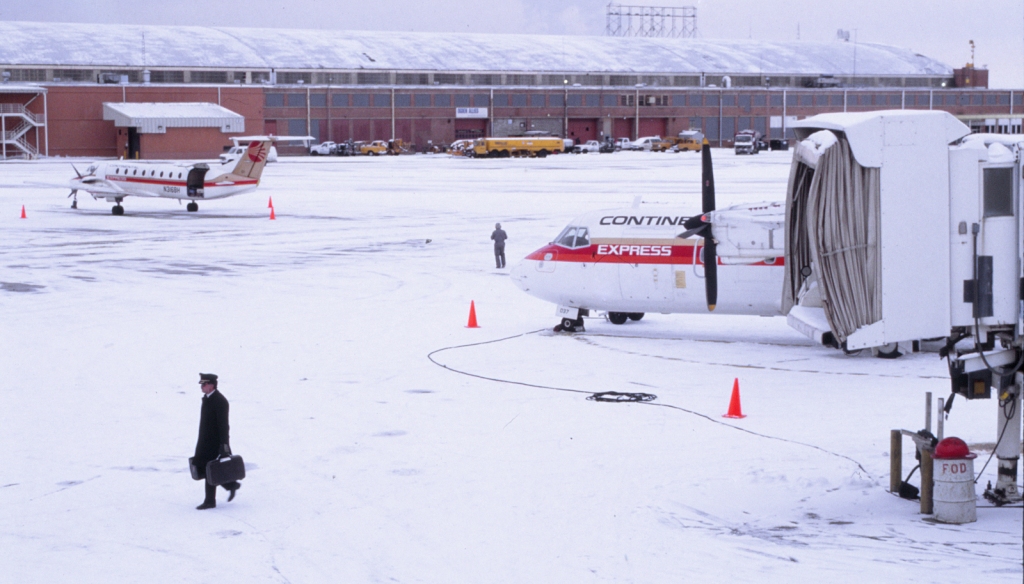
A photo taken in 1991 at Denver's Stapleton International, which closed in 1995. It shows a pilot trudging across a snow-covered apron. He's carrying his flight cases and two Continental Express commuter prop planes are in the background.
I photographed this scene at Denver’s now-closed Stapleton International Airport in 1991.

Many years ago, I went to a presentation about scrapbooking and journal-keeping given by a passionate historian. Sure, she said to document major social events, but remember to snap pictures of your everyday environment.

She mentioned something that got me thinking: Ever since Route 66 sprung into being, it’s been incessantly photographed. Despite being supplanted by interstates, people still take pictures of the Mother Road.

Yet, the historian wondered, who is photographically documenting the interstate highways?

She suggested that we spend at least a day each year going around our neighborhoods, taking black-and-white photos of things that seem as ordinary as dirt. Why use black and white film? Its negatives are archival and, unlike digital images, will not depend on possibly ephemeral technology.

It’s even a good idea to archive digital images on film.

The historian had some specific stuff she thought we should capture. You’ll probably chuckle — I know I did — but she was all about telephone poles, transformers, transmission lines, you name it.

But when you think about it, this makes sense. These things are mundane and ordinary, but they’ll be as rare as a dial-up modem one day. Tech moves fast, and soon all those cables and poles will be tucked away out of sight, underground. When that day comes, a humble photo collection becomes a precious historical record.

The point hit home for me in the early 1990s when I was living in Denver. I decided to photograph the soon-to-be-closed Stapleton International Airport. Man, did I pick a day to do it — it was snowing cats and dogs. But I’m glad I braved the cold. The snowfall added a certain magic to my photos. They aren’t just pictures anymore. They’re slices of history, proof that an era once existed.

Regular stuff only stays boring for a while because once something’s gone, it’s history.

The awesome legacy of ‘Land of the Giants’

Main title logo for the first-season opening of Irwin Allen's "Land of the Giants."


Land of the Giants” is a classic piece of science-fiction television history. Despite only airing for two seasons between 1968 and 1970, it established a robust presence in the genre. The series remains noteworthy with its thoughtfully blended narrative, ideas, and enduring special effects.

The show was developed by producer Irwin Allen, who effectively amalgamated elements from literary and cinematic works like “Gulliver’s Travels,” “Dr. Cyclops,” and “The Incredible Shrinking Man.” Allen’s synthesis of these and other sources gives “Land of the Giants” a unique flavor, leveraging established ideas to create an innovative and exciting narrative.

However, one significant criticism of “Land of the Giants” is its character similarities to another Allen production, “Lost in Space.” The prescient child and the cunning troublemaker found in both shows create a unpleasant sense of déjà vu. While not negating the originality of “Land of the Giants,” this structural mirroring makes it feel needlessly derivative.

On the plus side, the show effectively updated the premise of the most memorable segments of “Gulliver’s Travels,” infusing it with science-fiction elements. It explored power dynamics as symbolized by size, drawing inspiration from “Dr. Cyclops,” and, like “The Incredible Shrinking Man,” used size reduction to magnify life’s essential questions.

Additionally, “Land of the Giants” deserves commendation for its impressive special effects. Despite the technological constraints of its era, the show produced a believable world of giants. Its ability to deliver visually, even after half a century, is a testament to the skill and creativity of its production team.

“Land of the Giants” holds a special place in the history of science-fiction television. Despite its short lifespan, it showed an innovative approach to storytelling, combining thoughtful narrative with compelling visuals. It remains a reference point for the genre, a testament to its well-executed design and timeless appeal.

Original Concept Artwork from Land of the Giants (Irwin Allen Productions, 1968-1970). Vintage original concept art from The Land of the Giants in tempera and gouache, measuring 19-¾" x 30" on 4-ply artist board, glue tipped to a mat measuring 24-½" x 35" and hinged with transparent mylar overlay. The pre-production artwork depicts the crew in "Spindrift" being examined by a giant piercing eye.
If you’re an Irwin Allen fan and have some spare cash, check out the storyboards, concept art, publicity material, and toys from his movies and TV shows now up for grabs at Heritage Auctions. This pre-production artwork depicts the Spindrift crew encountering a giant. (Imaged by Heritage Auctions)

‘Ice Station Zebra’ is the perfect movie title

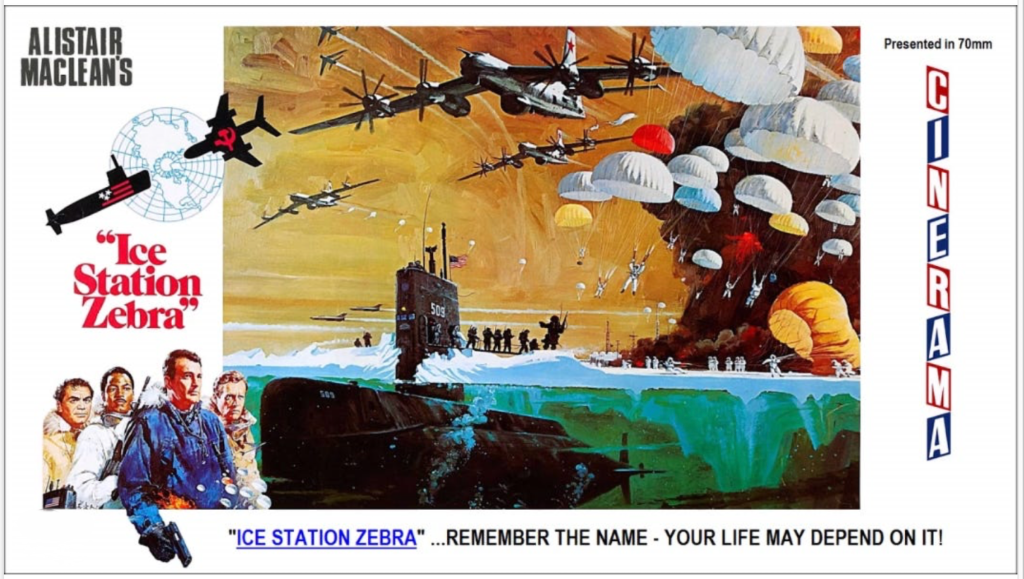
Poster art for 1968 film "Ice Station Zebra."


As a film viewer, one’s relationship with movie titles is like a sommelier’s with wine labels. Both encapsulate entire universes of experience in a few choice words. They are a prelude, a tease, an overture.

Over the decades, I’ve pondered upon hundreds of these word-woven spells, from the beguilingly simple “Jaws” and “Psycho” to the grandly pompous “The Magnificent Ambersons” and “Lawrence of Arabia.”

After all these years, however, one title has held me in its icy grasp: “Ice Station Zebra.”

Here’s why.

A title must be succinct but also evocative. It must tickle curiosity but only divulge a little. Now, consider “Ice Station Zebra.” It’s three simple words. Ice. Station. Zebra. Each is mundane. But together, they conjure up an image at once bizarre and intriguing. What is this icy station? And, pray tell, what is a zebra doing there?

The first two words, “Ice Station,” present harsh, chilly remoteness. Think about it. Any title beginning with “Ice Station” promises a grueling adventure in a frosty, desolate landscape. As audiences, we are immediately transported into a realm far removed from our comfortable living rooms. The tension is palpable.

Then comes the zinger: “Zebra.” What an unexpected departure. It’s like taking a left turn at Albuquerque on your way to Seattle. Suddenly, the mundane “Ice Station” transforms into a mysterious, surreal landscape. The contrast of a zebra’s stark stripes against the white snow brings a delightful paradox, a twist that one can hardly resist.

“Ice Station Zebra” also has the advantage of perfect context. The film is a Cold War thriller based on a novel by Alistair MacLean, released at the height of the space race in 1968. The title’s chilly nuances echo the frosty U.S.-Soviet relationship. The “Zebra,” a code name, hints at espionage, covert operations, and secrets buried beneath layers of ice and intrigue.

Perhaps most important, “Ice Station Zebra” doesn’t overpromise. It’s not “The Greatest Story Ever Told.” It doesn’t pronounce itself as “Unforgiven.” It’s understated yet compelling. It’s unassuming yet unforgettable.

The artistry of a movie title lies in its ability to capture the essence of a film and yet leave ample room for imagination. By that measure, “Ice Station Zebra” is a testament to the art. It stands as a bold beacon in the wintry white landscape of cinema, a lighthouse guiding curious audiences to the warmth of a riveting tale. It is a perfect title, a zebra among horses. A paradox, a poem, and a promise all rolled into one.

So here’s to “Ice Station Zebra.” Long may it reign in the frosty kingdom of movie titles. We might all be a bit warmer for it.

I saw this epic film first-run in 70mm at Denver’s Cooper Cinerama Theater.