Elderly neighbor clues me in on kratom

Kratom comes in many forms, including these edibles.

In my highrise condominium building’s elevators, I often chat with Mrs. X, a 90-year-old gal with a sharp mind, a sharp wit, and an unquenchable desire to knock boots with Che Guevara.

Her infatuation with Che isn’t teenybopper puppy love but the burning desire of a limousine-lib lady deeply engrossed in understanding a revolutionary’s psyche. I often see her with a thick tome about Che, lost in tales of revolutions and rebels.

One recent evening, as we rode the elevator up, I winced from the sharp sting of diabetic neuropathy. Mrs. X’s eyes twinkled with mischief.

“Ever heard of kratom?” she asked.

Now, if you’re imagining kratom as some exotic dance from Guevara’s Cuban revolution days, let me set the record straight. “Kratom” usually refers to the prepared leaves from Mitragyna speciosa, a tree native to Southeast Asia.

The plot thickens when you learn that kratom’s lead actor, mitragynine, holds court with the same receptors in our brain as opium does. Its leaves have compounds with pain-numbing, mind-altering effects.

It’s a bit like a passionate tango between Che and an opponent on the dance floor of your neurons. This dance brings a suite of side effects, many eerily similar to opioids. From the itching that feels like ants dancing a rumba on your skin to thoughts racing faster than a retro jukebox on a caffeine spree and speech that rivals the speediest auctioneer. Plus, pupils that constrict to the size of the period at the end of this sentence.

Yet, amid this chaotic carnival, there emerges a soothing, pleasant buzz. The euphoria you might feel listening to an old, soulful song on a rainy day. And boy, did it tackle my neuropathic foot pain head-on.

However, much like Guevara’s ideologies, kratom comes with its complexities. The enchanting hum it provides is tempting. So tempting that in my journey, I’ve learned to respect its power, using it sparingly and wisely, ensuring I’m not being led astray by its allure.

Life is full of unexpected teachers. Who would’ve thought a 90-year-old Che Guevara-loving neighbor would be my gateway to the enigmatic world of kratom?

If this story teaches you anything, it’s that wisdom can come from the most unpredictable sources. And as always, if you’re contemplating a dance with kratom, ensure you lead and consult a medical professional first.

Disclaimer: I am not a doctor, scientist, or medical professional, and nothing in this post should be interpreted as medical advice. Kratom is a controversial substance with potential risks, and its effects can vary widely from person to person. If you are considering using kratom, consult with a qualified healthcare provider first. Do not take this flash-fiction post as an encouragement to try kratom yourself. You are solely responsible for your own decisions and actions.

“““““““`

Cowboy rhythms and unexpected Christmas anthems

Midjourney synthograph of a contemplative young cowboy at home on Christmas Eve.
I’ve created an Apple Music Playlist to play in the background and help me write cowboy stories for Christmas. I’ll be publishing them on Amazon’s Kindle platform. (Midjourney synthograph)

The festive season always stirs a potpourri of emotions. As I craft a series of cowboy romance short stories this year, I’ve found solace in an eclectic Apple Music playlist of holiday songs, each echoing the ambiance of the West.

At the pinnacle of my list is the enchanting “Christmas Cowboy Style” by Michael Martin Murphey, seamlessly marrying the holiday spirit with the rustic allure of cowboy culture. But the playlist boasts more than just cowboy tunes. Tracks like “Santa Looked a Lot Like Daddy” by Buck Owens and “Hard Candy Christmas” by Dolly Parton bring their own charm.

Diving deeper into the playlist, John Denver’s “Please, Daddy (Don’t Get Drunk This Christmas)” strikes a sad and, unfortunately, familiar chord. The song poignantly speaks to the heartbreak of children witnessing the struggles of alcoholic fathers, especially during a season meant to be merry.

Yet, the playlist has its quirks, too. “Weird Al” Yankovic’s “Christmas at Ground Zero” takes us on a wild departure from traditional holiday tunes, presenting a satirical take on the festive season that’s uniquely “Weird Al.”

There’s a story and a song for every emotion in the world of cowboy romance, Christmas songs, and tales of heartache and humor. And as I write, I’m reminded of the joy, pain, love, and laughter the season brings.

It isn’t even Halloween yet, but it’s never too early for me to wish everyone a tapestry of tales, tunes, and delightful holiday memories.

Did Tyson Foods bend me over with Jimmy Dean sausage?

Image of front of box of Jimmy Dean English Muffin Sausage, Egg & Cheese Sandwiches fails to mention the meat is not pure pork.
I like this product. I dislike that the presence of chicken is not stated on the front of the packaging.

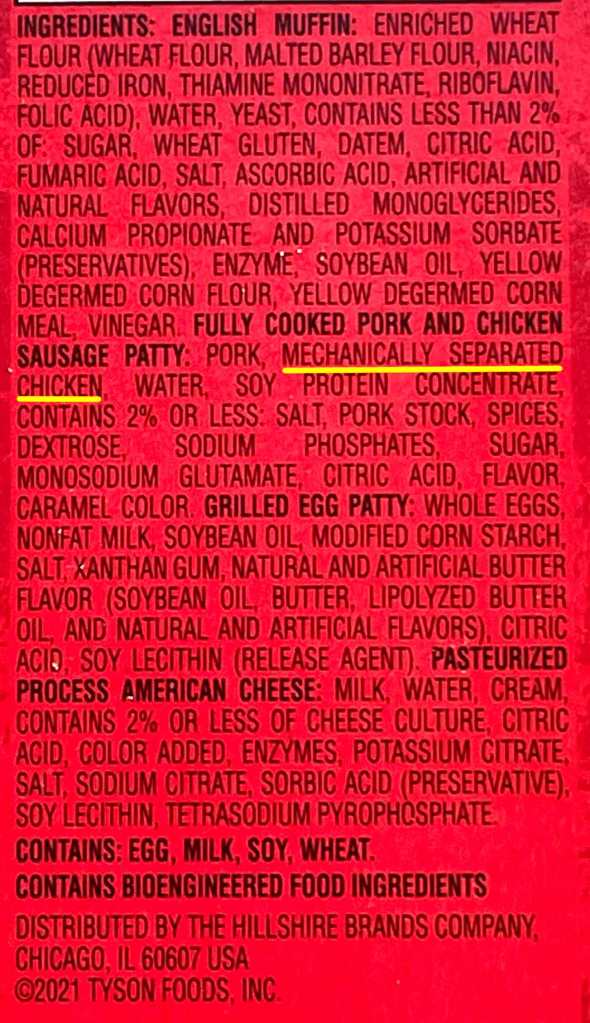
Is Tyson Foods less than transparent by failing to state on the front packaging of its Jimmy Dean English Muffin Sausage, Egg & Cheese Sandwiches that the meat is a blend of pork and mechanically separated chicken?

Consumers like me, who grew up seeing commercials in which Jimmy Dean touted the pure pork in his company’s sausage products, will naturally assume that these sandwiches are solely made from pork.

They’re not.

Jimmy Dean English Muffin Sausage, Egg & Cheese Sandwiches contain a mixture of pork and chicken.

I don’t have a problem with that, just with the fact you won’t know it unless you happen to inspect the ingredients list on the side panel. Dozens of other manufacturers’ products spell out the components of their meat right on the front label or panel.

Why isn’t Tyson doing so?

Recently, I voiced my concerns to Tyson Foods, and the only response they sent was that they would pass my concerns on to the quality control team. The company then mailed me a free coupon for the product in question.

I think I got blown off with Form Response No. 7B. What do you think?

Here’s the message I sent. . .

Photo of ingredients list for a Jimmy Dean product. It's only here that one discovers the product is not 100 percent prok but contains mechanically separated chicken.
Mechanically separated chicken is revealed in the ingredients list.

Dear Tyson Consumer Relations Team,

I hope this letter finds you well. I am writing as a long-standing and loyal consumer of your Jimmy Dean product range, specifically the English Muffin Sausage, Egg & Cheese Sandwiches. I have appreciated and enjoyed your products for many decades, and they have been a staple in my household since Jimmy Dean introduced his line in the late 1960s.

However, I recently discovered some information on the packaging of this product that left me feeling disappointed and deceived. Upon scrutinizing the ingredients list, I learned that the sausage, as advertised on the front of the package, is not purely pork, as I had assumed, but also contains mechanically separated chicken. This was a surprise, as the product’s marketing and branding led me to believe I was consuming a higher-quality product.

I understand that Tyson is likely meeting all legal requirements in labeling. Still, the fact that this crucial information about the content of your sausage is not immediately visible or accessible to the consumer seems, frankly, deliberately deceptive. The information is tucked away in tiny print on one of the side panels, which many consumers, including myself, might easily overlook.

I find it disheartening that Tyson, a brand I have trusted for so long, seems to take such measures to hide the presence of what many consumers would consider to be a cheap filler meat in a premium product. Other manufacturers appear to have no issue with upfront disclosure about their product’s ingredients, leading me to wonder why Tyson opts for a different approach.

It feels to me like a betrayal of the quality and transparency that Mr. Jimmy Dean himself advocated when he marketed his products as “pure pork sausage.” I am sure I am not alone in feeling that Tyson has strayed far from this ideal.

I truly enjoy the Jimmy Dean English Muffin Sausage, Egg & Cheese Sandwiches, and I would like to continue purchasing this product. However, my personal principles dictate that I cannot support a product that I believe is deceptively marketed.

In conclusion, I hope you will take my feedback into account and consider making your product ingredients more transparent to consumers. I believe this action would enhance trust, increase consumer satisfaction, and align more closely with Jimmy Dean’s original values of quality and honesty.

Thank you for your time and consideration.

Yours sincerely,

Leigh T. Hanlon

Front of a package of Jack's Pizza does the right thing and clearly states that its sausage and pepperoni are a combination of pork, chicken, and beef.
Why can’t Tyson Foods declare meat ingredients on the front of its packaging like Jack’s Pizza does? Attaboy, Jack!

Does clinic app want me to join the 500-pound club?

Clinic's scheduling app wants to know if you under or over 500 pounds.

So, there I was, thumbing through my clinic’s app, trying to schedule an echocardiogram stress test.

Boring stuff, right? Until I got to this gem: “Certain locations have weight limitations, please select the range of your weight.”

The options?

“500 lbs and over”

“450 lbs and over, but less than 500 lbs”

“Under 450 lbs”

And get this, the default? “500 lbs and over”

Was the gravitational pull stronger? Did someone toss a black hole in my pocket when I wasn’t looking? I checked my mirror. Still the same old guy. Attractive in a rugged, 2 a.m. beer-googles way, not in a “might-break-the-medical-equipment” way.

Default settings can be a riot, especially when you’re obliged to scroll through a drop-down menu of almost every country on the planet before locating “United States” beneath “Uganda.” I see that one all the time. But having to choose among “Large,” “Extra Large,” and “Omigawd, he’s heading our way!” was new to me.

In the end, I clicked “Under 450 lbs” and chuckled. Whoever programmed that app, cheers to you for the unexpected laugh.

I did not need to watch this video at 2 a.m.

I’ve been to many places, seen many things, and heard a truckload of stories.

By day, I worked at newspapers. By night, I’d lean into conspiracies. It’s not every journalist who’s got a side passion for Fortean phenomena. I’m not saying I believe in all that jazz, but something about UFOs, cryptids, and high strangeness catches me and hooks me in. It’s like a lousy earworm of a song you can’t shake.

Legends? They’ve got a life of their own. Ever heard of the telephone game? Start a rumor on one end of the bar, and by the time it reaches the jukebox, it’s turned into some wild tale. These urban myths — they spread, mutate, and grow legs. Sometimes wings.

Speaking of wings, let’s talk Mothman. A creature seen in Point Pleasant, West Virginia. But it’s not the red-eyed beast that gets me. It’s his alleged buddy, Indrid Cold. Some folks call him the Grinning Man.

The story goes: a chap named Woodrow Derenberger was driving home one night in 1966 when he got flagged down by a vehicle that screamed, “Not from this galaxy.”

Out pops a man with a metal grin dressed to the nines. This smiling suit introduces himself as Indrid Cold. Over time, Woody and Indrid chat telepathically, with Mr. Cold spewing tales of interstellar travels. Bizarre, right?

Then Indrid Cold became intertwined with the Mothman sightings. Some say he’s an alien, others believe he’s a government agent covering up the Mothman hullabaloo, and others still reckon he’s a fragment of overactive imaginations.

Whatever the truth, stories like his keep the legend alive, burning like a neon sign outside a dive bar.

I’ve driven endless late nights under countless starry skies, sometimes thinking about those twinkling dots. Could there be life out there? Probably. But I’m not holding my breath for a close encounter.

I’m as skeptical as they come. But when the clock hits 3 a.m., and I hear a strange noise outside my window, I get a tad jumpy.

UFOs and cryptids might be campfire tales, but they sure as hell make the night a little more interesting.

Rome’s legacy more than just history

Midjourney synthograph shows a Roman center in front of rthe U.S. Capitol.

While watching historian Garrett Ryan’s latest YouTube Toldinstone episode, I got to thinking about how right he is that Rome still holds sway over our world.

The vast expanse of Rome’s influence in the annals of history is undeniable. When we speak of the Roman Empire, we touch on an epoch that shaped civilizations and laid the groundwork for our contemporary world. Roman culture and governance’s monumental advancements and intricacies are far more than tales of conquests or ancient grandeur.

Every corner of our modern life bears the indelible mark of Rome. The architecture that graces our cities, the languages that have evolved from Latin roots, and the democratic principles many societies hold dear — are all bequeathed to us from the great Roman civilization.

While discussing Rome’s influence, it’s essential to acknowledge the other side of the coin.

Rome often gets a bad rap, and much of it stems from Christian narratives that emerged as the religion gained prominence. It’s interesting, and perhaps surprising to some, that even after Rome embraced Christianity, some of its more brutal practices persisted. For example, the spectacle of gladiators fighting to the death remained a fixture of Roman entertainment.

This serves as a reminder that history is multifaceted, and the interpretation of events and cultures changes depending on the perspective and agenda of those recounting it — plus the ability to ram a slanted narrative down student throats with a toilet plunger.

I’m fond of an ancient belief we grant them immortality by invoking the names of gods, heroes, and those of renown. How often have scholars and enthusiasts recalled names such as Julius Caesar, Cleopatra, or Augustus?

Doing so ensures their stories, values, and dreams resonate through the ages. This age-old custom, while symbolic, underscores the profound respect and reverence we have for these figures and the civilization they represent.

I have no doubt Caesar would be delighted that we still read his books. Mark Antony would revel in his perpetual role as history’s alpha bad boy. And as for Cleopatra, yes, she’d be glad to be one of history’s beauties, but I’ll bet she’d be more satisfied that she’s also remembered as a savvy statesperson who took on Rome and, at least for a time, gave the empire a run for its pecunia.

On a personal note, my deep appreciation for Rome has led me to explore, with uncharacteristic earnestness, parts of Roman religion.

I share in the allure of venerating deities such as Ceres, who watched over the harvest, or of seeking the ideals of love and beauty through Venus. Historically and philosophically, their significance provides us with rich narratives that help shape our understanding of the world and our place in it.

The legacy of Rome isn’t limited to what’s written on parchment or carved in stone. Its essence thrives in humanity’s collective consciousness.

We owe a deep debt to Rome — not just for the tales of its past, but for the wisdom and foundations it provides for our future.

Garrett Ryan’s Toldinstone is one of my favorite YouTube channels.

You’ll really eat up ‘The Stuff,’ a classic sci-fi comedy

Michael Moriarty opens his mouth as wide as a salad plate in "The Stuff," a comedy sci-fi film made in 1985.
Michael Moriarty demonstrates how big earthlings’ mouths get when they’re controlled by The Stuff, an extraterrestial goo masquerading as a frozen dessert. Watch “The Stuff” free on YouTube.

After many years, I rewatched “The Stuff,” a 1985 flick by Larry Cohen.

Man, what a ride!

Started with a bubbling, gooey substance oozing from the earth. People taste it. Big mistake, but hey, it’s delicious — and they’re hooked. It’s dessert, it’s a lifestyle, it’s an addiction. Everyone’s gobbling it up.

Enter a corporate saboteur, a young boy, and a disgraced FBI agent played with gusto by Michael Moriarty. Odd trio, but they’re onto the deadly secret of The Stuff. They’ve got to stop its rampage and the clock’s ticking.

Cohen’s direction? Genius. This isn’t your run-of-the-mill horror; it’s a satire. Think about consumerism, 1980s corporate greed, and the junk we feed on, literally and metaphorically.

Subtle? Hell no. Fun? You bet your ass.

Laughs and screams intertwine. The practical effects are pure ’80s charm. Watch folks get devoured by tasty white goo, and tell me you don’t chuckle and cringe simultaneously.

So, if you’re yearning for something different on your screen, this flick’s your ticket.

You’ll never look at dessert the same way again.

‘Voyage to the Bottom of the Sea’ has the best TV theme music

Television has seen only a few theme songs that have excited viewers and encapsulated the essence of the shows they introduce. Paul Sawtell’s composition for the series “Voyage to the Bottom of the Sea” stands out as a masterstroke, and here’s why.

From the first haunting sonar pings of the main title, listeners are instantly transported to the vast and mysterious realms of the ocean. This isn’t just any ocean but one filled with intrigue, danger, and grandeur. Sawtell’s theme is a siren song, drawing us deep into the depths of the story before the actors even have a chance to say their lines.

But the end credits truly crescendo into something magnificent. With a sweeping dance of deep brass and soaring strings, there’s a feeling of culmination, like returning from an epic voyage. It paints an audioscape of sea monsters, heroic submariners, glimmering treasures, and shadowy threats. The grandeur of these compositions makes one think of oceanic sagas from eras long past.

Unfortunately, the series’ scripts didn’t always rise to the lofty standards set by this stirring music. But Sawtell’s gift to “Voyage to the Bottom of the Sea” is unassailable. While storylines may falter, music can remain timeless, and Sawtell’s theme stands as a testament to this – echoing through the annals of television history as one of the best.

In defense of AI partners for writers and artists

Graphic shows a robot and a human male standing side-by-side. Text: Say hello to my new writing partner.

Integrating artificial intelligence into writing and illustration projects has seen its fair share of contention.

Yet, when done judiciously, AI can significantly enhance these creative processes. Embracing AI in my writing and illustration projects is not about relinquishing my creativity but rather about harnessing tools that make that creativity sharper, more refined, and more impactful.

To understand my viewpoint, it’s vital to realize that, historically, writers and illustrators have always sought aids and tools to improve their work.

The progression has been relentless, from the quill pen to modern-day word processors. AI is just another step on this evolutionary ladder.

Is it wrong for machines to relieve us of complex tasks? Is it unethical to set a DSLR to the automatic setting, that little green square that tells the camera to adjust exposure and focus automatically?

Of course not. That green square upholds photographers’ creativity, helping them quickly achieve their vision.

Sometimes, tools, whether human or AI, are needed to refine and enhance our initial creative bursts.

For years, I worked as a copy editor, enhancing and sometimes heavily revising the work of others, many of whom struggled profoundly with the art of writing. Nobody whined about the ethical implications of my input or its impact on the originality of the content. So, why the outcry when silicon does the job?

The era of AI isn’t about the machine surpassing us but about us working hand in hand with technology.

Whether a human tool or a silicon-based one, the goal remains unchanged: to improve and refine my creative expressions.

Let’s embrace AI not as a threat but as an ally in our continual pursuit of excellence in writing and illustration.