Holdenville (Oklahoma) Daily News
October 8, 1951

Holdenville (Oklahoma) Daily News
October 8, 1951

It’s an age-old debate in art and creativity: what is true originality? Every artist has tapped into universal themes, stereotypes, and structures that resonate with audiences, from Shakespeare to Spielberg. As we dive into the 21st century, a new contender has entered the arena—Artificial Intelligence. As writers and creators turn to AI for inspiration and even content generation, skeptics raise eyebrows. But is there really much difference between human-generated clichés and those constructed by algorithms?
Let’s consider popular genres.
Despite the studio, superhero movies often orbit around a protagonist with a tragic backstory, a formidable antagonist, a colossal battle, and a resolution.
Similarly, romance novels are interwoven with familiar tropes: enemies to lovers, hidden royalty, or the classic will-they-or-won’t-they.
Spy thrillers? A charismatic lead, global stakes, high-octane chase sequences, double agents, and plot twists.
Sounds formulaic? That’s because it is.
And it’s not just limited to literature and film. Pop songs have their share of predictable patterns. Inevitably using Auto-Tune, sometimes called the “Cher effect,” gives vocals a distinct robotic sound.
And can we ever have enough of the word “baby” in our love songs? A college instructor told us that if we ever wanted to know how “baby” is overused in song lyrics, substitute the words “boat dock.” She was joking, but now, 50 years later, I still hear . . .
“Be My Boat Dock”
“Boat Dock Love”
“Love to Love You Boat Dock”
. . . well, you get the idea.
What we’re encountering isn’t a deficit of originality but a reflection of our collective consciousness — a set of stories, beats, and patterns that resonate universally. If these patterns are deeply embedded, why shouldn’t an AI designed to recognize and emulate patterns produce something similar?
AI’s ability to create isn’t about replacing human ingenuity. It’s about acknowledging that much of what we consume and call “original” is often derived from age-old patterns. If a machine can replicate those patterns, it doesn’t demean our art — it merely reflects our preferences.
To dismiss AI-generated content as “unoriginal” means confronting an uncomfortable reality about our tastes and patterns.
Instead of shunning silicon assistance, it may be time we embrace it. After all, whether it’s Shakespeare, Spielberg, or an AI, aren’t we all just looking for a good story?
By the way, that “Calvin and Hobbes” strip was shared with me many years ago by a famous comics artist. We got a good laugh of it — but I doubt either of us predicted AI’s coming impact.

As you might know, Solo changed the shape of its famous round cup a few years back. The company adopted a square design to help prevent the cup from sliding out of partygoers’ hands.
My experience with the iconic product wasn’t all that extensive until recently when I embraced the cup for its ease of use and 18-ounce capacity to avoid repeated trips to the coolerator.
I figured they’d solved the slip-and-slide mystery that turns a simple drink into a mess. But boy, was I wrong, at least in my case.
Picture this: I’m in my apartment, set to enjoy a full-sugar, ice-cold Pepsi-Cola. I fill the Solo cup with crystal-clear, commercially produced ice, pour in Pepsi fresh from the freezer that had almost but not quite reached Slurpee consistency, and fill the cup with cola goodness.
I reach for the cup, and Solo flies from my sausage snappers like a greased pig at a county fair. Next thing I know, Pepsi’s doing the cha-cha across my 18-percent gray, wall-to-wall carpet.
The redesign seemed to make sense: Square the cup, slap on their logo, and — for a laugh, I guess — throw in some pleasure dots. Like something you’d find on a … well, let’s not get into that.
For all I know, the improved design reduced most users’ butter fingering.
But guess what? My ham hands weren’t having any of it. Slip, drop, splash. Again and again.
When I thought I’d have to ditch Solo for good, I stumbled onto a game-changer. Before you pour in your poison, give that cup an outside rinse with hot water. This probably washes away some residual lubricant or antistatic agent left over from the factory.
So, try it the next time you’re ready to party with Solo — and banish those butterfingers quicker than you can say, “Last Tango in Paris.”
Oroville (California) Mercury Register
October 2, 1943
(Scan of newspaper page bottom incomplete.)


Several years ago, I went to a film party held at a friend’s big-ass house in, of all places, the Lincoln Square neighborhood. The hood was once heavily German, an irony that will be apparent shortly.
The crowd was a motley crew of film students, history buffs, and just plain hangers-on. I wound up there because I’d had dinner with friends who knew about the party and dragged me along.
The first few films at the event were funny World War II-era shorts, many requiring a trigger-warning disclaimer today but still riotously funny. I’m talking stuff like Looney Tunes’ “Tokio Jokio,” Paramount’s Superman cartoon “Japoteurs,” and then British intelligence’s “The Lambeth Walk: Nazi Style.”
Right after the Teutonic “Lambeth Walk” came the film that had provided its inspiration: Leni Riefenstahl’s “Triumph of the Will.” On the surface? A propaganda machine oiled and prepped by the Nazis.
But dive deeper, and you’ll see the sinister craftsmanship — the kind that seduces you with visuals, as tempting as a fresh streuselkuchen straight out of a Berlin bakery.
Artistic? Sure. George Lucas thought so, snatched that Nuremberg Rally three-person strut for “Star Wars” (1977). Brian De Palma? He nabbed it for “Mission to Mars” (2000). Tinsel Town got its claws on Riefenstahl’s shots a long time ago.
Yet, here’s the deal: No one’s lauding the message, just acknowledging the craft. Is it kosher to admire a snake’s beauty, knowing it can bite?
This post came about because I’ve finished reading “Leni Riefenstahl: The Seduction of Genius” by Rainer Rother, which prompted me to watch “Triumph of the Will” again.
My favorite scene? The one where Hitler looks up from his motorcade Mercedes-Benz and locks eyes with a cat. The cat’s perched at a window beside a swastika flag, taking in the show. A moment of serendipity in a film otherwise dense with choreography. Those eyes, Hitler’s and the cat’s, a dance of curiosity in a world on the cusp of darkness.
But I’ll be clear: Nazis? They’re the storm cloud in every silver lining. Admiring Riefenstahl’s work isn’t a salute to them. It’s a nod to a filmmaker’s ability to make evil look good, a reminder always to question what we see.
FOR MORE INFORMATION
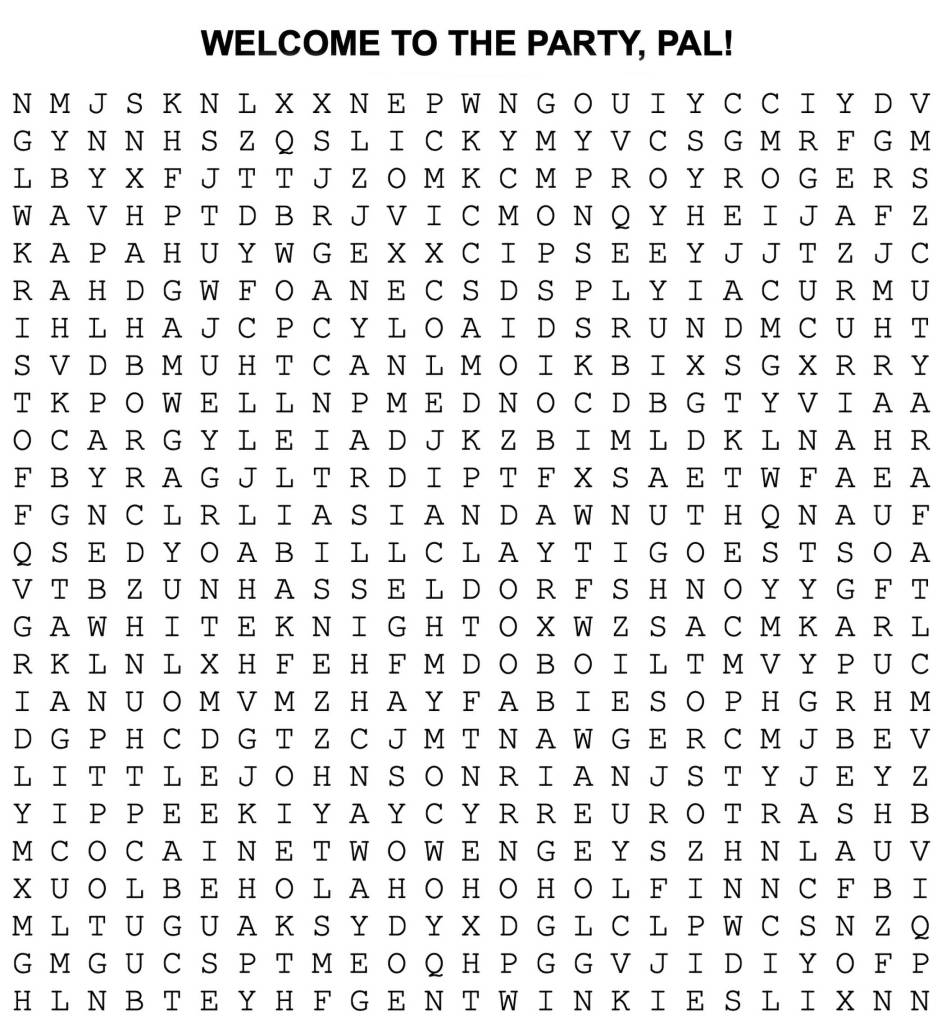
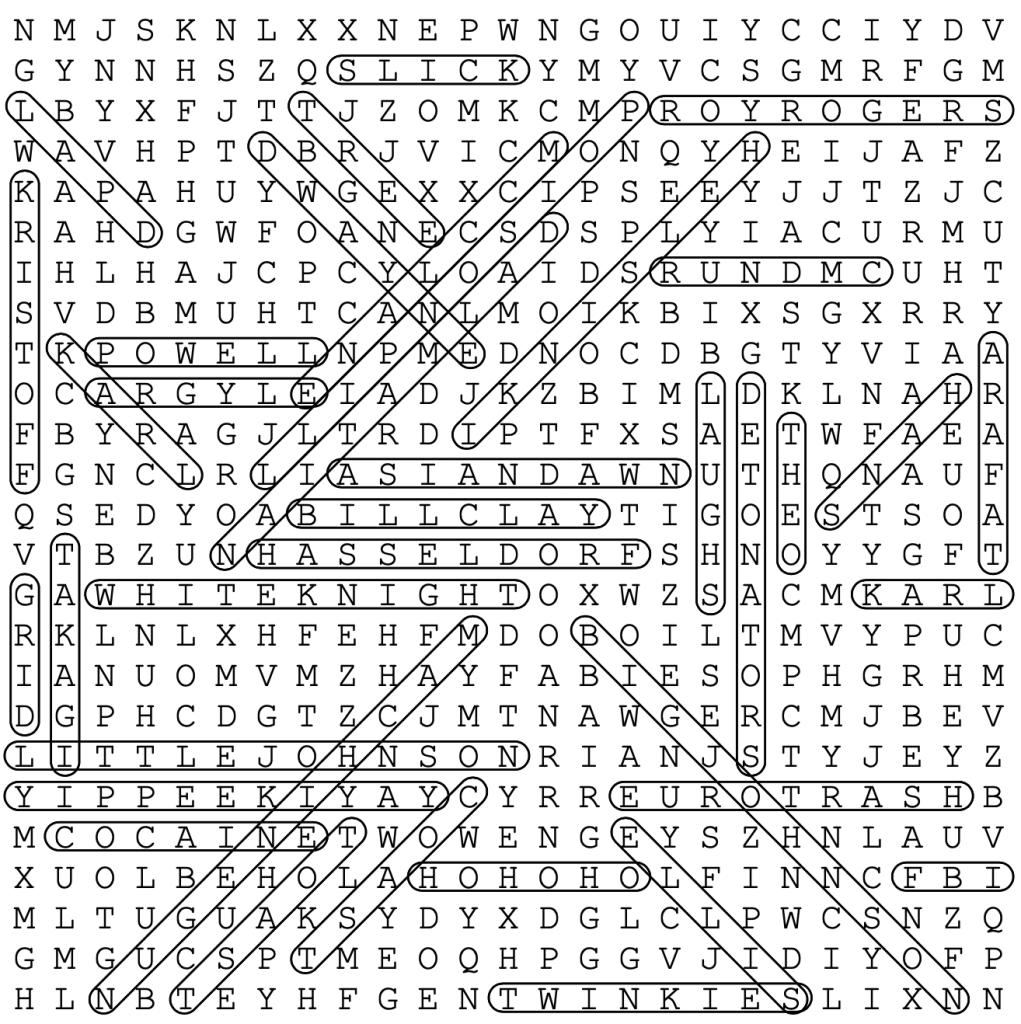
I didn’t have time to publish my “Yule be Sorry” Christmas newsletter last year, so I’ve been working on it earlier this time. In addition to a crossword, I’m considering including a word search puzzle. Something along the lines of this one I threw together. Printing the post itself usually won’t work well, so click here for a printable version.
Too easy? Too hard? What do you think?
BIG JOHNSON
TREE
ARGYLE
TWINKIES
MACHINEGUN
ASIAN DAWN
SLICK
DWAYNE
YIPPEE KI YAY
DETONATORS
ELLIS
HELSINKI
TAKAGI
HANS
ARAFAT
KARL
EUROTRASH
DALMATIAN
HASSELDORF
POISON PILL
RUN DMC
THEO
KARL
GRID
FBI
COCAINE
LAPD
COAST
TOAST
POWELL
LAUGHS
ROY ROGERS
BILL CLAY
LITTLE JOHNSON

Having recently dived into “Gen V,” a fascinating spinoff of “The Boys,” I’ve been taken by its gripping portrayal of young superhumans in the hallowed halls of Godolkin University.
This isn’t your typical college drama. At Godolkin, where elite superhumans are molded, students must not only grapple with the challenges of young adulthood but also confront the malicious presence lurking right beneath them.
Drawing parallels to the ominous likes of Dolores Umbridge and the formidable Miranda Priestly, the director of the clandestine lab beneath the university grounds masterfully sets the tone for intrigue and suspense. As viewers, we’re drawn into the complex web of power dynamics, ethics, and the often-blurred lines between right and wrong.
Speaking of characters, Emma “Little Cricket” Meyer has undoubtedly caught my attention. Portrayed with depth and nuance by Lizze Broadway, Cricket’s ability to shrink herself by inducing bulimic episodes isn’t merely a party trick. It’s a poignant commentary on young women’s pressure and the lengths they may go to fit into society’s mold.
A stunning effects sequence showcases Cricket’s daring venture into the university’s underground lab to help free a young man being tortured there. This scene makes me yearn for a modern-day reboot of Irwin Allen’s “Land of the Giants.”
However, it’s not all praise for “Gen V.”
As visually captivating and plot-rich as the series is, it sometimes overindulges. I always appreciate the artistry of effects and storytelling, but some moments — like a sex scene with Cricket I won’t describe — could be toned down or eliminated without sacrificing the series’ essence.
While the superhuman college drama offers a mostly fresh perspective, the underlying teen angst is already trying my patience. I like “Gen V” for what it is, but given the looming melodrama, I wonder how long I’ll stay loyal to the series.
“Gen V” brilliantly explores the world of young superhumans and presents a delightful mix of suspense, emotion, dark comedy, social commentary, and visual spectacle. It’s undoubtedly worth watching, especially if you love “The Boys.”
Chicago isn’t just wind and deep-dish pizza. It’s full of stories. One such story involves yours truly getting jabbed with three vaccines on Monday afternoon: COVID-19, the flu, and RSV.
Come nightfall, my body was cooking. My Apple Watch buzzed like an angry wasp every time my heart rate did a lap around the 120-plus mark. For a guy whose ticker usually beats around 70, this was concerning.
When my condition hadn’t improved by Tuesday morning, I went to immediate care. They collected my vitals, did an EKG, and handed me a one-way ticket to the ER. Ah, the ER. I got another EKG, got plugged into some fluids, and had a lovely moment with a puke receptacle that looked like a giant condom designed by Salvador Dali.
So, was it the vaccines? It might’ve been. But here’s where it gets dicey.
Correlation and causation. Just because two things happen together doesn’t mean one caused the other. The high heart rate? The fever? It could’ve been the vaccines, sure. But it could’ve been my dodgy sandwich, the Chicago air, or maybe my own damn body acting up.
In my case, the vaccines and the symptoms? Possibly related, sure. But it’s not a sealed deal. So, next time something’s got you scratching your head, ask yourself: Is it correlation or causation?
I ended up back home by 4 p.m., tired as hell. On the bright side, no atrial fibrillation. And they gave me Graham crackers. Ain’t nothing like carbs to keep your mind off other … urges.

Ah, it’s almost that snug, cozy time of year: Thanksgiving.
No, I’m not early. I’m talking about Canadian Thanksgiving, the second Monday in October. This holiday came to mind today while I tarried in the frozen food section in search of something sweet and satisfying.
And that’s when I found my answer: Mrs. Smith’s frozen pumpkin pie. As I type this, my kitchen is filling up with an aroma like a slice of heaven.
But let me tell you, the best part is what I’m listening to while that pie’s getting golden brown. I’ve got a playlist chock-full of authentic Canadian country artists.
I’ve got a soft spot for the real deal regarding country music, and our North of the Border friends deliver. Artists like Blake Berglund, who’s all heart and soul, and Belle Plaine, whose melodies are as captivating as a prairie sunset. Or Corb Lund, who weaves a tale like no one else. And, of course, there’s Tim Hus, Colter Wall, and a whole slew more — as authentically Canadian as a jug of maple syrup.
So, this coming Canadian Thanksgiving, my gratitude isn’t aimed solely at a delicious pie and my good fortune to have enough to eat.
I’m also tipping my hat to Canada for gifting us some of the realest country music. Thanks to those genuine tunes serenading me in the background, every bite of that pumpkin pie will seem sweeter.
So here’s to a delightful slice of Mrs. Smith’s and hearty cheers to our northern neighbors for keeping country music real.
 L.T. Hanlon