My disappointment with the Holga 120: A cautionary tale

Photo of Chicago's Oak Street Beach taken from the 44th floor of the John Hancock Center.
Here’s one of the few good images I managed to coax from a Holga 120GCFN medium-format camera.

As someone who has experimented with various cameras, my experience with the Holga 120 has been disappointing. Despite its cult following, I’ve never gotten reliably consistent results from any model I’ve owned. It baffles me how people can be in love with this camera.

The Holga 120, introduced in China decades ago, was designed to target the country’s vast consumer market. Surprisingly, the poor-quality images this camera produces didn’t spark another cultural revolution. The design is meant to be simple and affordable, but it meets those goals at the expense of quality. None of the images I’ve taken with the Holga are printable or digitally usable without extensive work in Photoshop.

One of the most significant issues I’ve found is the camera’s inconsistency. One roll might come out somewhat decent, and the next, a complete disaster. Light leaks, focus problems, and scratched film are a few of the recurring issues.

The camera’s plastic lens, while charming to some for its vignetting and blurring effects, often results in more frustrating than artistic images. Even the “premium” Holgas with glass lenses don’t cut it.

A particularly disheartening experience was with the Holga stereo camera. I had an assignment to shoot event photos and decided to use this camera to capture 3-D images, adding an exciting dimension to the project.

Before the event, I shot two test rolls that came out perfectly, which gave me false confidence. On the night of the event, however, things went awry. One or both lenses intermittently did not work, making fewer than a third of the images usable.

Naturally, these defects weren’t apparent until the photofinisher returned the film and scans.

This was embarrassing because the event organizer and I had distributed anaglyph glasses to attendees, promising them the thrill of seeing themselves in glorious 3-D on a website. Instead, I spent hours in Photoshop trying to salvage what I could from the usable images. Despite my best efforts, the final product was far from the stunning 3-D experience we had envisioned.

The Holga’s unpredictability and the amount of post-processing required make it a tool more suited for hobbyists looking for a whimsical challenge rather than advanced amateurs or professionals needing reliable results. While some may argue that the Holga’s flaws are part of its charm, I find them deal-breakers.

It’s not that I don’t appreciate the unique aesthetic the Holga can produce — when it works. The problem is that it rarely does so consistently. Amateur or professional photography requires a certain level of dependability that the Holga can’t deliver.

While the Holga 120 camera might have a niche appeal for those who enjoy its quirky, unpredictable nature, it falls short for anyone seeking consistent results. My experiences with this camera have been marked by frustration and disappointment, and I can’t understand the adoration it receives.

If you’re considering a Holga, be prepared for a lot of trial, error, and post-processing. For me, the Holga’s charm has long since worn off.
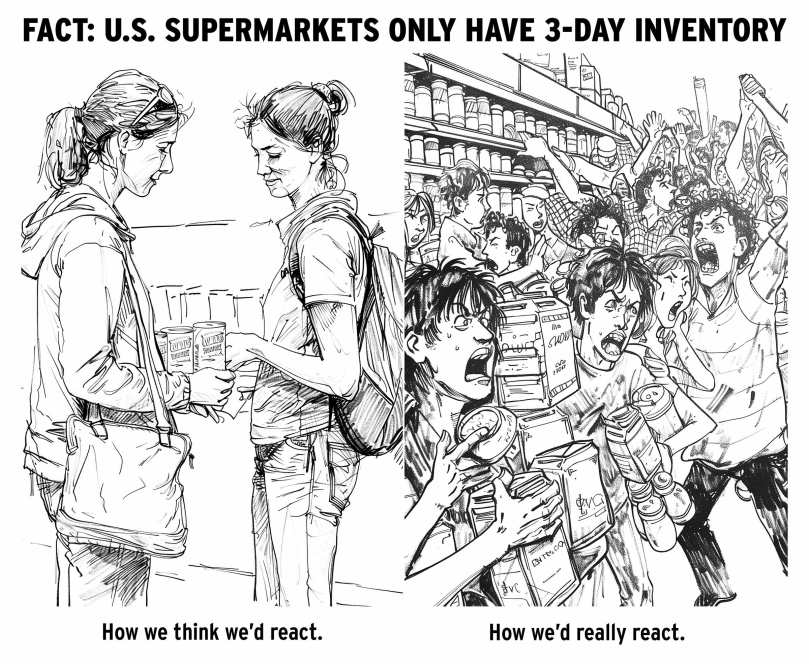
How would Americans react to food shortages?

The U.S. food supply chain, often perceived as robust and unshakeable, is far more fragile than many realize. Supermarkets typically hold only a three-day inventory of food. This revelation has raised concerns about what might happen if the food supply were to be disrupted.

The “just-in-time” nature of the food supply chain means that stores receive frequent shipments to keep shelves stocked, minimizing storage costs and reducing waste. However, this efficiency comes with significant risks. If any link in the chain — ranging from farms to processing plants to transportation networks — experiences a disruption, the impact can be felt almost immediately in grocery stores.

A disruption could stem from various sources. Natural disasters like hurricanes or earthquakes can devastate local supplies and cripple transportation routes. Even more insidious are the potential impacts of a major cyberattack or a pandemic resurgence. During the COVID-19 pandemic, for example, labor shortages at every level — from farm workers to truck drivers — led to noticeable gaps on supermarket shelves and soaring prices.

Jamie Lutz from the Center for Strategic and International Studies (CSIS) points out that the pandemic caused a significant strain on the supply chain. Increased demand from consumers, who turned to home cooking during lockdowns, combined with labor shortages due to illness, exacerbated the situation. The result was a sharp rise in food prices, making it harder for families to afford basic necessities.

Toby Hemenway, an expert on food security, explains that while the food system is indeed complex and adaptive, it’s also highly interdependent. This interdependence means that a disruption in one area can cascade through the system, causing broader impacts. He suggests that localizing food production and diversifying supply chains could help mitigate some of these risks. Hemenway argues that storing vast amounts of food in urban areas is less effective than ensuring a steady flow of goods through a resilient and flexible supply chain.

If a severe disruption were to occur, supermarkets could run out of food in just a few days. This would lead to panic buying and hoarding, further exacerbating shortages. Vulnerable populations, such as those relying on Supplemental Nutrition Assistance Program (SNAP) benefits, would be particularly hard hit. The federal government attempted to address these vulnerabilities by temporarily increasing SNAP benefits during the pandemic, but these measures are short-term solutions to a long-term problem.

While the U.S. food supply chain is designed for efficiency, its lack of redundancy makes it vulnerable to disruptions. Preparing for these potential crises involves not only improving the resilience of the supply chain but also encouraging local food production and ensuring that all communities have access to emergency supplies. The complexity of the system requires comprehensive strategies to protect against the myriad threats that could lead to empty shelves and widespread hunger.

DO YOU WANT TO KNOW MORE?

The state of grocery in North America

Feeding America in a time of crisis

High prices, empty shelves

Fear and the three-day food supply