Can humans, AI collaborate at New York Times?

A human man and a robot wave in friendship.

As a longtime New York Times subscriber, I appreciate the depth and breadth of its content, particularly the extensive online archives dating from 1851, and its coverage of arts, entertainment, and international news.

Yet, I’ve grappled with the paper’s editorial stance, particularly its approach to domestic news, which I perceive as being distinctly elitist and favoring a progressive, globalist viewpoint.

The Times’ appointment of Zach Seward as Editorial Director of A.I. Initiatives marks a significant step toward integrating generative AI into journalism.

Seward, with his impressive background as a founding editor of Quartz and a stint at The Wall Street Journal, is set to lead a small team focusing on the application of AI in news reporting. His role includes establishing principles for using generative AI in the newsroom and ensuring that The Times’ journalism continues to be reported, written, and edited by human journalists while AI tools assist them in their work.

This development brings to the forefront an intriguing proposition: Could AI play a role in addressing biases in reporting?

For instance, employing AI in copy editing might introduce a level of objectivity that I feel is sometimes missing in The Times’ reporting.

If configured to uphold impartiality, an AI-driven copy desk could potentially mitigate the paper’s perceived bias toward progressive viewpoints and its narrative on climate change and social disparities. This approach might balance the editorial tone, addressing concerns like mine about the paper’s leaning.

In conclusion, while The Times remains a valuable source for its archival content and global reporting, its foray into AI under Seward’s leadership presents an opportunity to explore new frontiers in journalism.

Perhaps, with careful implementation, AI can bring a fresh perspective to the newsroom, potentially addressing longstanding concerns about bias in media reporting.

Mystery airships of the Civil War

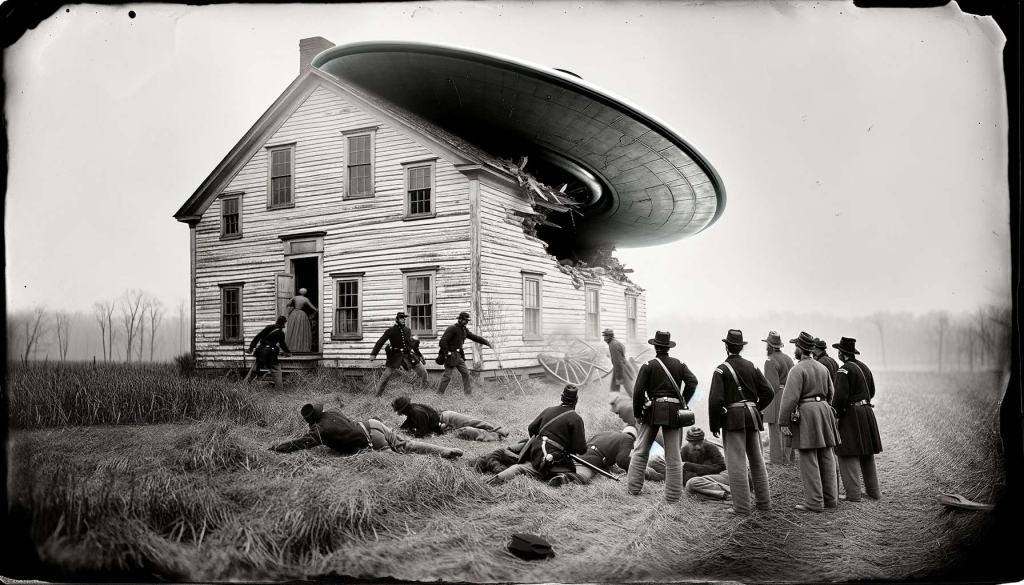
Civil War-era photo shows a flying saucer that has crashed into a two-story farmhouse.

My Dearest Cousin Lavinia,

With a spirit agitated by events most peculiar, I pen this missive. It has been but a fortnight since General Sherman’s men did descend upon Goshen Farms.

Amidst the chaos, a happening most strange and fearful took place – a great flying machine, the likes of which I could scarce imagine, fell from the sky and crashed into the side of Master Thompson’s farmhouse, laying ruin to its structure.

Under the compulsion of the General’s men, I was bade enter this abode of destruction. Within, I beheld a sight that has since haunted my slumbers.

Creatures of an aspect most unusual were strewn amidst the wreckage. They were of a slight and delicate frame, with skin as pale as the moon’s glow and eyes that seemed to hold the very cosmos. They bore no resemblance to any beast of God’s creation known to my eyes.

Their attire was of a fabric unknown, shimmering under the dim light that pierced the gloom of the shattered dwelling. Though fear gripped my heart, I could not deny a certain sorrow for these otherworldly beings so far from their home, now lying silent in their iron carriage.

I pray thee, believe my words, for what mine eyes have beheld, the mind struggles to comprehend. May the Lord grant us understanding of these mysteries in His own time.

Yours in bewildered kinship, I remain,

Jessy Worthington
Goshen Farms, Georgia

Text and photo copyright © 2024 L.T. Hanlon. All content in this post is fiction.

From machete mayhem to timeless tale: Revisiting ‘Big Jake’

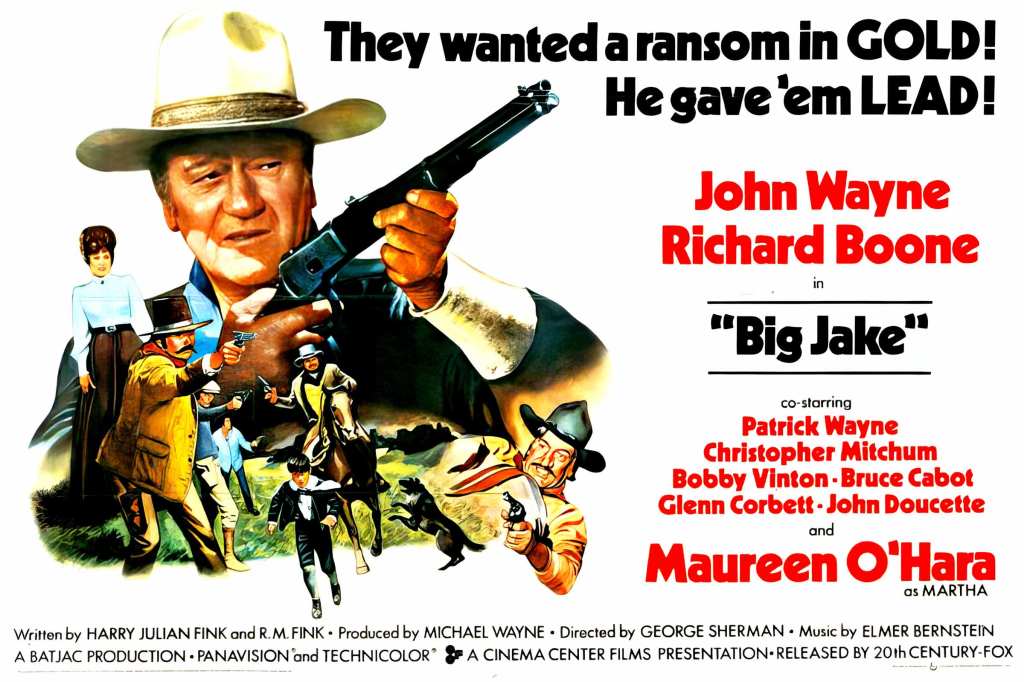
Poster for the 1971 John Wayne film "Big Jake."

Having watched “Big Jake” for the first time in more than 50 years, its timeless quality struck me. It’s amazing how this 1971 John Wayne classic could easily pass for a modern production, especially considering its graphic narrative and intense action sequences that resonate with the high-amp shocks we adore in Quentin Tarantino movies.

The film spins a riveting tale of child kidnapping, and it doesn’t shy away from brutality, much like the stylized violence we see today. There’s a particular member of the kidnap gang who wields a machete with chilling fondness. The gruesome fate of the Duke’s dog, not to mention a few unfortunate characters, reflects a brand of violence that’s unsettling precisely because director George Sherman leaves much of the violence to the imagination.

Yet, despite the grim elements, “Big Jake” remains a standout Western, thanks to a powerhouse cast including Richard Boone, Maureen O’Hara, and Patrick Wayne. The movie holds its own, even when you put it side by side with other Westerns of its era like “The Wild Bunch” or “Butch Cassidy and the Sundance Kid.” These films, too, pushed the boundaries of the genre, but “Big Jake” has a unique appeal. Its mix of traditional Western tropes with unexpectedly graphic content gives it a distinctive edge.

It’s fascinating to see how this film anticipated the evolution of cinematic storytelling, embracing a rawness and directness that would become the hallmark of later directors.

In revisiting “Big Jake,” I’ve rekindled memories of the classic Western era and gained a fresh appreciation for its forward-thinking approach to storytelling and visual style.

Is there a solution for Chicago’s winter transit woes?

A photo of Christopher Judge as Teal'c appears next to the following text: A friend of mine describes the Chicago 'L' as something akin to Stargate's wormhole network: A transportation system built by a long-vanished civilization whose motivation and technology we still only barely understand. "Indeed>"

As Chicago grapples with winter, the performance of Chicago Transit Authority rail service during challenging weather conditions has again been scrutinized.

Despite the CTA’s extensive preparations for winter, including implementing track switch heaters, equipping railcars with sleet scrapers and snowplow blades, and deploying special “sleet trains” to remove snow and ice, there have been disruptions in service.

The most notable was the temporary suspension of the Orange Line service due to a derailment. This highlights the ongoing struggle of the CTA to maintain seamless operations during extreme weather despite their evident efforts to prepare and respond to these challenges.

The CTA’s snow-removal process, crucial for ensuring safe and accessible transit, involves a coordinated effort across different entities. While the CTA is responsible for clearing its properties, including rail stations, bus turnarounds, and transit centers, clearing bus stops and shelters often falls under the jurisdiction of local municipalities or adjacent property owners. This division of responsibility can sometimes lead to confusion and frustration among transit riders, especially when areas leading up to CTA properties are inadequately cleared.

Amid these operational challenges, the CTA continues to emphasize its affordability, positioning itself as a budget-friendly transportation option for Chicagoans. With various payment options and unlimited ride passes, the CTA seeks to offer an economical alternative to private transportation, especially for events and regular commutes across the city.

Issues faced by the CTA, particularly in weathering Chicago’s harsh winters, raise questions about the adequacy of funding, staffing, and overall infrastructure investment.

This is perplexing considering Chicago’s political alignment and historical significance, being a stronghold of the Democratic party and the home of a two-term president. The juxtaposition of Chicago’s political clout and the CTA’s struggles points to broader issues in urban infrastructure and public transportation funding.

Why, in a city that has been a significant player in national politics, does its public transportation system seem perpetually caught in a cycle of underfunding and underperformance, especially in times of need such as during severe weather events”

Sure, the CTA could improve by ensuring that all entities responsible for snow removal are perfectly synchronized — but this is beyond the agency’s power.

Therefore, it may be time for a comprehensive review of CTA funding, resources, and operational strategies, particularly in light of the recurring issues during inclement weather. Such a review could focus on enhancing coordination among various municipal entities for more effective snow removal and exploring technological innovations for better winter weather preparedness.

Further, it’s worth questioning why the CTA struggles with these recurring issues despite Chicago’s political influence. This situation could reflect a broader pattern in urban politics, where local issues like public transportation often don’t receive the attention or funding they require, despite the city’s significant role on the national stage.

In a city renowned for its political history and contributions, the state of its public transportation system seems incongruous. This paradox might suggest a need for a renewed focus on local infrastructure issues, ensuring that the city’s transportation network is robust, resilient, and adequately funded to meet the needs of its residents, regardless of the weather or other challenges.

The CTA’s struggle against Chicago’s harsh winters is not just a matter of inconvenience; it reflects deeper issues in urban infrastructure, funding, and political priorities. As residents face the brunt of these challenges, it becomes increasingly clear that a strategic overhaul may be necessary to bring about the much-needed improvements in the city’s public transportation system.

Time, space, and Marty Robbins’ ‘El Paso’ saga

Today I chanced upon an excellent analysis of Marty Robbins’ El Paso song cycle. I’ve included it above, and you should watch the video — it’s that good.

I’m reminded of a blog post I published 17 years ago about the relationship of “El Paso” to “As Time Goes By” and Albert Einstein.

Round up the usual subatomic particles
(July 9, 2006)

Today at work, I needed to fact-check a reference to lyrics from “As Time Goes By” — best known for its use in the classic motion picture “Casablanca” — and discovered something pretty profound: This song’s introductory verse is actually about Albert Einstein and his Theory of Relativity.

This day and age we’re living in
Gives cause for apprehension
With speed and new invention
And things like fourth dimension.

Yet we get a trifle weary
With Mr. Einstein’s theory.
So we must get down to earth at times
Relax, relieve the tension
And no matter what the progress
Or what may yet be proved
The simple facts of life are such
They cannot be removed.

You must remember this. . .

You just don’t encounter a lot of verse introductions these days. It wasn’t until several years ago that I even heard the “White Christmas” intro about being in Southern California in December and why the singer dreams of a white Christmas.

Thanks to iTunes, I discovered another musical delight recently. I was searching for “El Paso,” the classic Western ballad by Marty Robbins and, yeah, I saw “El Paso City,” too — but also for sale was an incredible song I’d never heard before: “Feleena (From El Paso).”

This amazing song tells the “El Paso” saga from Feleena’s viewpoint and is guaranteed to evoke an almost operatic cascade of emotions from anyone like me who loves the original.

You surely know the tragic ending of the “El Paso” story, so I’ll risk a spoiler by quoting my favorite set of lyrics from “Feleena.”

Feleena knelt near him,
To hold and to hear him
When she felt the warm blood
That flowed from the wound in his side.

He raised to kiss her
and she heard him whisper,
“Never forget me, Feleena.
It’s over, goodbye.”

Quickly she grabbed for
the six-gun that he wore
And screaming in anger
and placing the gun to her breast,

“Bury us both deep
and maybe we’ll find peace,”
Then pulling the trigger,
she fell ’cross the dead cowboy’s chest.

Time — the fourth dimension — is why you might not have heard “Feleena.” The song clocks in at 8 minutes, 19 seconds, so it doesn’t get much airplay.

There’s also an internal time problem with “Feleena.” In the original “El Paso,” the young cowboy apparently spent some time in the badlands of New Mexico, yet in “Faleena,” he tragically returns the next day.

Or maybe, as Einstein might say, it’s all relative.

Young women, a young evening, and old tactics

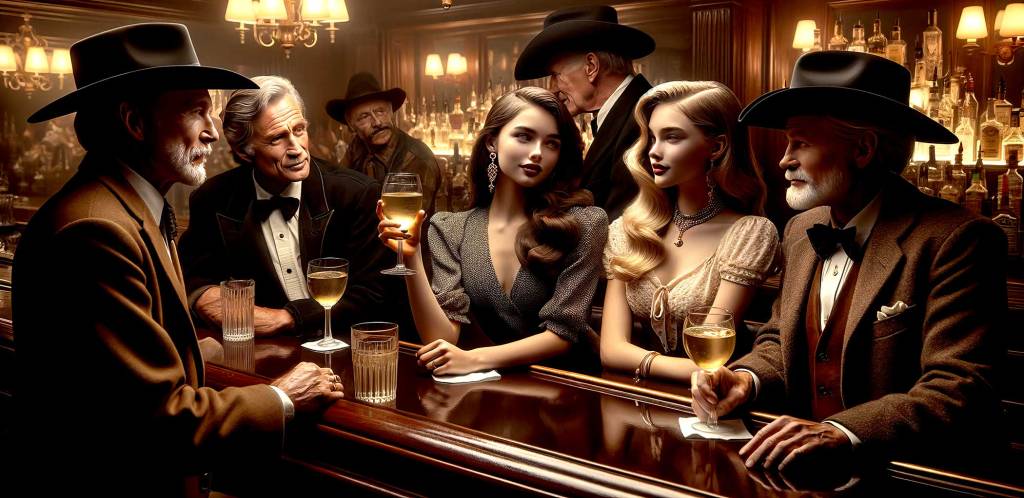
Two stunning young women sip white wine as they assess rich, older cowboys at the Brown Palace Hotel's Churchill Bar.

In the dimly lit Churchill Bar of the Brown Palace Hotel, Morgan and Debbree perched elegantly on their bar stools, sipped white wine, and engaged in their favorite pastime when the National Western Stock Show was in town: man-watching with a purpose.

The clock struck 6 p.m., and with each man who entered, they whispered assessments of looks, apparent wealth, and potential for an evening’s adventure.

Their game was interrupted as two men in black cowboy hats took seats beside them. One had a rugged charm, his eyes twinkling with mischief, while the other carried an air of quiet confidence. “Jack,” said the first with a warm smile, extending a hand. “And this is Bryce.”

Debbree, her eyes glinting with amusement, responded, “I’m Debbree, and this is Morgan. You boys look like you just rode in from the ranch.”

Jack chuckled, “Well, we might not have horses tied up outside, but we’ve got stories that’ll make you feel like you’ve been on a wild ride.”

Bryce leaned in, his gaze fixed on Morgan. “I bet we’ve got more than just stories to share. Maybe some experiences, too, if you’re interested.”

Morgan’s lips curved into a sly smile. “We’re all about new experiences. Aren’t we, Bree?”

“Absolutely,” Debbree said. “Especially those that involve a bit of adventure and … spontaneity.”

Jack raised an eyebrow. “Spontaneity? You ladies might just be in for a treat, then. Ever been to the Buckhorn Exchange?”

Morgan shook her head.

Bryce’s smile broadened. “It’s Denver’s oldest steakhouse. The kind of place where stories are as rich as the steaks. We’d love to show you.”

Debbree exchanged a glance with Morgan. The unspoken agreement was clear.

Text and photo copyright © 2024 L.T. Hanlon. All content in this post is fiction.

Celebrating 95 years of Tintin: A journey of adventure and imagination

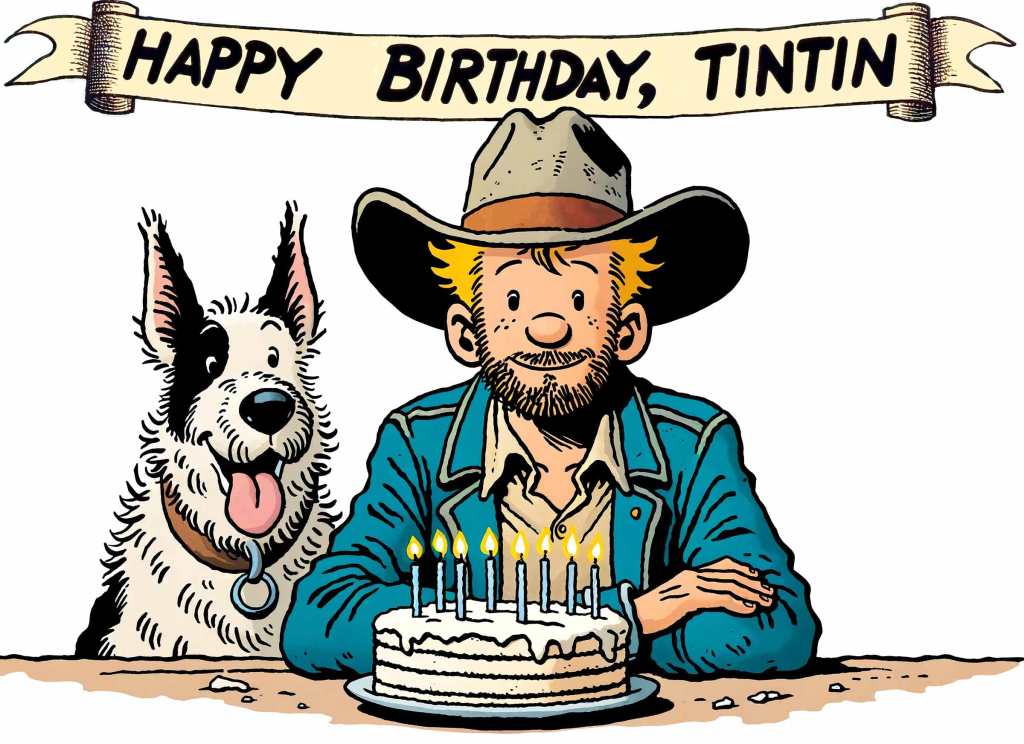
Portrait of L.T. Hanlon and a cattle dog in the ligne claire style that Hergé employed with Tintin.

As a kid who always had his head in the clouds, dreaming of airplanes, rockets, and mysteries that span the globe, Tintin was more than just a comic character to me; he was a gateway to a world of endless adventure. Today, on January 10, 2024, we celebrate an incredible 95 years since Hergé introduced Tintin to the world in 1929, marking a legacy of storytelling that has captivated generations.

From the very first story, “Tintin in the Land of the Soviets,” to the lunar escapades in “Explorers on the Moon,” each comic strip was a window into Hergé’s brilliant mind, filled with foreign intrigue and mysterious plots. As a young aviation enthusiast, I was especially drawn to stories like “Flight 714 to Sydney,” where Tintin’s adventures took to the skies, combining my love for airplanes with the thrill of adventure.

Hergé’s artistry was another aspect that set Tintin apart. His use of clear line style – or “ligne claire” – brought a unique clarity and expressiveness to the comics. The vivid, detailed backgrounds and the carefully researched settings make every panel a delight to explore. The level of detail is astounding, from the intricacies of the rocket in “Destination Moon” to the bustling streets of fictional countries.

The 2011 Steven Spielberg movie “The Adventures of Tintin” was another milestone, bringing these beloved characters to life with stunning 3-D animation and gripping storytelling. The film, for me, is a perfect homage to the original comics, especially with the clever nod to Hergé in the opening scene – a delightful treat for fans. The movie captures the essence of Tintin – the unyielding spirit of adventure, the tight-knit camaraderie, and the sheer fun of delving into a good mystery.

Tintin’s stories are timeless. They transcend generations, appealing to the sense of wonder in all of us. Whether uncovering ancient artifacts in “The Seven Crystal Balls” or foiling sinister plots in “The Blue Lotus,” each adventure is a testament to Hergé’s genius in storytelling and art.

As we celebrate 95 years of Tintin, I can’t help but wish for another 95 years of his adventures. Tintin has been more than just a character in a comic book for me; he’s been a companion in my own adventures, a symbol of curiosity and the relentless pursuit of truth and justice.

Here’s to Tintin, the quintessential adventurer, and the countless hours of delightful escapism he has provided. May his stories continue to inspire and entertain for many more years to come.

Text and illustration copyright © 2024 L.T. Hanlon.

Buster Chander buys a gun from an old friend

Buster Chander had always been a man of few words, but when it came to killing someone who had been blackmailing him, he was as clear as day.

“I want a handgun,” he said to Bisbee, owner of Silver State Sidearm Solutions. “Light enough so I can carry it all day without getting tired and still be able to aim true.”

Buster only cared a little about the brand or make as long as it could take down a man. Bisbee knew Buster well enough to understand his intentions. He nodded and began to showcase various guns on display.

“How about an AMT?” he asked, holding up a small pistol with a silencer attached. “Or maybe a Colt? Or a Beretta? We have SIGs, H&Ks, Smith & Wessons, Rugers — and even Tauruses if you’re looking for something more budget-friendly.”

Buster shook his head in disdain. “Something simple. Something I can use to put a bullet through an asshole’s skull without any fuss.”

Bisbee understood where Buster was coming from. He’d had seen plenty of cowboys like him come into his shop over the years, looking to settle old scores.

“Well, I happen to have one such gun in my underground inventory,” he said. He reached into a deep drawer under the display case and handed Buster a sleek black pistol whose plastic components made it look like a toy.

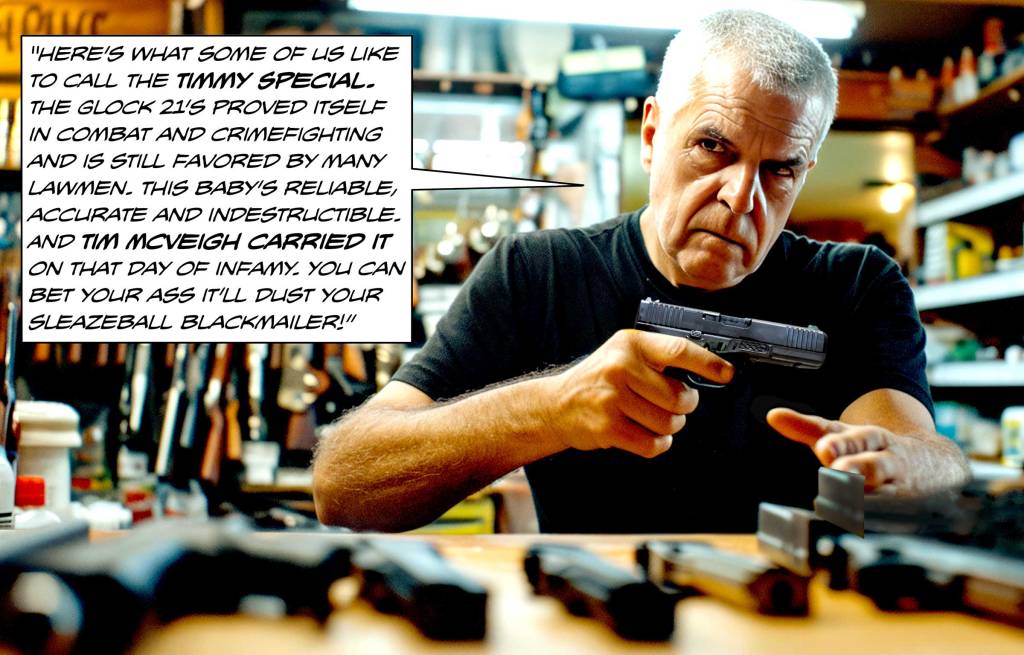
“Here’s what some of us like to call the ‘Timmy Special,’” Bisbee said. “The Glock 21’s proved itself in combat and crimefighting and is still favored by many lawmen. This baby’s reliable, accurate and indestructible. And Tim McVeigh carried it on that day of infamy. You can bet your ass it’ll dust your sleazeball blackmailer.”

Buster cleared the gun, sighted it, and pulled the trigger.

Click.

“This is the gun for you, Buster,” Bisbee said. “It’s lightweight enough to carry all day and packs quite a punch. You can solve most problems with just one shot from this bad boy.”

After some haggling, Buster paid top dollar in cash for the gun, no serial number, no records, no registration, no waiting period, fuck the feds.

With that, Buster left the gun shop, ready to blast that motherfucker to Kingdom Come.

Text and photo copyright © 2024 L.T. Hanlon. All content in this post is fiction.