High school revelation: Lyrics are poetry

During a discussion about poetry way back in a high school English class, some kid lamented that few poets other than Rod McKuen — I told you this was way back — made a living writing the stuff.

Our teacher, however, disagreed, and pointed out that plenty of folks, including McKuen, make a comfortable living writing poetry as song lyrics. What then followed was a fascinating discussion of song lyrics through the years.

What also followed was my first taste of the bad American tendency to enjoy disparaging successful people. More than a few of my classmates had already formed opinions that McKuen was a hack, a purveyor of kitsch, and a populist phony. I lacked the courage to ask them how McKuen was any different from the Beatles.

Over the years, I’ve often recalled that day at Jefferson High School when encountering a particularly good song lyric. Like just a few days ago when Apple Music played on past my KDP Rodeo Days playlist and treated me to “I Don’t Feel That Way Anymore” by Danni Leigh.

I love these lyrics. . .

Well, I’d love to take my clothes off
and throw them on your floor.
And I would,
but I don’t feel that way anymore.

How about you? Have you discovered any lyrics lately that you like?

I love the turn of phrases in “I Don’t Feel That Way Anymore.”

The perplexing packaging plight of everyday items

Photos of the packaging for Imodian A-D soft gels and Duracell CR2032 lithium batteries, both of which are a challenge to open.
I swear, the difficult-to-open packaging for both these products is enough to make you shit your pants.

Why, oh why, has accessing a CR2032 lithium battery become as complex as deciphering Morse code?

As if the extraction challenge weren’t enough, they’ve added a bitter coating to deter the adventurous kiddos from giving it a taste test. While I champion the safety-first approach, I’m left scratching my head when the same layer seems to revolt against some of my devices, including my beloved AirTags.

Ironically, there’s a quirky remedy to this. A dab of isopropyl alcohol or a swipe with a wet paper towel revives the battery’s spirit by washing off the bitter coating. And, in my moment of curiosity, I gave it a lick. It’s bitter, all right, but hardly the worst thing on the flavor spectrum.

Now, let’s shift gears to Imodium A-D soft gels, which come with their own catalog of woe. Because some folks have discovered that abusing these gels in high dosages produces opioid-like effects, there’s a federal restriction on the number you can buy at once.

In addition, the gel caps aren’t sold in bottles anymore but in blister packs that test my patience. The elaborate ritual to access just one gel cap feels like an intricate dance sequence. And I’m no Fred Astaire.

On the brighter side, the liquid version of Imodium is refreshingly user-friendly. Pop, pour, and done.

I’ll take a moment to mention a longstanding beef over the presence of combination prescription tablets with codeine and acetaminophen.

I’m one of those conspiracy-minded folks who think liver-toxic acetaminophen in the combo is less for the convenience of having both medications in one tablet and more for deterring those inclined to pop multiple pills recreationally. Why is this a deterrent? Because there’s a risk of destroying your liver with high doses of acetaminophen. I see no reason codeine and acetaminophen can’t be prescribed as separate medications.

To wrap up, while safety is paramount, there must be a middle ground. If using everyday items becomes a Herculean task, it’s time for creative rethinking.

Until then, you’ll find me here, wrestling with a battery pack, yearning for the days of more straightforward access.

Predictable patterns: How AI holds a mirror to our universal storytelling

Calvin and Hobbes comic strip in which Calvin defends creating generic snowmen.
Did Bill Watterson have Calvin predict the coming of AI-created content?

It’s an age-old debate in art and creativity: what is true originality? Every artist has tapped into universal themes, stereotypes, and structures that resonate with audiences, from Shakespeare to Spielberg. As we dive into the 21st century, a new contender has entered the arena—Artificial Intelligence. As writers and creators turn to AI for inspiration and even content generation, skeptics raise eyebrows. But is there really much difference between human-generated clichés and those constructed by algorithms?

Let’s consider popular genres.

Despite the studio, superhero movies often orbit around a protagonist with a tragic backstory, a formidable antagonist, a colossal battle, and a resolution.

Similarly, romance novels are interwoven with familiar tropes: enemies to lovers, hidden royalty, or the classic will-they-or-won’t-they.

Spy thrillers? A charismatic lead, global stakes, high-octane chase sequences, double agents, and plot twists.

Sounds formulaic? That’s because it is.

And it’s not just limited to literature and film. Pop songs have their share of predictable patterns. Inevitably using Auto-Tune, sometimes called the “Cher effect,” gives vocals a distinct robotic sound.

And can we ever have enough of the word “baby” in our love songs? A college instructor told us that if we ever wanted to know how “baby” is overused in song lyrics, substitute the words “boat dock.” She was joking, but now, 50 years later, I still hear . . .

“Be My Boat Dock”
“Boat Dock Love”
“Love to Love You Boat Dock”

. . . well, you get the idea.

What we’re encountering isn’t a deficit of originality but a reflection of our collective consciousness — a set of stories, beats, and patterns that resonate universally. If these patterns are deeply embedded, why shouldn’t an AI designed to recognize and emulate patterns produce something similar?

AI’s ability to create isn’t about replacing human ingenuity. It’s about acknowledging that much of what we consume and call “original” is often derived from age-old patterns. If a machine can replicate those patterns, it doesn’t demean our art — it merely reflects our preferences.

To dismiss AI-generated content as “unoriginal” means confronting an uncomfortable reality about our tastes and patterns.

Instead of shunning silicon assistance, it may be time we embrace it. After all, whether it’s Shakespeare, Spielberg, or an AI, aren’t we all just looking for a good story?

By the way, that “Calvin and Hobbes” strip was shared with me many years ago by a famous comics artist. We got a good laugh of it — but I doubt either of us predicted AI’s coming impact.

Do Red Solo Cups leave you slippery and wet?

Screen shot of Betty Rubble making the shape of a square.
Read on and learn how to conquer a Red Solo Squared cup.

As you might know, Solo changed the shape of its famous round cup a few years back. The company adopted a square design to help prevent the cup from sliding out of partygoers’ hands.

My experience with the iconic product wasn’t all that extensive until recently when I embraced the cup for its ease of use and 18-ounce capacity to avoid repeated trips to the coolerator.

I figured they’d solved the slip-and-slide mystery that turns a simple drink into a mess. But boy, was I wrong, at least in my case.

Picture this: I’m in my apartment, set to enjoy a full-sugar, ice-cold Pepsi-Cola. I fill the Solo cup with crystal-clear, commercially produced ice, pour in Pepsi fresh from the freezer that had almost but not quite reached Slurpee consistency, and fill the cup with cola goodness.

I reach for the cup, and Solo flies from my sausage snappers like a greased pig at a county fair. Next thing I know, Pepsi’s doing the cha-cha across my 18-percent gray, wall-to-wall carpet.

The redesign seemed to make sense: Square the cup, slap on their logo, and — for a laugh, I guess — throw in some pleasure dots. Like something you’d find on a … well, let’s not get into that.

For all I know, the improved design reduced most users’ butter fingering.

But guess what? My ham hands weren’t having any of it. Slip, drop, splash. Again and again.

When I thought I’d have to ditch Solo for good, I stumbled onto a game-changer. Before you pour in your poison, give that cup an outside rinse with hot water. This probably washes away some residual lubricant or antistatic agent left over from the factory.

So, try it the next time you’re ready to party with Solo — and banish those butterfingers quicker than you can say, “Last Tango in Paris.”

Hitler, a cat, and the allure of deceptive beauty

Frames taken from "Triumph of the Will" appear to show Hitler and a cat looking at each other."
Adolf Hitler and a cat exchange glances before the Nuremberg Rally.

Several years ago, I went to a film party held at a friend’s big-ass house in, of all places, the Lincoln Square neighborhood. The hood was once heavily German, an irony that will be apparent shortly.

The crowd was a motley crew of film students, history buffs, and just plain hangers-on. I wound up there because I’d had dinner with friends who knew about the party and dragged me along.

The first few films at the event were funny World War II-era shorts, many requiring a trigger-warning disclaimer today but still riotously funny. I’m talking stuff like Looney Tunes’ “Tokio Jokio,” Paramount’s Superman cartoon “Japoteurs,” and then British intelligence’s “The Lambeth Walk: Nazi Style.”

Right after the Teutonic “Lambeth Walk” came the film that had provided its inspiration: Leni Riefenstahl’s “Triumph of the Will.” On the surface? A propaganda machine oiled and prepped by the Nazis.

But dive deeper, and you’ll see the sinister craftsmanship — the kind that seduces you with visuals, as tempting as a fresh streuselkuchen straight out of a Berlin bakery.

Artistic? Sure. George Lucas thought so, snatched that Nuremberg Rally three-person strut for “Star Wars” (1977). Brian De Palma? He nabbed it for “Mission to Mars” (2000). Tinsel Town got its claws on Riefenstahl’s shots a long time ago.

Yet, here’s the deal: No one’s lauding the message, just acknowledging the craft. Is it kosher to admire a snake’s beauty, knowing it can bite?

This post came about because I’ve finished reading “Leni Riefenstahl: The Seduction of Genius” by Rainer Rother, which prompted me to watch “Triumph of the Will” again.

My favorite scene? The one where Hitler looks up from his motorcade Mercedes-Benz and locks eyes with a cat. The cat’s perched at a window beside a swastika flag, taking in the show. A moment of serendipity in a film otherwise dense with choreography. Those eyes, Hitler’s and the cat’s, a dance of curiosity in a world on the cusp of darkness.

But I’ll be clear: Nazis? They’re the storm cloud in every silver lining. Admiring Riefenstahl’s work isn’t a salute to them. It’s a nod to a filmmaker’s ability to make evil look good, a reminder always to question what we see.

FOR MORE INFORMATION

“Triumph of the Will” analysis.

The real “Lambeth Walk” from “Me and My Girl.”

‘Die Hard’ word search

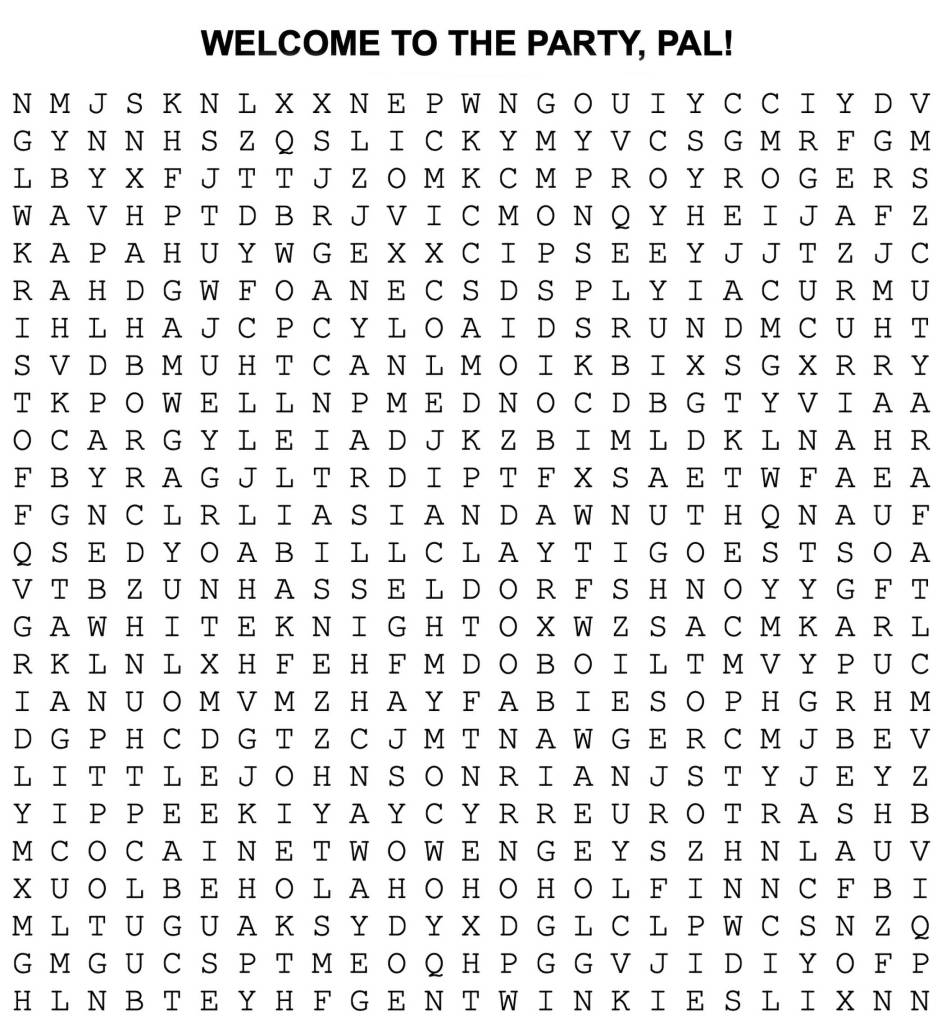
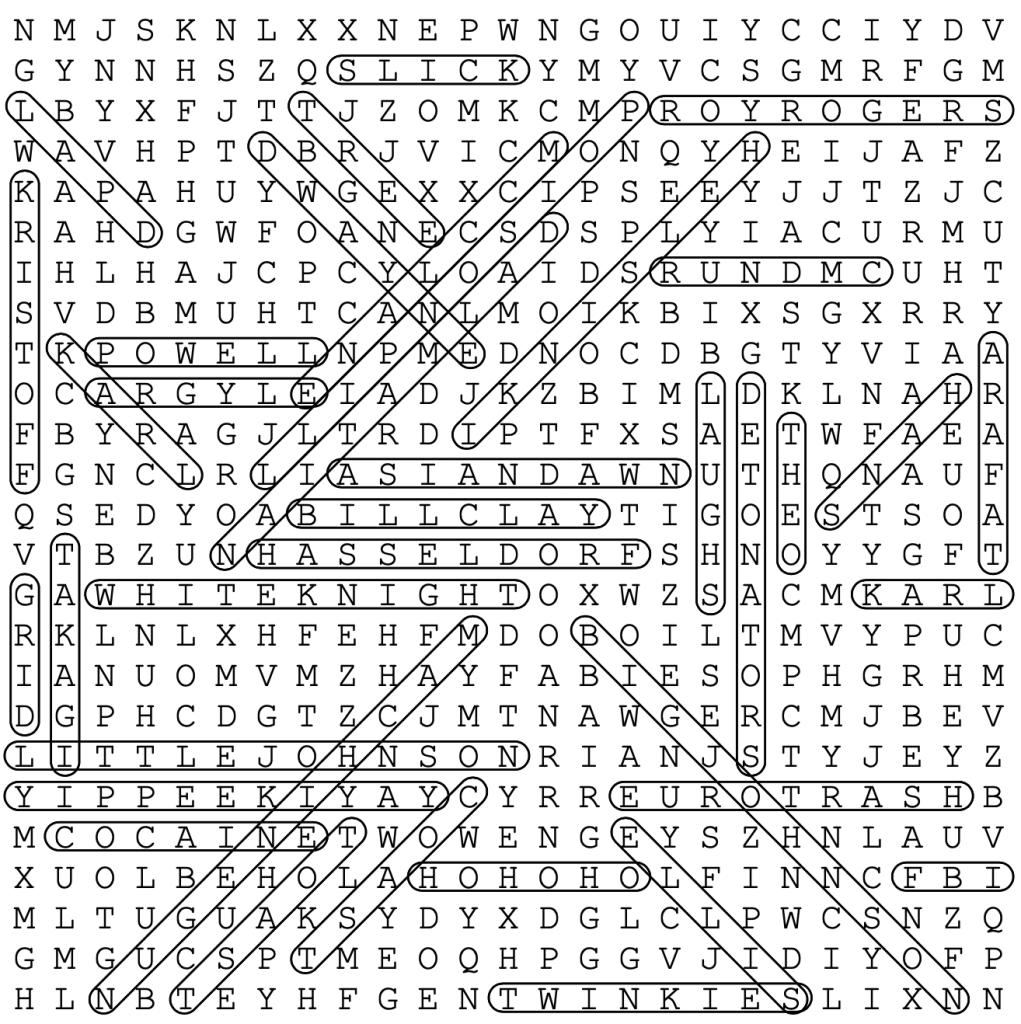
I didn’t have time to publish my “Yule be Sorry” Christmas newsletter last year, so I’ve been working on it earlier this time. In addition to a crossword, I’m considering including a word search puzzle. Something along the lines of this one I threw together. Printing the post itself usually won’t work well, so click here for a printable version.

Too easy? Too hard? What do you think?

BIG JOHNSON
TREE
ARGYLE
TWINKIES
MACHINEGUN
ASIAN DAWN
SLICK
DWAYNE
YIPPEE KI YAY
DETONATORS
ELLIS
HELSINKI
TAKAGI
HANS
ARAFAT
KARL
EUROTRASH

DALMATIAN
HASSELDORF
POISON PILL
RUN DMC
THEO
KARL
GRID
FBI
COCAINE
LAPD
COAST
TOAST
POWELL
LAUGHS
ROY ROGERS
BILL CLAY
LITTLE JOHNSON