The woman motorist early in the video? Whoa. I want to see an interview with her boyfriend or husband. Yikes! And I agree with other commenters that in this compilation, Trooper James Byrd has the best line I’ve heard in a long time. . .
“I ain’t playin’ around with you. You can play that shit over in Tennessee, but you’re not playing it here.”
As I’ve been experimenting with AI-assisted writing and editing, I’ve been thinking about how it will shake up the world of work and make many jobs go the way of the dodo.
He says the disruption’s coming fast. Faster than the industrial or digital revolutions. Jobs? Poof. Gone. But he isn’t all doom and gloom. He says it’s not just about handing out universal basic income like Halloween candy. People need agency, a reason to get up in the morning.
Altman’s way with words impresses me. He says humans find “great satisfaction in doing something useful,” something that lets us “add something back to the trajectory of the species.” What a great way to describe that need and feeling most of us share.
But what jobs are already circling the drain? Cashiers? We already have machines for that. Truck drivers? Self-driving semis are on the horizon. Writers and editors? You’re reading AI-generated stories all over the place.
What about bartenders? Can you imagine a robot listening to your troubles or cutting you off when you’ve had one too many? Some jobs need the human touch. But others? Sayonara.
Is it all happening too fast? Hard to say. But one thing’s sure: We can’t cram this genie back in the bottle. We’re on this rollercoaster, and there’s no getting off. So, what’s the plan? Retrain? Find new gigs? Or do we just sit back on our lazy asses and let the machines take the wheel?
Altman’s right: We won’t run out of stuff to do. Humans are restless. We always have been. But must we eternally labor, always sing for our supper? Maybe not. But we’ll find new ways to contribute, to matter. We’re built that way.
I wish I weren’t clocking in at 70. I’m sliding down the far end of the bell curve and won’t be around to see AI’s full Monty. But for those who will, buckle up. It’s going to be one hell of a ride.
The Rocky Mountain News tells the sad story of suckers taken for a ride.
While sorting through a box of newspaper clippings the other day, I found a painful reminder of my experience in 1974.
Back then, I was just another college kid with Hollywood dreams. Wanted to write and direct movies, be the next Coppola or Spielberg.
I had no talent but a pantload of enthusiasm.
So, when an ad popped up in the local papers, it was like a sign from the movie gods. Walt Disney Productions, no less, was looking for fresh meat — actors, crew, you name it — for a film in Denver.
My buddy and I were over the moon. Thought we’d hit the jackpot. All we had to do was show up at a Holiday Inn next to Mile High Stadium, get interviewed, and fork over 15 bucks for a union application. Had to be a check, though. No cash.
We did the song and dance, answered questions, and wrote the checks. As we were leaving, strutting like Travolta in “Saturday Night Fever,” in comes Denver District Attorney Dale Tooley flanked by a couple of cops.
It was easy to connect the dots. We bolted and stopped payment on those checks faster than you can say, “Cut!”
Months later, the Rocky Mountain News ran the story. Turned out 90 suckers got taken for a ride to the tune of $1,417.50. Adjusted for inflation, that’s close to nine grand today.
But the kicker? We have yet to figure out why they wanted checks instead of cash.
It was a lesson, all right. Showed me the world is full of hustlers and dreamers and that if you’re gonna shoot for the stars, you better have more than a slingshot.
So, here I am, still no closer to Hollywood years later. But I’ve got stories that could fill a screenplay or two.
And every time I think about that scam, I can’t help but chuckle. It was a cheap lesson in a world where nothing’s free.
“Law Talk With Mike” takes you on a high-octane, shag-carpet joyride you’ll enjoy every day.
If you haven’t caught “Law Talk With Mike,” you’re missing the fun boat.
Michael J. Gravlin, Chicago’s legal YouTube maestro, turns courtroom Latin into barroom English quicker than you can shout, “Objection!” The show? Think of it as a comedy club where the American justice system is both the joke and the punchline.
“Law Talk With Mike” is one of those YouTube channels you can’t help but binge, like a “Breaking Bad” season, but with less meth and more legal jargon.
Gravlin’s channel features a compilation of proceedings from our nation’s courts. And, boy, does this guy have a knack for keeping the show rolling. Sovereign citizen starts spouting nonsense? Boom! Out comes the red fez. Something bonkers happens? It’s time for the screaming goat toy. Yeah, you heard me right, a screaming goat toy. It’s like a courtroom version of a laugh track, only always on point.
One recent episode — Gravlin titled it “Vaseline!” — had me in stitches. It involved a defendant caught doing something so embarrassing in his car, parked in a CVS lot, it’d make a Kardashian blush. Gravlin tore into the case with the snark you’d expect from a late-night host, only with a law degree.
But here’s the kicker: Gravlin’s not just some talking head. He’s built a community around these online court shenanigans. The guy’s got over 1,400 episodes under his belt and is closing in on 200,000 subscribers. And amid the humor, he provides genuine insight into the legal process in which he’s been involved as a prosecutor and a personal injury and workers’ compensation attorney.
Thanks to Gravlin’s success, he’s helped turn judges, prosecutors, and even serial defendants into minor celebrities. It’s like the Marvel Cinematic Universe, but for people who can’t fly or shoot lasers from their eyes.
The guy’s got a new episode almost every day, sometimes more. So, if you’re tired of the same old reruns and want something that’ll make you laugh, think, and occasionally cringe, do yourself a favor and check out “Law Talk With Mike.”
Trust me, it’s the kind of ride you won’t want to get off.
Today, the act of writing might seem like a bygone era to some. But for those who value the tactile experience of pen on paper, a well-crafted pen isn’t just a tool — it’s a statement.
And if you’re looking for a statement, look no further than the lineup of finely engineered pens by RIIND.
I own three of the company’s iconic designs, I can confidently say these aren’t just pens — they’re an experience. Each meticulously crafted one is a testament to the brand’s commitment to excellence.
Let me take you through my collection:
“The Pen” — This is where my RIIND journey began. Their original design accepts the much-loved Pilot G2-type refills. (This includes refills with PIlot’s incredible, erasable FriXion ink.) Sleek, sturdy, and built to last, “The Pen” embodies precision and elegance.
“The Compact Pen” — This shorter rendition of the original caters to those who prefer Parker-type refills. Don’t be fooled by its size, this compact marvel packs in all the features of its elder sibling.
“The Slim Pen” — The Slim Pen redefines minimalism. With its shorter, slimmer profile and absence of a clip, it is designed for the modern minimalist. And like the Compact, it graciously accepts Parker refills.
But the genius of RIIND doesn’t stop at aesthetics or refill compatibility. One of the standout features of these pens is the innovative continuous cam mechanism. By simply twisting a small piece at the end, the pen point is smoothly advanced or retracted. The best part? You can twist it in either direction. This is not only functional, but it also doubles as a fantastic fidget device.
Now, let’s talk refills. With RIIND, you’re spoiled for choice. Whether you’re a G2 enthusiast or a Parker purist, there are a lot of options available. It’s this accessibility, paired with impeccable design, that makes RIIND stand out.
While I might not indulge in many luxuries, the joy of holding a fine pen is an affordable indulgence I allow myself. To write with a RIIND pen is to celebrate the art of writing, and I wholeheartedly recommend one to every pen aficionado out there.
NOTE: For some reason, Pilot designated its gel pen and refill as “G2” — or “G-2”; the company can’t decide how to style the name. Unfortunately, Parker had already designated its refill as “G2” many decades ago. To avoid confusion here, I’m calling the Pilot refill a “G2,” and the Parker refill a “Parker.”
In bizarre and often peculiar crimes, one category has consistently piqued my curiosity: panty banditry.
You might wonder why these seemingly trivial incidents have captured my attention, and I’m here to shed some light on this peculiar fascination.
It all began during my early days working for a Denver-area weekly newspaper in the mid-1970s.
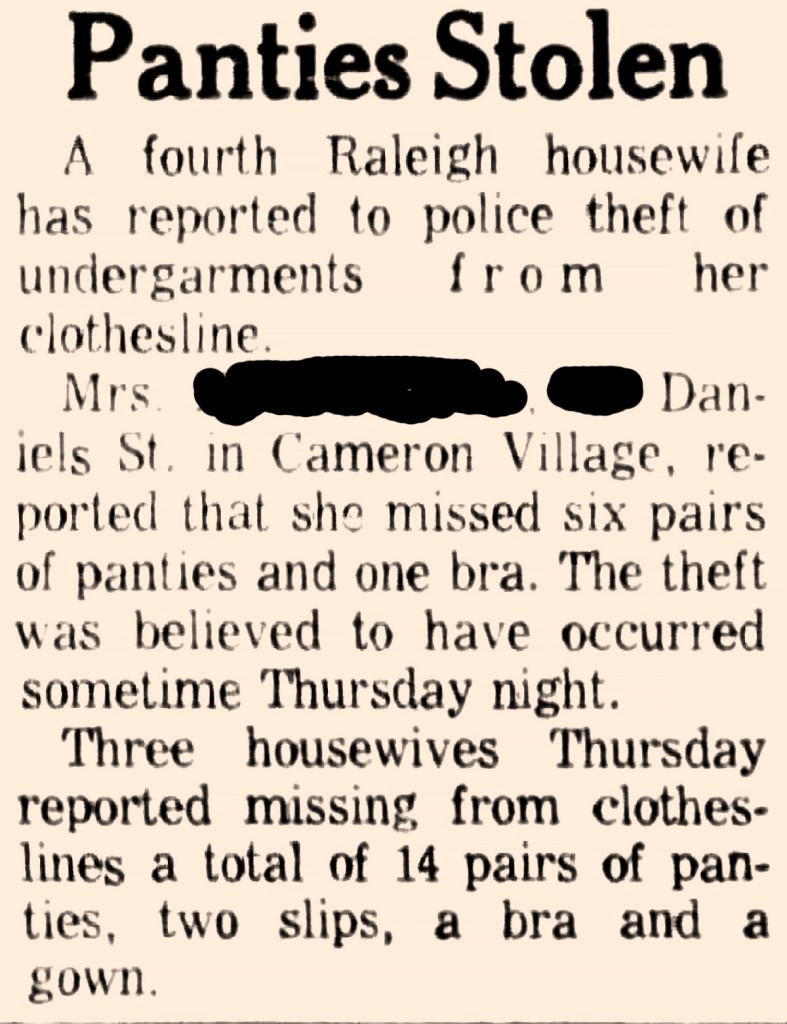
Panty banditry reported by The News and Observer of Raleigh, North Carolina, in its October 15, 1960, editions.
I had just started my career in journalism, and my responsibilities at Sentinel Newspapers’ Aurora and Southeast Denver editions included compiling the police blotter. A peculiar trend emerged amid the usual incidents of petty theft and minor misdemeanors: reports of someone stealing pink panties from apartment complex laundry rooms.
One day, my editor, a no-nonsense woman who’d worked with Gannett’s Al Neuharth, casually asked if the cops had referred to the suspect as the “Pink Panty Bandit” yet. My answer was affirmative, and she promptly instructed me to adopt the same terminology in writing up the police blotter.
Thus, the legend of the Pink Panty Bandit was born.
What intrigues me about panty thefts is that, to this day, they are not taken as seriously as they should be. A quick dive into newspaper archives reveals a troubling pattern that a handful of these panty bandits often commit more serious offenses. It’s a disturbing trend that underscores the importance of not dismissing these seemingly harmless crimes.
Today, journalists take great pains to avoid identifying crime victims, but that wasn’t the case in days gone by. A typical item about panty banditry would report victims’ names, exact addresses, and even their daily routines. “The victim, Betty Smith, 27, a registered nurse who lives at 123 Main St., told police she lives alone and discovered the panties stolen upon returning from working the late shift at Happy Valley Community Hospital.”
I redact most of this identifying information when displaying panty theft stories.
What’s equally interesting is the apparent gender bias in these crimes. I’ve scoured countless archives, and I’ve never come across a report of a woman stealing panties or men’s underwear.
Not only is panty banditry a uniquely male pursuit, but it peaked in the 1950s. In later years, the crime’s decline coincided with the widespread adoption of dryers, replacing clotheslines for laundry drying.
The allure of panty banditry lies in its peculiar nature, the bizarre alias, and the intriguing patterns that emerge from these small newspaper articles. It’s a window into a world where the most mundane crimes can carry unexpected weight and where the past holds secrets and lessons waiting to be uncovered.
My CCRadio Solar will be a great resource in an emergency. In the meantime, the radio is a stellar performer on AM, FM, and NOAA Weather Radio.
Every week, I check the power level on my CCradio Solar to ensure its battery is charged.
Just in case.
We live in an era dominated by smartphones. These pocket-sized devices have transformed our lives in countless ways, granting us unparalleled connectivity and access to information. But while smartphones are immensely versatile tools, a smartphone is not an emergency radio.
“But I can access any news site or weather app from my phone,” you might argue. Under normal circumstances, your smartphone can inform you about global news, local incidents, and upcoming weather conditions. In short-lived emergencies, such as power outages or brief network disruptions, a smartphone can be a lifeline, giving you essential updates.
However, the value and utility of a dedicated emergency radio, especially one that can receive AM, FM, and weather service broadcasts, should never be underestimated.
Here’s why:
1. Battery Longevity: An emergency radio is built to last. Many models have hand-crank or solar power options, ensuring they remain functional even when electricity sources are compromised. Smartphones drain batteries rapidly with their myriad applications and features. In prolonged emergencies, a dead smartphone is of no use.
2. Network Dependence: Smartphones rely heavily on cellular or Wi-Fi networks. These networks can be overloaded or down in disasters, rendering smartphones useless for gathering information. An emergency radio operates independently of these networks, directly receiving broadcasts to keep you informed.
3. Specificity of Broadcasts: Weather service broadcasts on emergency radios provide specialized information tailored for emergencies, including storm tracks, evacuation routes, and shelter locations. This targeted information might not be readily available on general news sites or apps.
4. Durability: Emergency radios are often built with rugged designs to withstand adverse conditions. Smartphones are generally more fragile, susceptible to water damage, and not designed to endure extreme conditions.
While smartphones are indispensable tools in our modern lives, they cannot replace the tried-and-true reliability of a dedicated emergency radio. It’s always wise to invest in an inexpensive emergency radio, ensuring you have a dependable source of information when it matters most. In an emergency, being well-informed can make all the difference.
Adobe Firefly Image 2 beta (left) and Midjourney 5.2 conjure up some cowboys.
The fusion of technology and artistry is continually evolving in the dynamic realm of AI-driven image generation. As someone who’s been embedded in the world of digital imagery, I was eager to see how Adobe Firefly Image 2 Beta squares off against its competitor, Midjourney 5.2, in generating photorealistic images from a textual cue.
I gave the same prompt to both AI tools:
Two 30-year-old white, male scruffy cowboys hold beer cans as they lean against a brick wall outside a small-town bar. It’s night, it’s raining, and they’re kept dry by a small overhang at the bar’s entrance. A red neon sign reads “Cattlemen’s Club.” Technicolor Anamorphic Panavision.
The outcomes, however, varied significantly. I chose the best of several images created by each chatbot.
To begin, neither chatbot managed to create the “Cattlemen’s Club” neon, each failed to have the guys holding cans, and Midjourney ignored the brick wall request.
Let’s talk about the winner first.
To the right, Midjourney’s rendition is nothing short of cinematic. This isn’t just an image; it’s a narrative. The atmospheric depth suggests multiple tales — from intense crime capers to heartwarming Hallmark moments. And the cowboys? Their faces are canvases, each conveying a story, making them irresistible whether they’re your knight in shining armor or just a night of careless passion.
Now, let’s shift our gaze to the left.
Despite its reputable lineage, Adobe’s Firefly Image 2 Beta presents an image reminiscent of a low-budget TV show. The lighting is overly bright, missing the nuance and depth that makes for compelling imagery. And our cowboy duo? Sure, they’re probably nice guys, but nice guys finish last.
However, Firefly’s modus operandi deserves mention. The AI’s user-friendly interface allows minimal prompting and offers menu options to tweak artistic style, background focus, lighting, and more. It’s possible I leaned too heavily on the textual prompt and didn’t dig deep enough into these refining features.
While Midjourney 5.2 took the lead this time, the AI imagery frontier remains vast and uncharted. Firefly’s track record in Photoshop, from skillfully replacing skies to completing fragmented elements, is undeniable. So, I’m optimistic about its future iterations.
Competition fosters innovation. As these AI tools lock horns and evolve, the creative community and consumers stand to benefit the most.




 L.T. Hanlon