Michael Moriarty demonstrates how big earthlings’ mouths get when they’re controlled by The Stuff, an extraterrestial goo masquerading as a frozen dessert. Watch “The Stuff” free on YouTube.
Started with a bubbling, gooey substance oozing from the earth. People taste it. Big mistake, but hey, it’s delicious — and they’re hooked. It’s dessert, it’s a lifestyle, it’s an addiction. Everyone’s gobbling it up.
Enter a corporate saboteur, a young boy, and a disgraced FBI agent played with gusto by Michael Moriarty. Odd trio, but they’re onto the deadly secret of The Stuff. They’ve got to stop its rampage and the clock’s ticking.
Cohen’s direction? Genius. This isn’t your run-of-the-mill horror; it’s a satire. Think about consumerism, 1980s corporate greed, and the junk we feed on, literally and metaphorically.
Subtle? Hell no. Fun? You bet your ass.
Laughs and screams intertwine. The practical effects are pure ’80s charm. Watch folks get devoured by tasty white goo, and tell me you don’t chuckle and cringe simultaneously.
So, if you’re yearning for something different on your screen, this flick’s your ticket.
Television has seen only a few theme songs that have excited viewers and encapsulated the essence of the shows they introduce. Paul Sawtell’s composition for the series “Voyage to the Bottom of the Sea” stands out as a masterstroke, and here’s why.
From the first haunting sonar pings of the main title, listeners are instantly transported to the vast and mysterious realms of the ocean. This isn’t just any ocean but one filled with intrigue, danger, and grandeur. Sawtell’s theme is a siren song, drawing us deep into the depths of the story before the actors even have a chance to say their lines.
But the end credits truly crescendo into something magnificent. With a sweeping dance of deep brass and soaring strings, there’s a feeling of culmination, like returning from an epic voyage. It paints an audioscape of sea monsters, heroic submariners, glimmering treasures, and shadowy threats. The grandeur of these compositions makes one think of oceanic sagas from eras long past.
Unfortunately, the series’ scripts didn’t always rise to the lofty standards set by this stirring music. But Sawtell’s gift to “Voyage to the Bottom of the Sea” is unassailable. While storylines may falter, music can remain timeless, and Sawtell’s theme stands as a testament to this – echoing through the annals of television history as one of the best.
Integrating artificial intelligence into writing and illustration projects has seen its fair share of contention.
Yet, when done judiciously, AI can significantly enhance these creative processes. Embracing AI in my writing and illustration projects is not about relinquishing my creativity but rather about harnessing tools that make that creativity sharper, more refined, and more impactful.
To understand my viewpoint, it’s vital to realize that, historically, writers and illustrators have always sought aids and tools to improve their work.
The progression has been relentless, from the quill pen to modern-day word processors. AI is just another step on this evolutionary ladder.
Is it wrong for machines to relieve us of complex tasks? Is it unethical to set a DSLR to the automatic setting, that little green square that tells the camera to adjust exposure and focus automatically?
Of course not. That green square upholds photographers’ creativity, helping them quickly achieve their vision.
Sometimes, tools, whether human or AI, are needed to refine and enhance our initial creative bursts.
For years, I worked as a copy editor, enhancing and sometimes heavily revising the work of others, many of whom struggled profoundly with the art of writing. Nobody whined about the ethical implications of my input or its impact on the originality of the content. So, why the outcry when silicon does the job?
The era of AI isn’t about the machine surpassing us but about us working hand in hand with technology.
Whether a human tool or a silicon-based one, the goal remains unchanged: to improve and refine my creative expressions.
Let’s embrace AI not as a threat but as an ally in our continual pursuit of excellence in writing and illustration.
I don’t always ride Google’s search engine. (Midjourney synthagraph)
All right, folks, let’s chat. The U.S. Department of Justice has gone after Google with antitrust charges — and honestly, it’s got many of us shaking our heads. Let’s break down what’s going on.
First off, Google isn’t stealing cookies from the cookie jar. They’re spending big bucks, fair and square, to have that sweet spot on our browsers. And guess what? The folks who own those browsers? They’re not forced to sell that spot to Google. They’re choosing to because it’s good business. If some other search engine wanted to fork out the cash, they could have that spot, too.
Now, let’s talk about search results. Yeah, I admit, I use Google. Why? Because for a ton of my searches, they’re just plain better.
But I’m also a fan of underdogs. Bing? They’ve surprised me more than once with top-notch results. And DuckDuckGo? It’s a great way to guard your privacy.
Google isn’t some sinister monopoly; it’s about getting the best bang for your click.
But here’s the rub: whenever someone does well in America, a line of folks is waiting to knock them down a peg.
Remember when Google was a scrappy startup? Where were AltaVista, Magellan, and HotBot when Google was on the rise? Oh, right, they got outpaced.
Think about our homegrown heroes – Amazon, SpaceX, eBay, Tesla, Microsoft, Apple. None got a free pass to the top. They clawed their way up, took risks, and made it big. And now? They’re household names.
Instead of applauding folks who make it big, we’re waiting to tear them down. What’s next? Will we make everyone play on the same level, even if they’re not bringing the same game?
You’ll be blown away by this one. Could it be that there are no coincidences?
Here’s the deal. I stumbled on this video, right? Puts “Back to the Future” and the September 11 attacks in the same sentence. Sounds like mixing apple pie and motor oil, doesn’t it? But bear with me.
First off, Marty McFly. Guy’s a regular teen with a crappy family and a DeLorean. He gets into a time machine and aims to fix his life. We’ve all seen the flick.
It’s Americana wrapped in Spielberg, a rollercoaster of a movie. But put it next to one of America’s most tragic days, and your brain starts doing somersaults.
This video claims all these “hints” and “clues” peppered throughout the film point to 9/11. I’m talking about clocks, license plates, scenes that should be viewed upside-down, and even lines of dialogue. Makes you think Marty should’ve been more worried about a national catastrophe than his parents’ lame love story.
So I watched it.
Once.
Twice.
Then, a third time after eating half a bag of kratom gummies because, hey, why not?
And I had a full-tilt freakout. Not because I bought into it but because someone sat down and stitched this wild quilt of conspiracy. Like taking pieces of a Picasso and a Pollock and saying they tell the same tale.
I’m not the tinfoil hat type. There are no alien abductions or Bigfoot sightings in my book. But this? It’s like when you’re three sheets to the wind, and someone starts talking politics — you listen but don’t buy the T-shirt.
So, watch the video, then let me know whether Marty McFly could’ve, would’ve, should’ve warned us about 9/11.
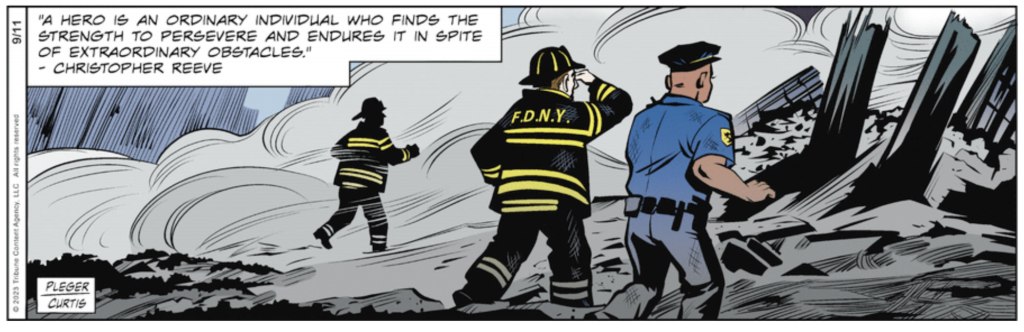
I’m proud to have worked with Mike Curtis, Shelley Pleger, and the creative team behind “Dick Tracy.” The comic strip always remembers 9/11 and its heroes.
It was a big day for I-DEP, a Chicago-based dot-com startup poised to ignite a new era in conducting remote legal depositions.
I-DEP’s tech team had found a way to seamlessly merge video, audio, real-time court reporter transcript, and secure private chat into a single, easy-to-use service.
This stuff is routine now, but in 2001, amalgamating the technologies to accomplish all this was bleeding-edge.
To show prospective clients how the I-DEP system worked, we’d improvise a brief sample deposition where staffers portrayed attorneys, plaintiffs, and defendants. At the same time, actual court reporters entered the live transcription.
On that day, we were on deck to hit a home run.
I-DEP had been invited to strut our stuff at a meeting in Washington, D.C., before a meeting of state attorneys general and federal prosecutors. I’d penned a script for a mock deposition inspired by Michael Fortier’s testimony in the McVeigh trial. Darkly ironic, it dealt with domestic terrorism. Showtime was close, adrenaline fired up.
I-DEP was ready for our closeup on September 11, 2001.
Then, the world shifted. Twin Towers, Pentagon, United Flight 93. All crashed and burned. A different kind of terror script, one you couldn’t delete or rewrite. Our team en route to D.C.? Uncertainty gripped us. Hours later, we determined they were OK. But we couldn’t say the same for nearly 3,000 others.
In the following days, the media got under my skin. They were already wringing politically correct hands over how to assess this attack. Or claiming that Todd Beamer “reportedly” or “allegedly” declared “Let’s roll!” as doomed passengers heroically prevented Flight 93 from being used as a weapon.
I also forced myself to look at those photos. The ones showing desperate souls leaping from the Twin Towers. Each image was an indictment, a promise from history that we’d forget too soon. Somewhere in those snapshots, the world’s tough questions lurked.
In the years that followed, everyone talked about resilience and heroism. All justified, sure, but what about the questions, the actual interrogation? People compared 9/11 to Pearl Harbor. Remember the Alamo, never forget; catchy slogans that fade into bumper stickers. Meanwhile, the tough questions remain AWOL.
I did my job and hit my PR targets in the aftermath.
But September 11 changed the script and not just the one I wrote. Some things can’t be revised or redacted. Questions remain forever unanswered.
There are no clean edits in real life. And that, as they say, is the hell of it.
Every year, hundreds of my highrise neighbors get the message when my Christmas tree goes up early.
When October rolls around, I’ll be dragging out the Christmas tree.
Yeah, you heard me. October 1. Go ahead, roll your eyes like it’s the end credits of a Hallmark movie. I have my reasons.
COVID’s on another tour, a sequel nobody asked for. So, lighting up that tree early will feel like a middle finger to the gloom. And this encourages everybody else to do the same. Put up a Christmas tree, fire up a menorah, or string lights on a Monstera deliciosa.
Your neighbors will see the spectacle. They’ll stop, scratch their heads, and wonder what you’re doing. It makes them think, doesn’t it? The world’s a shitshow right now. Wars, pandemics, politicians acting like they’re auditioning for a soap opera.
They’ll understand — and maybe put up their holiday decorations early, as well.
The tree? It’s your break from reality, your effort to wring laughter from sorrow. Trust me, we all need it.
Now, what do others say? Some call it holiday creep. Like it’s some kind of disease. Articles get written, social media defecate cinderblocks.
“It’s too early!” they shout like there’s a rulebook. The thing is, rules are meant to be snapped in half.
So, October 1, my tree goes up.
You don’t like it? Fine.
But I’ll be here, basking in the glow of my premature Christmas spirit, listening to vintage Kmart canned holiday Muzak, and not giving a damn what you think.
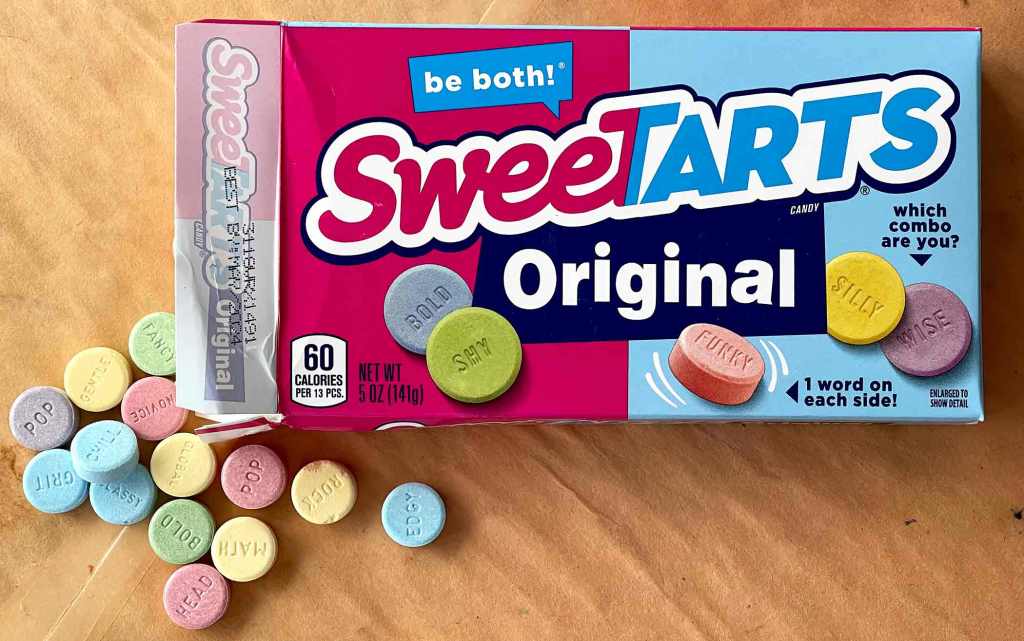
Bought these at the Streeterville Walgreens up the street from my Chicago apartment. One taste takes me back to days of my Colorado youth — and how bad girls got me hooked on SweeTarts.
Morrison, Colorado, the early 1960s. No street address, just a big-ass mailbox on a Rural Route. I spent my days in 4-H, raising sheep, a pig, chickens, and ducks. Tried to tame our Shetland pony from hell and yearned to be one of the cool kids who rode in the Westernaires.
Out past our back field, U.S. 285 bulked up like Stallone for a Rambo flick, ballooning from two to four lanes as Colorado lit the fuse for its population explosion.
Up the road, you could see Lakehurst, a world of tomorrow whose show homes featured built-in vacuum cleaners. No need to haul that bulkiy canister upstairs and down — just carry that hose from room to room and plug it into any strategically located wall receptacle connected to a central vacuum in the basement.
Back then, getting candy wasn’t a stroll to 7-Eleven. You’d have to talk your parents into driving you to Safeway or King Soopers miles away.
But me and the local gang discovered a gold mine. Residents at a reform school for girls a quarter-mile away ran a little commissary. Like some twisted Willy Wonka setup, they’d sell candy to the staff, inmates, and neighborhood kids.
So there I was, my pocket change jangling louder than Elvis’ hips.
I walked in, eyeing those shelves like I’d hit the jackpot in Vegas. Laid my coins down. “Gimme a SweeTarts,” I told the girl behind the counter. To my disappointment, she looked more like the girl next door than the girl behind some outlaw biker.
First bite? I hit the motherlode. A punch of tang and sweet; it was like the Beatles and the Stones jamming in my mouth. A rock concert of flavor. Each color a different opening act, all leading to that headliner — pure satisfaction. And from then on, I was hooked. . .
Bad girls and good candy!
Years roll by. Life’s been a spaghetti western of ups and downs, but those SweeTarts? They stayed the same.
So here’s my toast to SweeTarts, the candy of outlaws and reform school rascals. Whether you’re from the country or the big city doesn’t matter. Those little discs pack a punch like Ali.
And if you’ve never had ’em? Well, what are you waiting for?
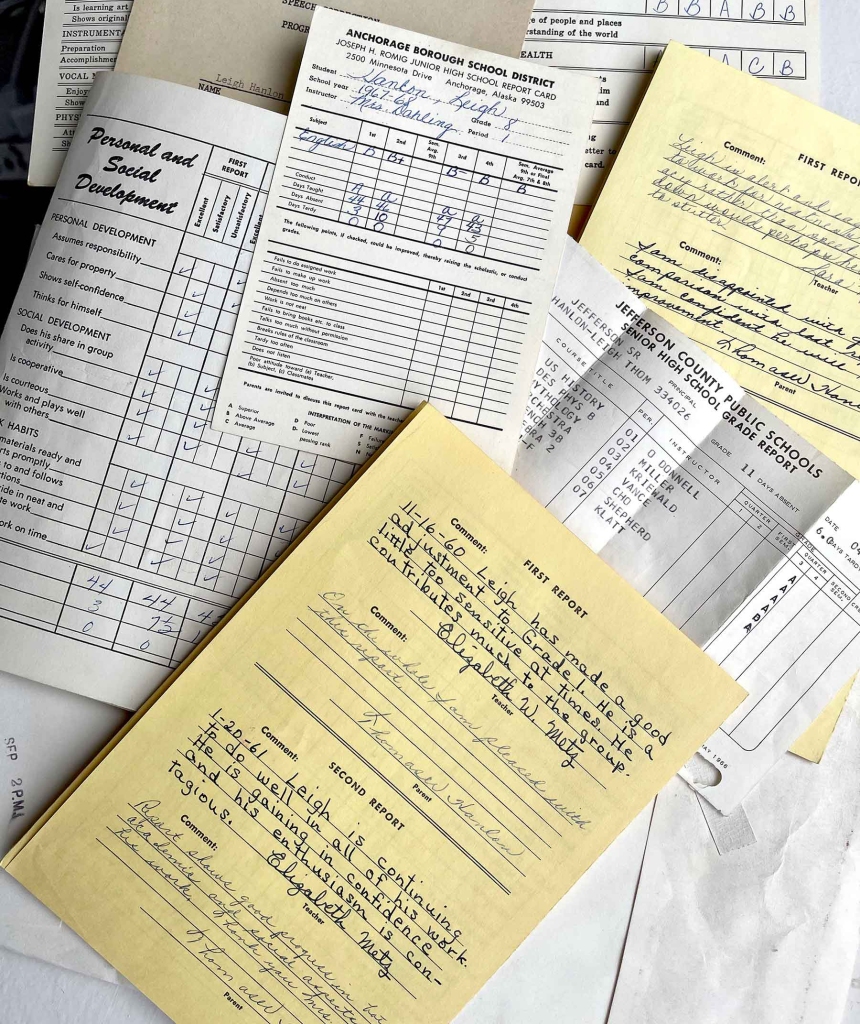
I moved to this highrise several years ago — and finally opened the last moving box. It had school report cards, class photos, and newspaper clips from early in my career.
I spent a couple of hours reviewing my reports, and something hit me like a slap. We’re all stuck in a system of reports and lists.
Think school report cards are a kid’s game? You’re dead wrong. They’re prepping you for the nine-to-five grind. A through F, pluses and minuses, it’s a whole circus act designed to put you in your place.
Flash forward to my first newspaper job, my first evaluation. My manager called me into the back office. Papers spread out, and it looked all too familiar. Like my high school report card, but without the doodles. Punctuality, teamwork, and performance — all had their neat little categories.
He looked at the paper, looked at me, then finally spoke. “Doing good, but room for improvement.”
Annual reviews are report cards.
They’re lists.
William Cooper, the late conspiracy radio host, was big on lists. He told his listeners there’s only one list in this world. Everything else, grades and promotions, is a subset like a Venn diagram of life’s screw-ups and victories.
You trade an “A” for a Christmas bonus; a “C” gets you a sit-down with human resources. Different stages, same drama. You live by the list; you get clipped by the list.
Here’s the lowdown: the system’s rigged like a carnival game. Your GPA morphs into your annual review, and your kindergarten gold stars become employee-of-the-month plaques.
The list never ends.
We’re all waiting for the next rating, the next evaluation, like a never-ending game of musical chairs. Just make sure you’re not the one left standing when the music stops.





 L.T. Hanlon